

150 years after the Civil War, it seems American art institutions are finally ready to discuss Confederate statuary. Seizing this opportunity, curator Hamza Walker (along with co-curators Bennett Simpson and Kara Walker) has gone to unusual lengths in his sprawling two-part opus “MONUMENTS.” Collecting primary research materials, namely bronze and stone statues created in the aftermath of the war, and pairing them with responses from contemporary artists,“MONUMENTS” is unlike any exhibition that will grace Los Angeles this year. Its sheer size and scale required financing from an array of funding organizations, weathering pandemic-era production delays, unusually complex logistical support to help move, store, and show its oversized historical works, and the cooperation of two exhibiting institutions, The Brick and the Museum of Contemporary Art, Los Angeles (MOCA), with each hosting one of the two cores of the exhibition.
The story of “MONUMENTS” begins in 2017, when the city council of Charlottesville, Virginia,voted to deaccession its controversial statues of Confederate generals Robert E. Lee and Stonewall Jackson—an event that contributed to nearly a thousand white supremacists descending upon the city for the Unite the Rightrally that same year. The two statues were eventually given away in 2021, with Hamza Walker acquiring the Stonewall statue and beginning the arduous process of finding and borrowing monuments like it for the exhibition that would become “MONUMENTS.”
The curatorial experiment also brings together 19 additional works by contemporary artists, including Bethany Collins, Karon Davis, Walter Price, Cauleen Smith, Hank Willis Thomas, Monument Lab, Leonardo Drew, Torkwase Dyson, Jon Henry, Hugh Mangum, and Martin Puryear. (Ofthese 19 artists, 11 produced new works commissioned by MOCA and The Brick.) Artist-curator Kara Walker’s sculpture Unmanned Drone (2023)—a reworking of the Charlottesville Stonewall Jackson statue made into a disfigured half-human, half-beast machine—forms the centerpiece of her solo presentation at The Brick.
“MONUMENTS” oozes with what most contemporary art exhibitions lack: righteousness, heartfelt inquiry, and a loud, expansive reckoning with art’s relationship to power. The works included in the show not only draw from a vast array of disciplines and aesthetic paradigms, but demonstrate how far sympathy for Lost Cause doctrine—the belief that the seceding Southern states sought to protect their sovereign rights during the Civil War, not their ability to own, sell, and domesticate African slaves—has drifted from the South and even penetrated liberal government bodies at times.
For example, in Practice, Practice, Practice (2024), Kevin Jerome Everson interviews Richard Bradley, a working-class Black man who climbed a flagpole outside San Francisco City Hall three times in 1984 to remove the Confederate flag. Now in his 70s, Bradley’s attempts to remove the flag resulted in his arrest and then-mayor Dianne Feinstein replacing the flag eachtime. In his Stranger Fruit series, photographer Jon Henry places Black mothers and their sons in poses that recall Catholic pietàs where the Virgin Mary holds the mortal body of her crucified son. The photographs, taken in cities across the U.S. with large Black populations and histories of racial discrimination, speak to the reckoning many Americans had to face when scores of Black men and children were wrongly killed by police in highly documented and publicized cases in the 2010s—an enlightenment wrought from the death of these Black victims. Perhaps the most moving of these offerings is HOMEGOING (2025), where vocalist Davóne Tines and filmmaker Julie Dash ceremoniously honor the victims of the 2017 Emanuel African Methodist Episcopal Church shooting with a recorded gospel send up of This Little Light of Mine. Looping between Tines and his band performing their song in the 200-year-old church and the haunting landscape that surrounds the Angel Oak Tree, itself more than 400 years old, outside of Charleston, HOMEGOING and its dirge spread into MOCA’s common areas, coating its peerworks in a funereal song.
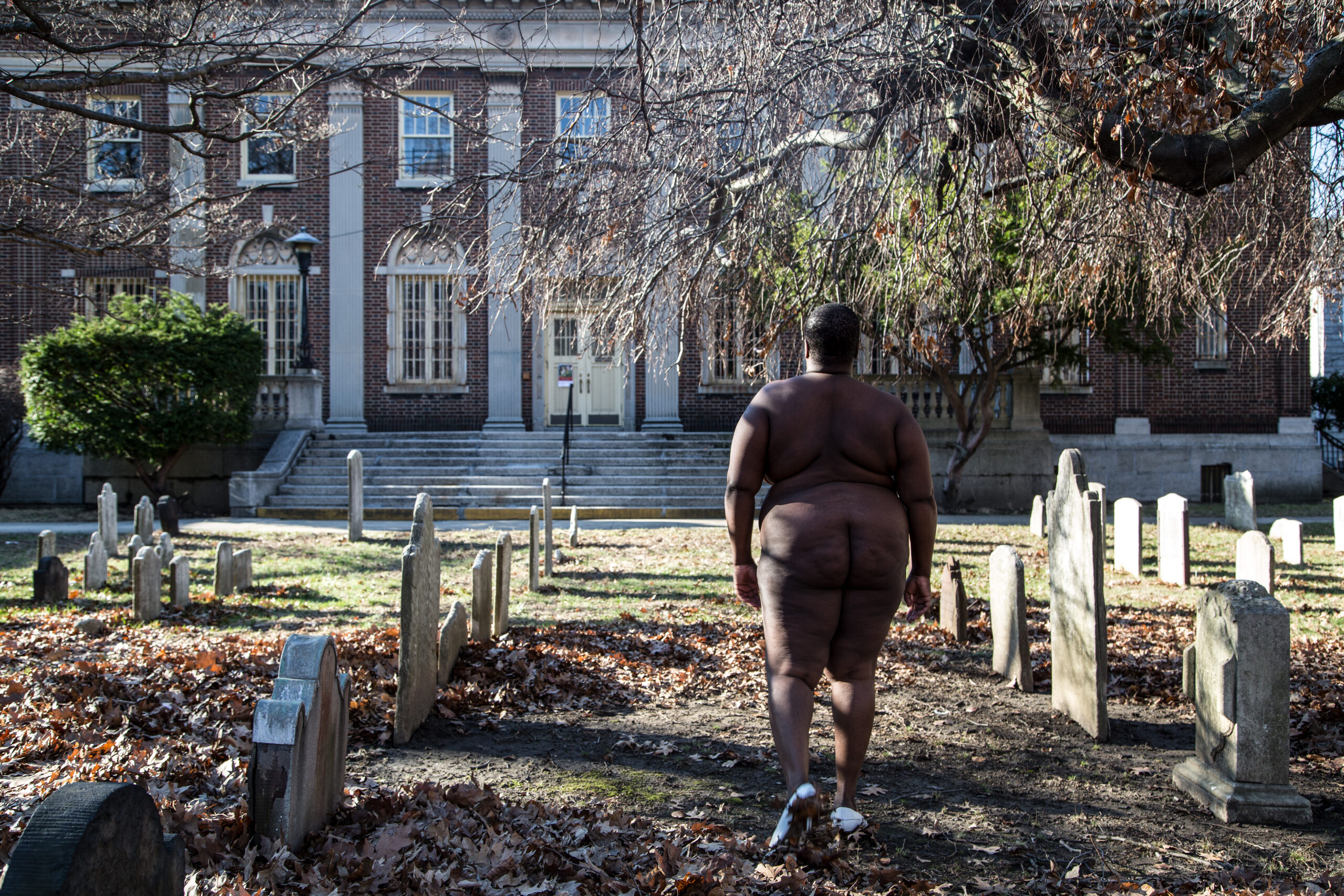
These emotionally charged and frankly humbling contributions to the exhibition do not mean that “MONUMENTS” is a perfect or conversation-ending installment in the dialogue about racial justice in America. It is easy, for example,to point to the amount of exhibition space dedicated to The Klan, the 1990 photo series by photographer Andres Serrano that shows intimate, though veiled, portraits of Klansmen sporting hoods whose colors ironically rhyme with the colors of the Palestinian flag. The slightly magnified portraits show high-ranking Klan membersin a traditionally honorific format—something that feels harder to ignore since early November, when art publication Hyperallergic noted that Serrano’s correspondence with disgraced pedophile Jeffrey Epstein is included in the trove of government documents now called the “Epstein Files,” and shows the artist expressing sympathy for Donald Trump. To make matters worse, Serrano’s photographs are situated in the gallery that directly abuts HOMEGOING, meaning many viewers had to pass through his fetishistic Klan portraiture before experiencing Tines and Dash’s heartfelt remembrance of the Charleston victims. Other works included in the exhibition, like Kahlil Robert Irving’s New Nation (States) Battle of Manassas—2014 (2024–25) and Abigail DeVille’s Deo Vindice (Orion’s Cabinet) (2025), large, monumental works, deliver conceptually charged critique at the expense of more directly communicated emotion. At the same time, smaller works like the seven photographs the late Nona Faustine produced for her White Shoes series show viewers that monumentality is not about size and scale so much as the ability to shape cultural memory. Self-portraits of the artist,a proudly heavy-set Black woman, wearing nothing but white pumps and occasionally a robe at sites related to New York City’s history with slavery and colonialism, give stark reminders that even the Union was not always righteous. Given that the spine of contemporary America is built on forgetting the slavery of its past, Faustine’s nude photographs subtly offer a way to make others live with the truth: show them exactly what they don’t want to see, exactly what they don’t want to remember.
Not far from Faustine’s photographs is perhaps the most concise material argument about what to do with America’s slaving past within the exhibition. Going beyond the institutional consensus that suggests comparable Nazi art and cultural objects should be destroyed if found, theJefferson School African American Heritage Center took the General Lee statue they received from the city of Charlottesville and reduced it to its basic material parts. Melted into bronze ingots and shown alongside the impurities from the burn-off process as well as the granite slab that previously formed its pedestal, the piece is paused mid-transformation as the school prepares to turn the sculpture into a new public artwork. Something between art, ritualistic purification, and institutional critique, the deconstructed sculpture is an indelible and profound reminder that the process of remedy rarely returns the aggrieved what they had lost. Rather, remedy grants the opportunity to recall the state of the world before injustice occurred. It provides the space to meditate on loss without denying the afflicted the ability to speak abouttheir suffering. For Black Americans, this is a new privilege, and one that“MONUMENTS ”celebrates while mourning its costs.