

In 1969, just months before Neil Armstrong allegedly walked on the moon, Queen Elizabeth rang in London’s brand-new,ten-mile-long Victoria tube line with a ceremonial ride in thetrain’s front car. Her celebration was warranted: the line was the first of its kind to be built in London in over 50 years. It was also completed at an astounding pace, having been approved for construction by Parliament just seven years prior, in 1962. For context, that same year, California Governor Edmund G. Brown greenlit Los Angeles’s Wilshire Boulevard subway line, intending to connect Downtown to the Pacific. That line, of course, became the D Line, and it remains unfinished today, almost 65 years later.No matter, this summer, LA Mayor Karen Bass celebrated the grand opening of the D Line’s three-stop, 3.9-mile extension—which took twelve years to build—with a ceremonial ride in thetrain’s front car. Though much of the line’s political legwork was completed by the time she entered office in 2022, Bass nevertheless treated the photo-op as if she were the Queen, beaming as she waved for photos. Her jolly posture was curious: just days earlier, she’d lobbied against a much-needed subway extension on thecity’s K Line, and, in spite of the billions spent on the D Line’s three new stops, the city continues to neglect almost all its other underground infrastructure. At the time of writing, for example, the Sunset Strip is literally underwater because a 110-year-oldwater main ruptured on Holloway Drive, creating a sinkhole large enough to swallow up the ghosts of Spago, Tower Records, and Book Soup, legendary Hollywood hotspots that once dominated the intersection.
Unearned celebrations are also par for the course in the art world, and, like Bass’s victory lap, they often mask the unhealthy, more insidious nature of things. A steady stream of record-breaking auction sales, for example—like the ones at Sotheby’s this summer that were celebrated widely in the press—haven’tnecessarily correlated with trickle-down sales or even confidence among living artists, both of which have withered to the point that Josh Kline—a blue-chip artist himself—made the earnest suggestion this spring that everyone ought to pick up and move to Philadelphia. (Philadelphia!?) Kline’s advice came in a much-lauded article in October that blamed the art world’s livability crisis on systemic issues relating to real estate. His writing excused the choices of artists and art workers almost entirely—yes, the ones who choose to invest hundreds of thousands of dollars on arts education, rent property in the world’s priciest zip codes, and spend extra cash on expensive drinks and recreational drugs. Instead of questioning those choices, Mr. Kline explicitly defended all of them, insisting that they’re “required to network and advance careers in the field.” Cocaine is in the job description, apparently—a cause for celebration, indeed. So, as you can see, it’s a rather confused time. The celebrations will carry on, justified or not. It’s only right, then, that we get in on the action, celebrate what was actually good this summer, and rain on a parade, as well.
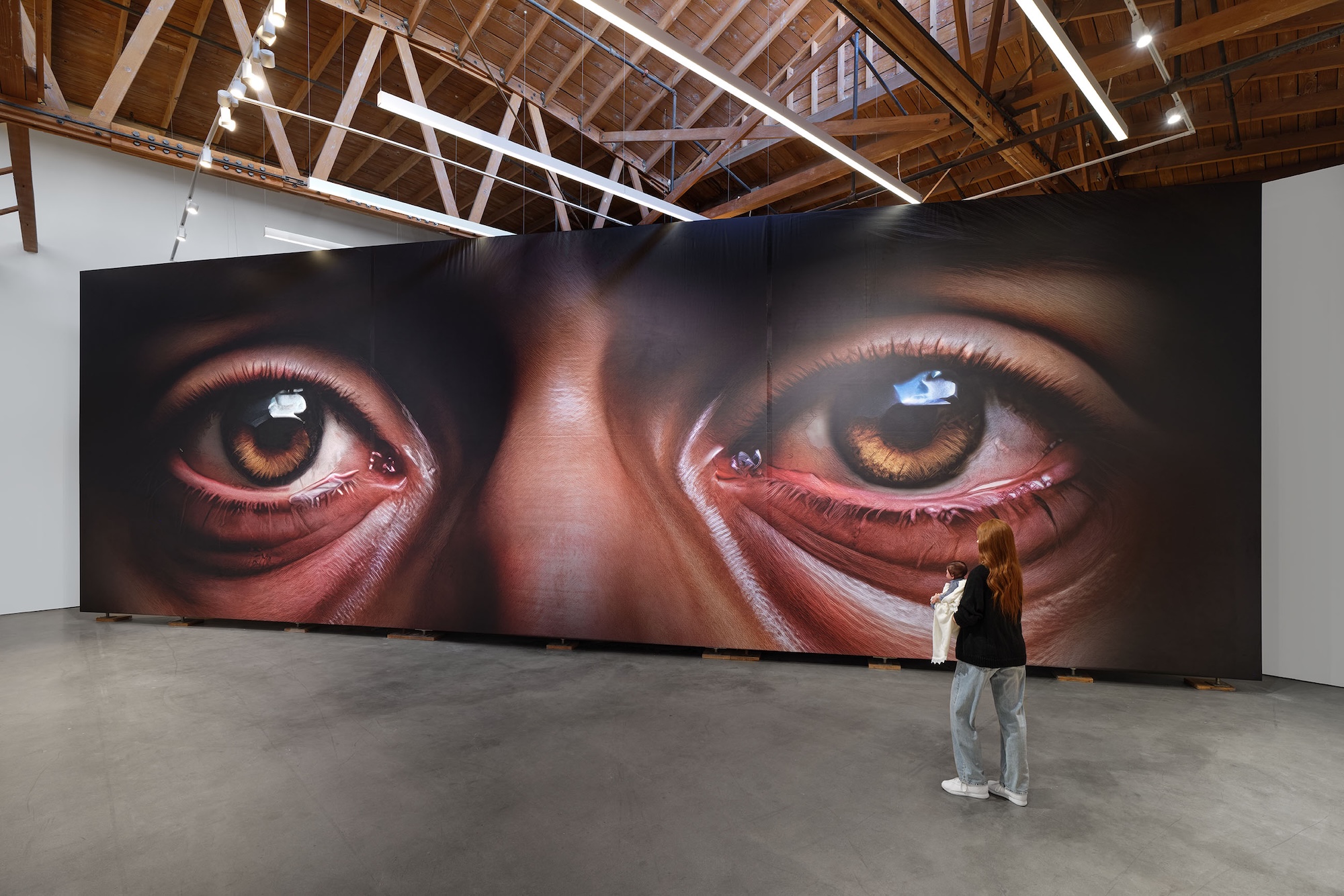
 Patrick Jackson, Memorial, 2026. Billboard, scaffolding, steel, drywall, wood. Dimensions variable.
Patrick Jackson at François Ghebaly
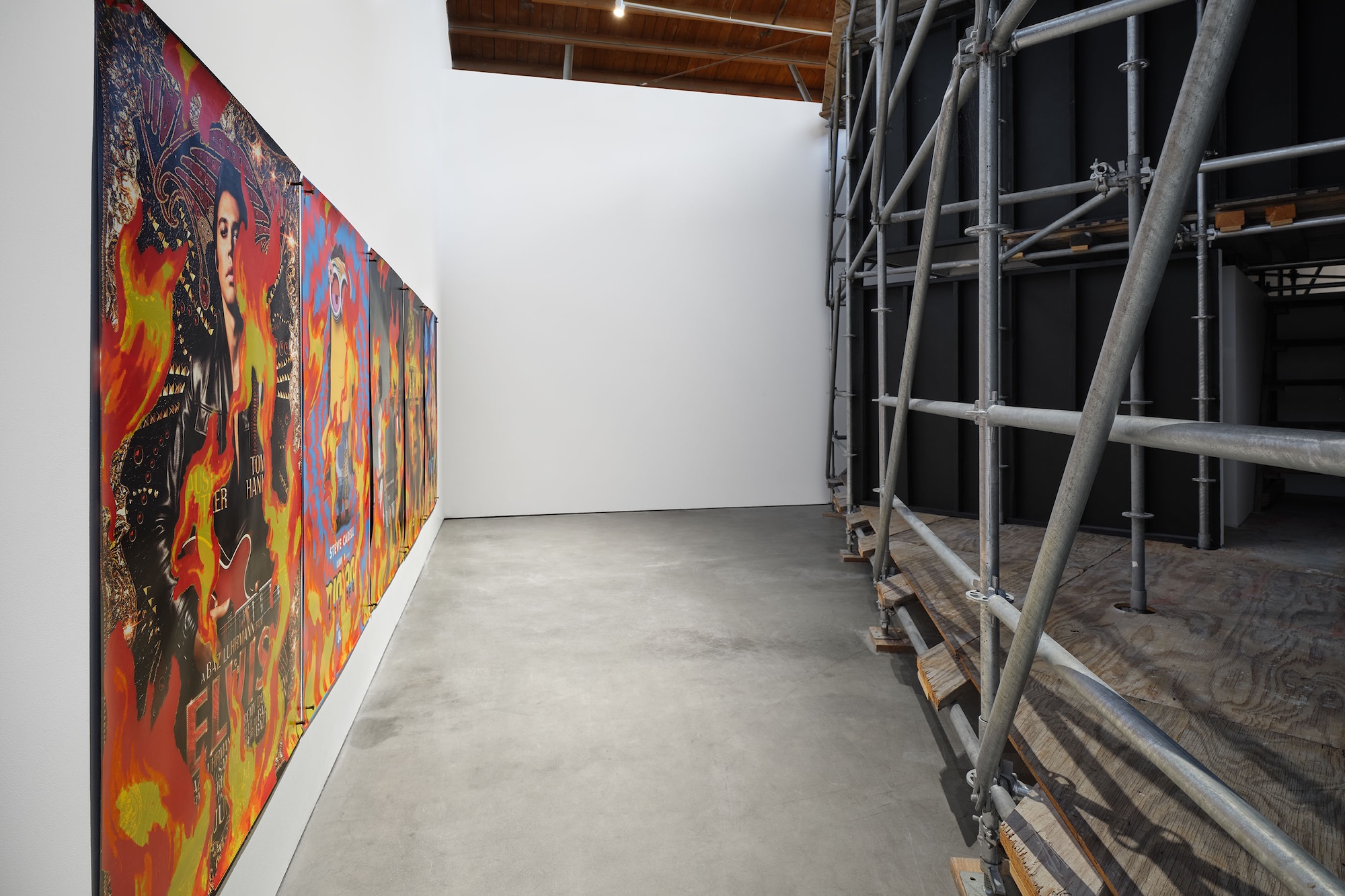
“Isn’t this just like old school François?” a woman pipes as we wander around the labyrinthine backrooms of Patrick Jackson’s Memorial (2026), two stories of scaffolding fronted by a forty-foot-wide billboard that, together, serve as the centerpiece of his latest show “All Signs Fail” at François Ghebaly. She’s referring to the intrepid Ghebaly shows of yesteryear, the ones that centered large-scale sculpture and spatial intervention, hallmarks of the gallerist’s program in the early teens shaped by artists like Joel Kyack, Candice Lin, and Jackson himself. In recent years, however, against a backdrop of market volatility, Ghebaly’s program has leaned heavily on the more saleable asset of paintings, flattening what the gallery’s had to offer as a result.“All Signs Fail,” then, deploying readymade spectacle and immersive installation as an entrée into the subconscious, is a welcome rejuvenation for Ghebaly, and an ambitious, if somewhat familiar, effort from Jackson. The scaffolding is the star of the show. Though not visible upon entry, the multi-level structure props up Jackson’s billboard, which features only a massive pair of weary, presumably infected eyes, a visual sourced from the AIDS Healthcare Foundation’s“Eye Syphilis Is Serious” billboard that has dotted LA thoroughfares since 2024. Jackson’s image, exhibited in an America ravaged by unchecked capitalism, has a clear referent in the eyes of Dr.T.J. Eckleburg from F. Scott Fitzgerald’s The Great Gatsby. Those eyes, also on a billboard, loom over the depraved “ash heaps” of Queens amidst another era of unfettered capitalism in America, the Roaring Twenties. Whereas Eckleburg’s eyes act more as an impassive observer, however, a step removed from the world they watch, Jackson’s seem to be enduring it, their health afflicted by it. All-seeing though these eyes might be, they can’t speak, so how are we to uncover the truth?
After walking behind the billboard, the steel supports become visible, and viewers can climb up into the stairwells, halls, and dead ends behind those weary eyes. Just as it was in “The Third Floor”—Jackson’s 2013 show at Ghebaly that used scaffolding to split the gallery into three stories—the invitation to explore here is very much a Freudian one. Viewers poke around the mind space for meaning, mining not to “see what the other sees,” but for latent impulses, clues for what might perpetuate the dread broadcast by the billboard. That the viewer finds nothing inside the structure’s clapboard halls, not even light, leaves the piece with a challenging self-implication: perhaps we are the object within.
 Michael Benevento, Kristina Kite Gallery. Photo credit: Ed Mumford.
“PHANTOM, STILL” at Michael Benevento
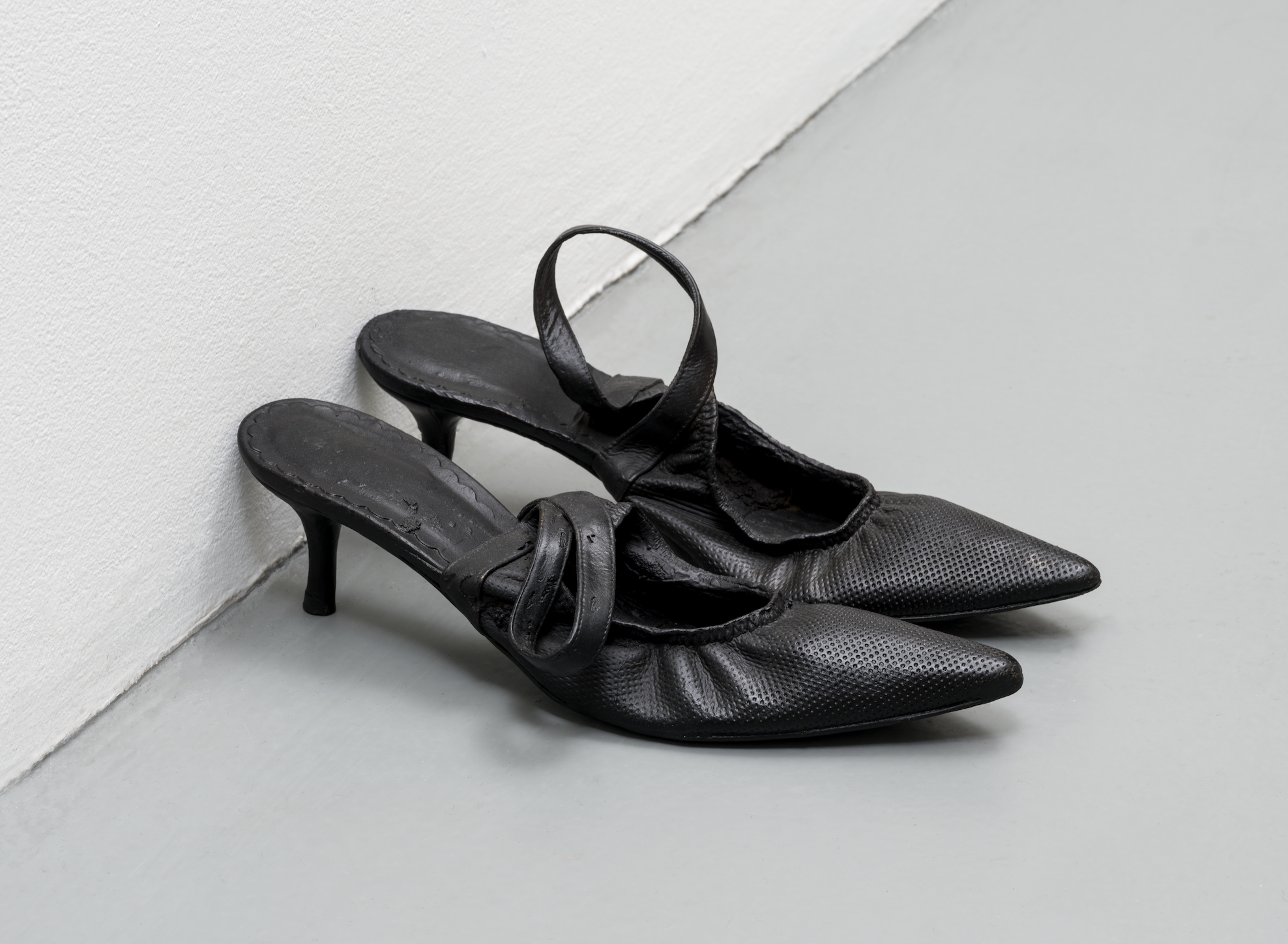
Michael Benevento has quietly put together one of the strongest years thus far of any gallery in LA. After Bjorn Copeland’s semiotic attack in “Boiled Alive” and Joan Jonas and Silke Otto-Knapp’s tightly wound duo show, the gallery opened “Phantom, Still” this summer, aco-production with Kristina Kite featuring seven artists whose work is at once inviting and ready to pounce, installed throughout the space sparingly. The show’s push-pull is no more apparent than in Devin T. Mays’s Flag (2025), a piece comprised of a taxidermy bobcat lounging on a branch affixed to a constructed wall. The animal, whose piercing gaze might otherwise signal an impending ambush and kill, is frozen herein form, its exotic appeal giving way to more somber and terrifying notions about a body without spirit, about an eternity in limbo. The bobcat’s initial charm is further upended by Flag’s insistence on falsehood, underscored not only by the piece’s critically-loaded title and uncanny subject, but by its use of a supporting wall flat mere feet from the gallery’s more permanent wall of the same color. (For whatit’s worth, there’s another mischievous spirit haunting the room, too, that of a piece equally as alluring and shocking: Gozié Ojini’s 881.5 lbs (2025), which showed in the same corner during Benevento’s “Stitious” group show last year, baiting viewers to examine a deconstructed piano before startling them with a sonic jolt of discordant strings.) Elsewhere, enticing the viewer through the space are a couple pairs of bronze shoes by Fiona Connor, in one instance positioned heading toward the next room, in another waiting just outside of it. If theWhite Rabbit lures Alice into Wonderland, and Mr. Tumnus guides Lucy around Narnia, it is Connor’s shoes that urge us to go deeper into “Phantom, Still,” to wonder about what’s absent (here, the body), and to follow wherever it went. A final note: “Phantom, Still” is now the third show that Benevento has produced with Kristina Kite this year, all yielding stellar results. Both have previously run galleries with a co-principal—Benevento in New York with Michael Clifton and Kite in LA with Lisa Overduin. Will the two join forces more officially? Benevento & Kite, perhaps?
 Courtesy of Marcel Alcal.
“THE ART PARADE” at Jeffrey Deitch & LACMA
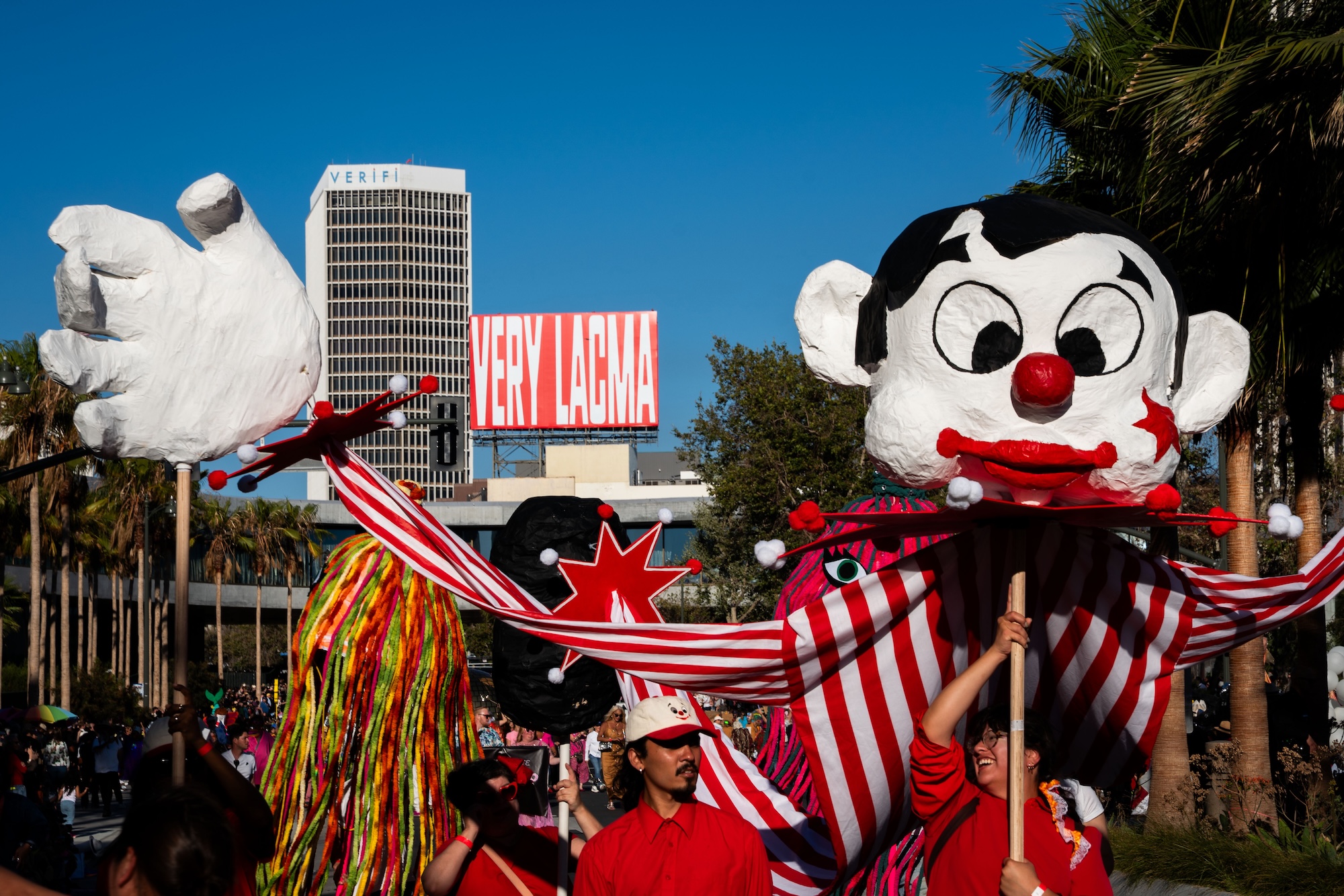
As if responsible for upholding this industry city’s penchant for godless celebration, two of LA’s most influential art institutions—LACMA and Jeffrey Deitch—came together in June to produce a parade on Wilshire Boulevard, effectively a reboot of Deitch’s “ArtParade” held in New York from 2005 to 2008. The happening was the season’s marquee event, featuring more than 1,600 performers spread across 140-some-odd presentations, all marching down the half-mile stretch of Wilshire directly in front of LACMA. And, to be clear, to a certain extent, it delivered. The sidewalks were packed with anestimated 60,000 attendees, and there were a handful of memorableperformances, including Marcel Alcalá’s Conquest Narrative (2026) in which the artist, wearing Payasa-inspired makeup, carried the burdenof an oversized, American flag-painted cross, and Jordan Rountree’s DEVIL JACK IN A BOX WITH CROCODILE (2026)—in whichRountree, dressed as the devil with classic red horns, periodicallypopped out of a rolling black box emblazoned with a woodcut crocodile. Despite the procession’s successes, though, the mood felt subdued, and for good reason: there just wasn’t much to celebrate. UnlikeDeitch’s previous New York parades, which fêted the start of the fall season for all galleries citywide, the LA parade’s celebrant was singular: LACMA’s new Peter Zumthor-designed David Geffen Galleries, which have been almost universally panned by critics and audiences alike, their near $750 million price tag notwithstanding. As such, while the parade no doubt carved out space for creative expression, it also had the air of a spectacle engineered in the boardroom—a photo-op for thee, but not me. To complicate the mood further, especially within LA’s immediate art community, the parade came in the wake of Celeste Dupuy-Spencer’s show at Deitch, “Burning in the Eyes of the Maker,” which opened without delay on the Friday after the artist’s suicide. Notably, the text for Dupuy-Spencer’s show, written by the artist herself, begins with a reproach of commercial art for its extractive impulse, for prioritizing the bottom line and attention over more human concerns