

As a kid, spaghetti westerns made me sweat. Not the violence, the dubbing—that quality where a mouth moves at one rhythm and the voice lands just slightly off it, as if the sound had come loose from the body and traveled through some other room to reach me. I hadn’t thought about that in years until I sat down for Julia Weist’s Questioning at New Theater Hollywood and felt my whole body go back to being nine.
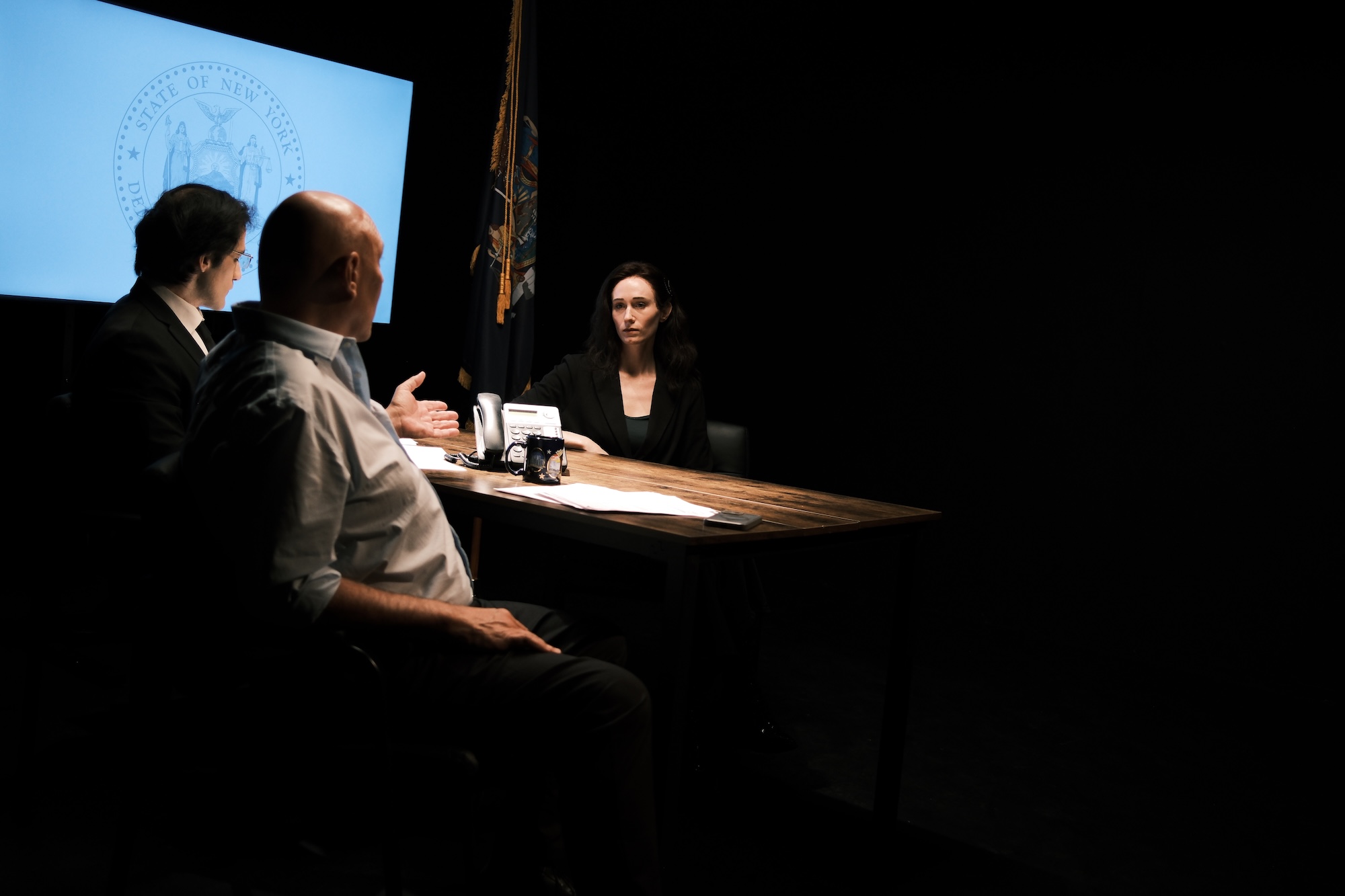
I learned, the hard way, that reaching the bathroom means crossing the stage itself. I didn’t go. I sat there, close enough to touch the table, sweating a little, watching three actors lip-sync to a woman’s real interrogation—mouths and voice never quite belonging to the same body. It was that other room again, except now I was inside it.
The theater was founded by two artists who never trained in theater, and I could feel that freedom everywhere. Julia Weist’s Questioning fits right in. She’s spent years getting access to information regular people never see, and this time the file was her own.
In 2024, the New York Department of State called her into a room in Albany over exactly that. Weist had gotten a private investigator’s license two years earlier to access restricted, surveillance-grade data ordinary people never see, and used it as material for her art: years of license-plate camera photographs of her own car, taken at all hours in places she didn’t remember visiting, turned into diagrammatic collages shown in galleries. One earlier show even featured a photographic reproduction of her own PI license, down to the perforated edge, exploiting a loophole in the law that only bars displaying someone else’s license.
When she went to renew hers, the State flagged it and brought her in, spending most of the hour deciding whether an artist could legitimately hold that credential, at one point pressing her on whether she’d improperly looked up information about her own neighbors. She recorded it on her phone. When she later asked the State for its copy, they said it couldn’t be found. So she made her own.
Erika Mugglin, playing Weist, isn’t allowed to interpret a single line—only match it, the same discipline her co-star Adron Duell picked up from a friend who used to perform drag: run the tape everywhere, car, bathroom, feeding the cat, until the rhythm lives in you. Spaghetti westerns were often shot with actors speaking different languages on set, dubbed into one voice later, so the mythology I grew up scared of was never spoken by the people saying it. It was built secondhand. Watching Mugglin hold that beat felt less like grief than watching someone notarize it.
Later, Weist mailed an investigator an invitation made from his own handwritten notes. It came back unopened, with a note saying it would be unethical to accept anything from someone he’d investigated. He wasn’t declining a play. He was filing another document.
There’s a version of this story where the real subject isn’t the State, it’s the market’s appetite for authenticity, and Weist found the purest unit of it: someone’s real fear, ready to be installed in Miami. I don’t think that cancels anything out. I just don’t think it’s nothing. New York never brought charges. It renewed her license anyway, through 2027. This winter, a “lush” 4K version—her word—heads to Art Basel Miami Beach, through her gallery. I found this charming: fifty-five minutes taking apart one bureaucracy, then walking straight into another.