

Few exhibitions make the gap between the United States and the rest of the world’s art capitals so blatant than “Sandra Vásquez de la Horra: The Awake Volcanoes” at Institute of Contemporary Art, Los Angeles. Pegged as the artist’s solo debut in the US, the exhibition has all the features and tells of a traveling survey retrospective, but features a contemporary vision, honed spiritual instinct, and sexual appeal that LA—the city of artists in search of a subject—frequently struggles to produce on its own.
In its construction, “The Awake Volcanoes” is a visual journal that charts a mature artistic practice. Born in Chile, Vásquez de la Horra came of age during the US-backed regime of dictator Augusto Pinochet. Eventually relocating to Germany, where she has become a recognized figure in the broader European art scene, she has continued to develop a body of work with clear sexual and political themes as well as a commitment to drawing as a means of conducting research.
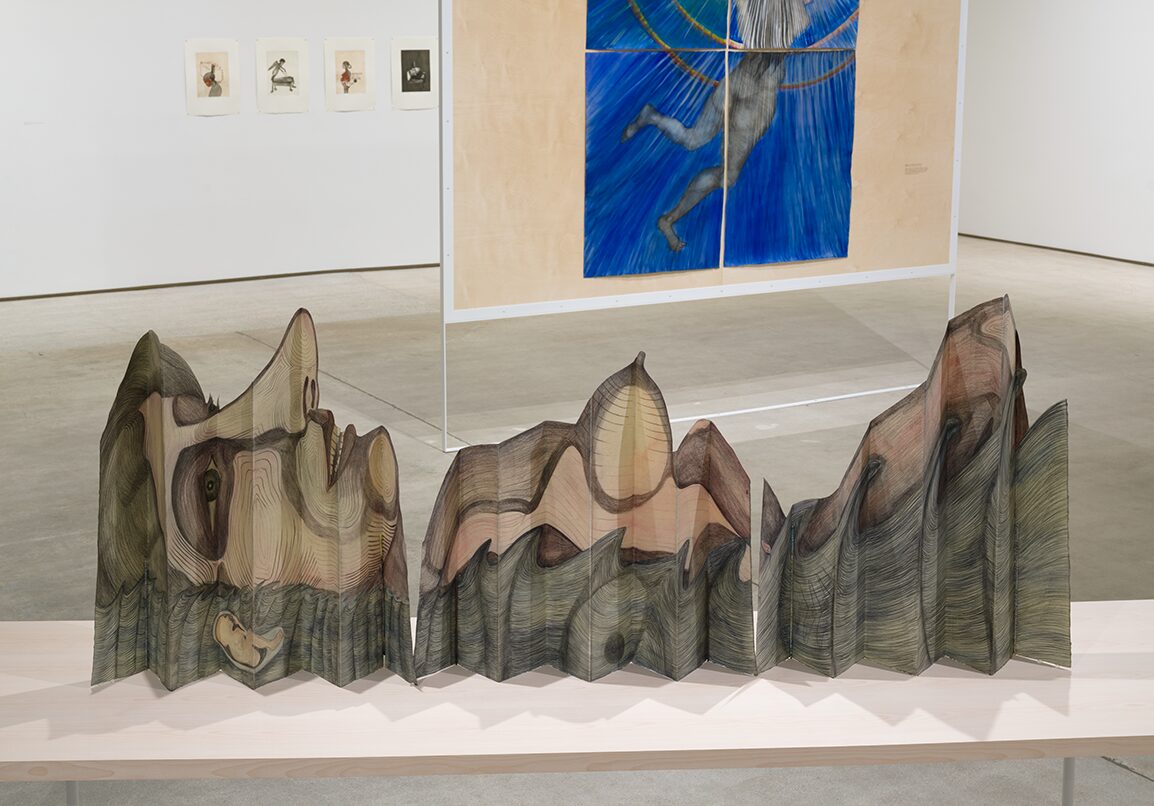
The fruit of this artistic labor, “The Awake Volcanoes” contains nearly one hundred works and its iteration at the ICA includes a handful of new pieces produced last year. Its contents span nearly four decades of Vásquez de la Horra’s practice and feature experiments tinged with a material awareness that seems perpetually raw, new, and alive despite some of the works being conceived and executed years ago. That material knowledge is most profoundly on display in the artist’s storied use of beeswax immersion treatments to coat her drawings like Anillo de feugo (Ring of fire) (2023) and Deidad Planetaria (Planetary deity) (2015) with a sticky, lifelike film. Elsewhere, self-standing and double-sided drawings such as Yemanjá (2025) and Volver a ti (Coming back to you) (2023) are folded in kinetic, zigzagging patterns that echo the radiating, chevron-tinged topologies traced into their surface. Often featuring nude female subjects in reclining poses with their internal anatomy peeking through their skin, these works show the development of Vásquez de la Horra’s treatment of embodiment as both a psychological state and anatomical science. Her drawings are precise renderings of the human body that also drip with wet, effusive psychic energy.
A notable feature of Vásquez de la Horra’s way of working is her consistent engagement with series, sets, and group compositions. Much of the work included in the show is either shown as components of a larger series collection or segment in pieces that when assembled reveal a larger complete image. During times like these, when our basic liberties are under siege, “The Awake Volcanoes” is a stimulating and necessary encounter with the invisible but perceptible sensations that give signs of life.
Editor’s Note: The following section originally misattributed Samar Al Summary’s work to Sandra Vásquez de la Horra.
Tucked in the project room near the entrance to the exhibition—where viewers must pass the aptly titled Aerial view of a pilot’s artery (2024), the exhibition’s singular canvas oil painting — What goes up is a seismic shift in perspective. The 29-minute film concerns two Iraqi pilots who died in crashes at the same Air Force training base in Arizona in 2017. From there, Samar Al Summary folds fact and fiction into an audiovisual experience that blisters, smacks, kisses, and caresses in its search for meaning behind the pilots’ deaths while placing a poignant dot at the traveling epicenter of American imperialism.