

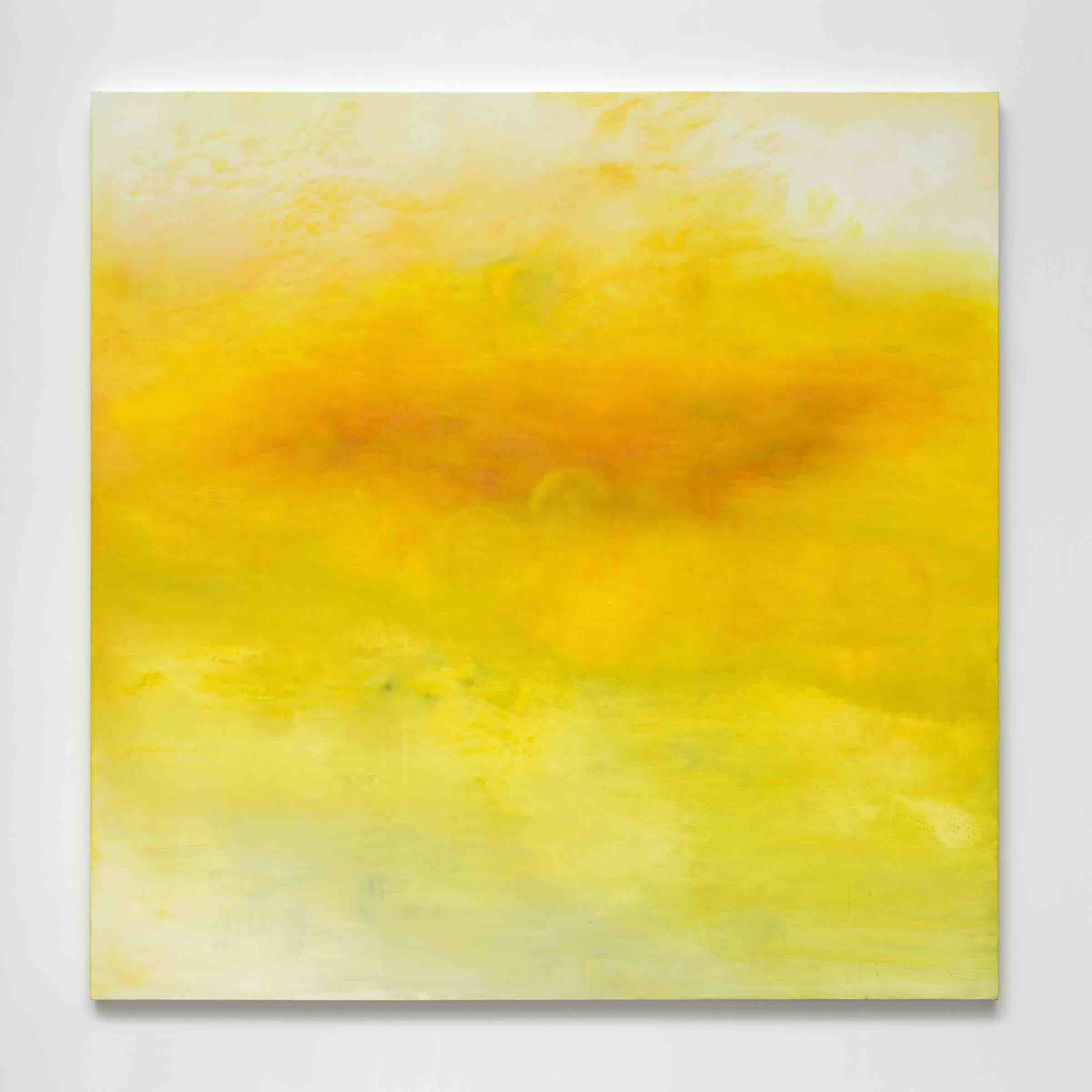
I saw the sun saved and erased at the same time. In Zoe Koke’s recent paintings, oil becomes a way of holding sun. Here oil paint behaves like a desert light fixed in place, absorbing rather than illuminating. In one of her new paintings, Rainbow (2026), the desert thins into a loose field. Blue slips into ground. Gold spreads from above. In Yellow Soul Mirror (2026), all representation disappears. What remains is a dense blur of yellow. The surface carries the memory of desert light, with changing intensity, layers of sunbeams immobilized. “Blue Sky and Yellow Sunflower” brings Zoe Koke’s recent paintings into conversation with historical works by Lee Mullican and Luchita Hurtado, installed within their shared archive.
The installation shows that the desert is rendered as eternal and unmarked, built almost entirely from color fields that resist time. Hung above the archive racks, Lee Mullican’s Cuppings West (1962) steadies the room in place, like a second sun. Its textured marigold surface stabilizes the surrounding works, fixing the exhibition’s palette into a shared register.
Luchita Hurtado’s Untitled (1976) hangs slightly to the left, like a secondary body in orbit. The surface is dense with movement—dark blues, punctured yellows—that remain in motion, around a fixed center. The painting was made as part of a series intended to attract moths to that center. Hurtado designed it not purely for display, but for a specific form of life, drawn toward light. This is one of the most intimate moments in the exhibition. Not symbolic. In use. Between the artist and not the viewer but a specific one. The painting was made to function within a private world. That privacy operates by the same logic as the desert. The desert is not absence but duration. Its private permanence. This is not desert mysticism or California transcendence. Intimacy appears externally, stabilized in color.
Installed inside the archive of Luchita Hurtado and Lee Mullican at Wolfpack HQ, and co-curated with Marie Heilich, the presentation frames lineage as a lived condition rather than a historical one.
Seen from behind, in Mullican’s A Possible Portrait, For Luchita (n.d.) made shortly after the couple’s meeting, Hurtado’s head becomes less a portrait than a stand-in. The lines of her hair dissolve into Mullican’s striations, flattening into their own kind of color field and landscape. The figure folds into the exhibition’s larger logic. The desert sky and its colors throughout are rendered intimate—unchanging, steady, shared by everyone who looks up. Spread across the vitrine at the center of the exhibition, that same intimacy appears at a smaller scale: dozens of Koke’s photographs of skies she stood under, bedsheets, warm bedroom light, lace curtains, and layered peach clouds. Anchoring the photographs are hand-picked rocks and other organic ephemera found on her trips to the desert, a second home of hers. Mixed within these are bronze sculptures cast from pomegranates, which Koke associates with the sun itself. The original fruit is destroyed in casting. Like light itself, the form is taken in and disappears. The bronze does not preserve it; it holds its shadow. Hurtado’s works on paper are woven into the display as well, including her delicate studies of plants and of Lee driving. Her depictions of him repeat the same orientation of his portrait of her, his face obscured, framed by the freeway extending, endless. These images are private, but they are not singular. They feel repeatable, lived-in, and forever.
In the end, the project does not resolve its own logic. It commits to it. Light is saved and erased. Intimacy is expanded without being exposed. History is folded into daily life.
The exhibition reads as a study in how art absorbs life rather than transforms it. Landscape and spirituality function here as tools for staying rather than searching. Instructions are given. Sensations are shown.
Blue Sky and Yellow Sunflower does not argue for transcendence. It argues for continuity. The desert appears not as metaphor or frontier, but as a working condition—something returned to, lived with, and relied upon. The archive functions the same way. These works are not framed as revelations but as repetitions: the same light, the same drive, the same bed, the same sky, held again. In Los Angeles, where landscape and spirituality often operate as stabilizing forces, this exhibition shows how belief becomes a daily practice rather than a test. What it offers is not escape, but a shared terrain. Something to stay inside.