

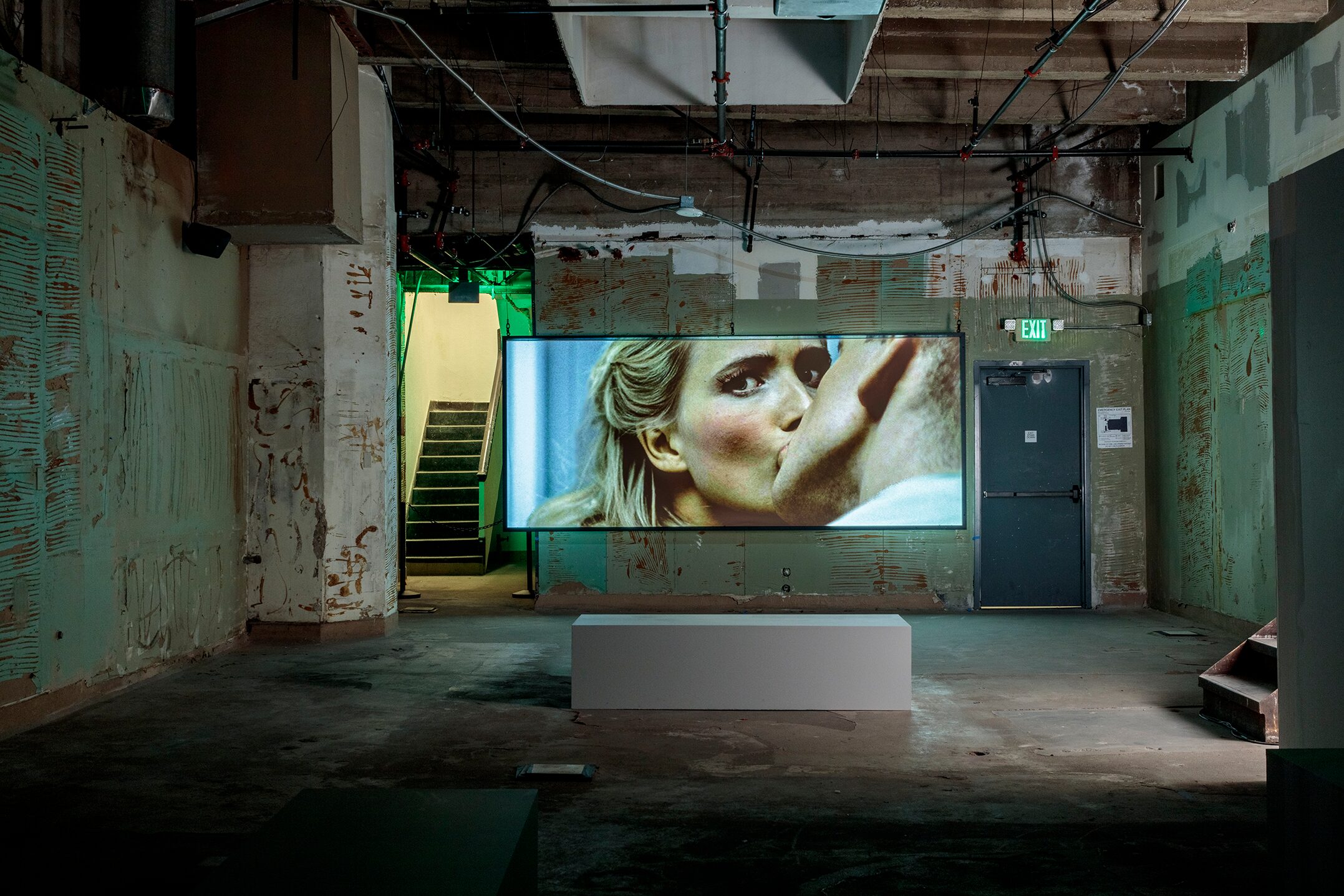
The Renaissance Revival-style Variety Arts Theater normally sits dormant at the chaotic corner of Figueroa and Olympic. However, for six weeks, from February 6th to March 20th, the theater hosted “What A Wonderful World: An Audiovisual Poem,” a presentation from the collection of the Dusseldorf-based Julia Stoschek Foundation. The exhibition spanned everything from contemporary video art to century-old films. You would be forgiven, but far from correct, for thinking that this display of forty-five temporal works from forty-five artists in a theater was a dry, durational experience. There were no blindingly white galleries here. Rather, the exhibition made full use of all five floors of the Variety Arts Theater.
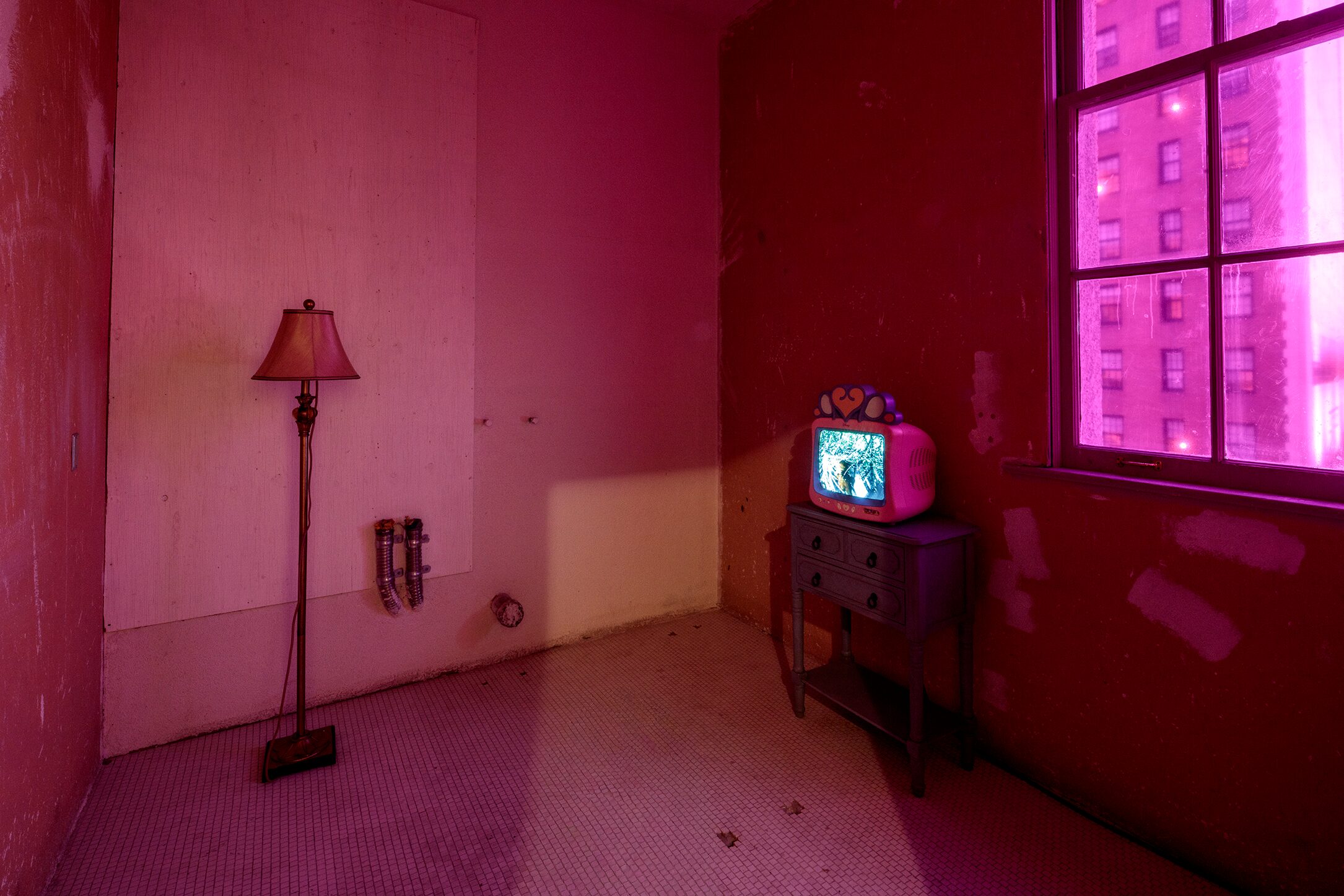
Precious Okoyomon, It‘s dissociating season, 2019 (installation view), “What a Wonderful World: An Audiovisual Poem”, 2026. Photo by Joshua White, Courtesy Julia Stoschek Foundation.
The building was originally built as an arts and social club for women in the 1920s. It includes a conventional theater on the ground floor, but the other four floors include the sorts of social spaces necessary for the gatherings of early 20th century bourgeois Angelenos and Udo Kittelmann, the exhibition’s curator, made full use of this diversity of space. On the top floor, Max and Emil Skladanowsky’s grainy 1895 short film of a man boxing a kangaroo played in a custodial closet. Doug Aitken’s Blow Debris (2000), a quasi-narrative film of nude wanderers drifting through a desert landscape, dominated a darkened ballroom. Klara Lidén’s Untitled (Trashcan) (2011) played behind a mezzanine bar. In a room draped completely in red velvet curtains, viewers could rest and watch Travers Vale and George Cowl’s 1917 silent film, Betsy Ross, about the eponymous heroine of the American Revolution. Naturally, the main theater was reserved for the big stars—Arthur Jafa, Jon Rafman, Walt Disney, and Marina Abramović.
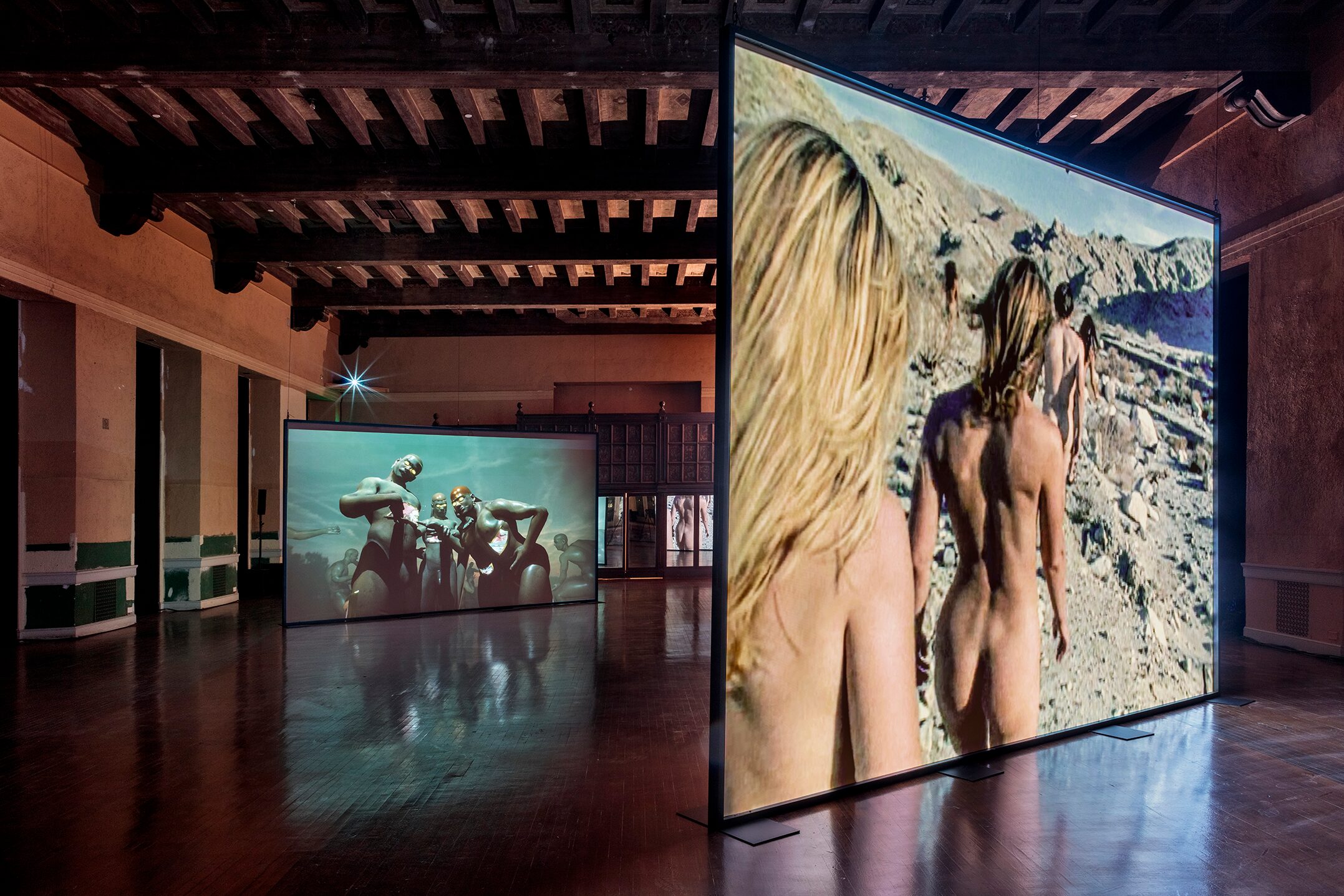
Left, Jacolby Satterwhite, 2 Shrines, 2020, Right, Doug Aitken, 2 Blow Debris, 2000, (installation view), “What a Wonderful World: An Audiovisual Poem”, 2026. Photo by Joshua White, Courtesy Julia Stoschek Foundation.
Filmmaking is a medium uniquely concerned with the tension between form and content. Film’s temporal dimension lends itself to narrative content, but this comes at the cost of hiding its own labor. By masking this labor, film creates an escape from reality. The “audiovisual poem” at the Variety Arts Theater reversed this tendency. I don’t mean that film was somehow “deconstructed” to expose its production. Rather, the exhibition demystified film in order to reveal how weird it really is precisely because it is made by people.
The films on view did not act as a “mirror” to reality. That framing simply serves to externalize the weirdness of film. Instead, by focusing on the craft, one began to see filmmaking as a form of phantasmal alchemy. Watching the Skladanowsky brothers’man versus kangaroo bout more than a century after it is filmed, I was most struck by how bizarre it is that someone set up this scenario to record it. Kader Attia’s Mimesis as Resistance (2013) made this point in a more self-consciously heady way. The film uses BBC nature documentary footage of a lyrebird—a master of mimicry—to focus on the unstable boundary between technology and biology. As human development has encroached on the birds’ territory, they have begun imitating chainsaws, camera shutters, and other sonic fragments of modern technology. The mating calls of lyrebirds, like film itself, become unsettling combinations of living creatures and dead machines.
It makes sense then that many of the works played with horror as a genre, something the presentation was acutely aware of. Films jumped from behind corners, videos snuck up on you. In Precious Okoyomon’s It’s dissociating season (2019), a deformed, buffalo-like monster wanders through a forest while a narrator, Okoyomon’s brother, describes a tense encounter with police as a Black teenager. The work was made all the more eerie because it played on a Disney-themed box TV in a room glowing under fluorescent neon pink light. Jesper Just’s Something to Love (2005) was similarly unnerving. The film was shown in a darkened maintenance room; paint was chipping off the walls while dust gathered on the window ledges. We watch two men pull into a parking garage. The passenger gets out and enters the elevator while the driver runs after him. Eventually the driver finds the passenger in a passionate embrace with a woman in the elevator. The couple begins to float and spin in the air. The driver sheds a tear. The film is romantic, unsettling, haunting. Likewise, in Thomas Demand’s Balloons (2018), a cluster of balloons floats aimlessly around a storm drain as the plastic clip holding each string lazily grazes the ground. The balloons move as if they’re alive even as we know they are just floating air, phantoms.
A feeling of impending dread pervaded the upper levels of the exhibition. As one descended though, dread turned to outright terror. The big screen in the main auditorium was reserved for Arthur Jafa’s Apex (2013), an eight-minute montage of found images ranging from pop culture to the truly macabre set to a taut, pulsing electronic beat. Blackness is at the center of the work; at times this is direct and at others it looms in the background. As the beat builds to an agonizingly tense climax, split-second images flash of mangled bodies, Mickey Mouse, smashed-in skulls, the Death Star, Tupac, microscopic parasites, Angela Davis. Apex puts the viewer in a chokehold that never relents. To serve as an exhale of sorts, Jafa’s work alternated with Jon Rafman’s Oh, the humanity! (2015) a vibey, impressionist video of inflatable tube-riding vacationers gently floating in a wave pool. Though this work was undoubtedly less stressful to watch than Jafa’s, Rafman’s fleshy bodies blending into an abstract mass is horror of a different sort.
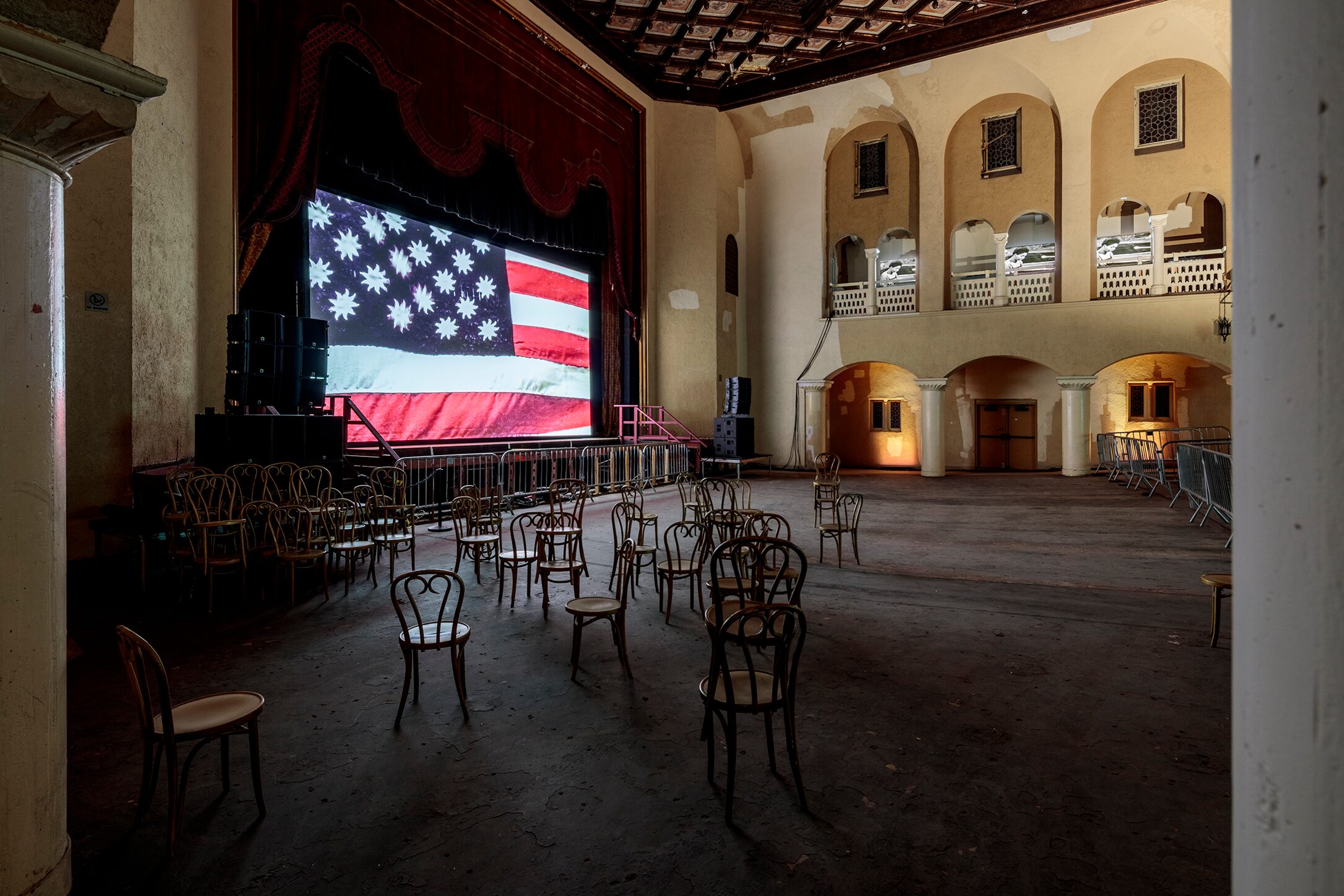
Arthur Jafa, Apex, 2013, (installation view), “What a Wonderful World: An Audiovisual Poem”, 2026.
Photo by Joshua White, Courtesy Julia Stoschek Foundation.
Similarly, on seven monitors set on the upper balcony seats of the main theater, Ulysses Jenkins’ Mass of Images (1978) examined the violence of mass-media spectacle. Jenkins emerges from behind a stack of television sets, playfully swinging a sledgehammer while repeating that we are simply masses of images. All the while, infamous uses of blackface play on the screen: The Jazz Singer, Birth of A Nation, The Little Rascals. Thus, in the exhibition’s main auditorium, the primary site in which to view film, the works forcefully confront the viewer with the racialized terror buried deep in the history of film itself.
This terror is not just racial though, nor is film simply an inert container for society’s prejudices and violence. In the basement (naturally the subconscious of any building), we were forced to confront one of film’s great moral challenges: even as we condemn the violence in movies and sex on TV, we can’t look away. Tucked in a darkened corner, An Andalusian Dog, an extraordinary 1929 film directed by Luis Buñuel based on a screenplay written by Salvador Dalí, made this tension painfully clear. Early in the film, we watch a man hold open a woman’s eye as he slices it cleanly across the iris. Nearby, Sigalit Landau’s Barbed Hula (2000) depicts the artist, nude from the chest down, as she rotates a barbed hula hoop around her waist, cutting herself even as she continues to perform. Across the room, in Anne Imhof’s Untitled (Wave) (2021), a topless woman on a beach with her back turned to the camera, cracks a whip into the waves washing up on shore. Sex and violence become indistinguishable features of an all-encompassing spectacle. Like the silver screen itself, everything is simultaneously heightened and flattened
The climax of this spectacle was, for me, Robert Boyd’s four channel video installation Xanadu (2006). The work is a whiplash compilation of pop culture and political footage spanning roughly thirty years, from the failed revolutions of 1968 through the liberal end of history in the 1990s. Footage of Mujahideen defiantly carrying AK-47s, Aum Shinrikyo, David Koresh, Manson Family trials, Rwandan massacres, and presidential speeches are paired with EDM remixes of “Con te Partirò,” “Everytime” by Britney Spears, and “Don’t Cry for Me, Argentina.” Just as both the music and political absurdities of the time reach a fever pitch, the screens go black and the music cuts out. Two screens show each tower burning while on the opposite wall, we watch in silence as a woman jumps from the upper floors of the World Trade Center. The crumbling towers function as a symbolic, if perverse, release after decades of pent-up phantasmagoria. Watching twenty-five years on though, it is all too obvious that this spectacular release was merely temporary, 9/11 quickly became material for a subsequent explosion of meaning.
This seems to be the audiovisual poem’s parting message: whether a man landing a blow on a kangaroo or the twin towers falling, there is an alluring yet ghostly horror intrinsic to film itself. Cynical maybe, but I couldn’t look away.