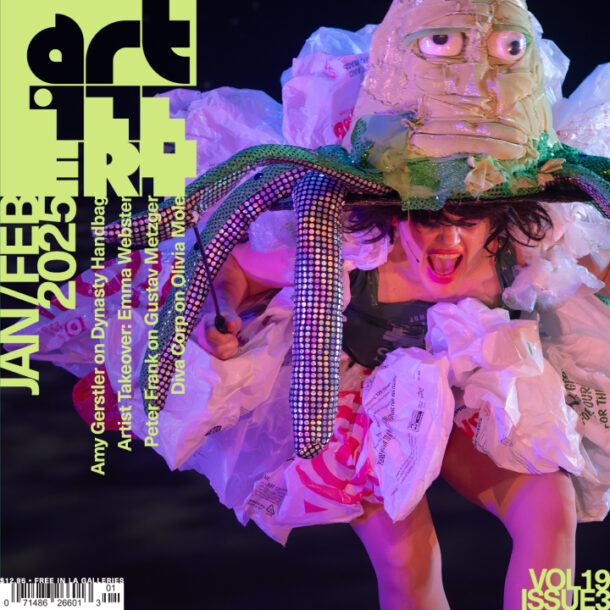


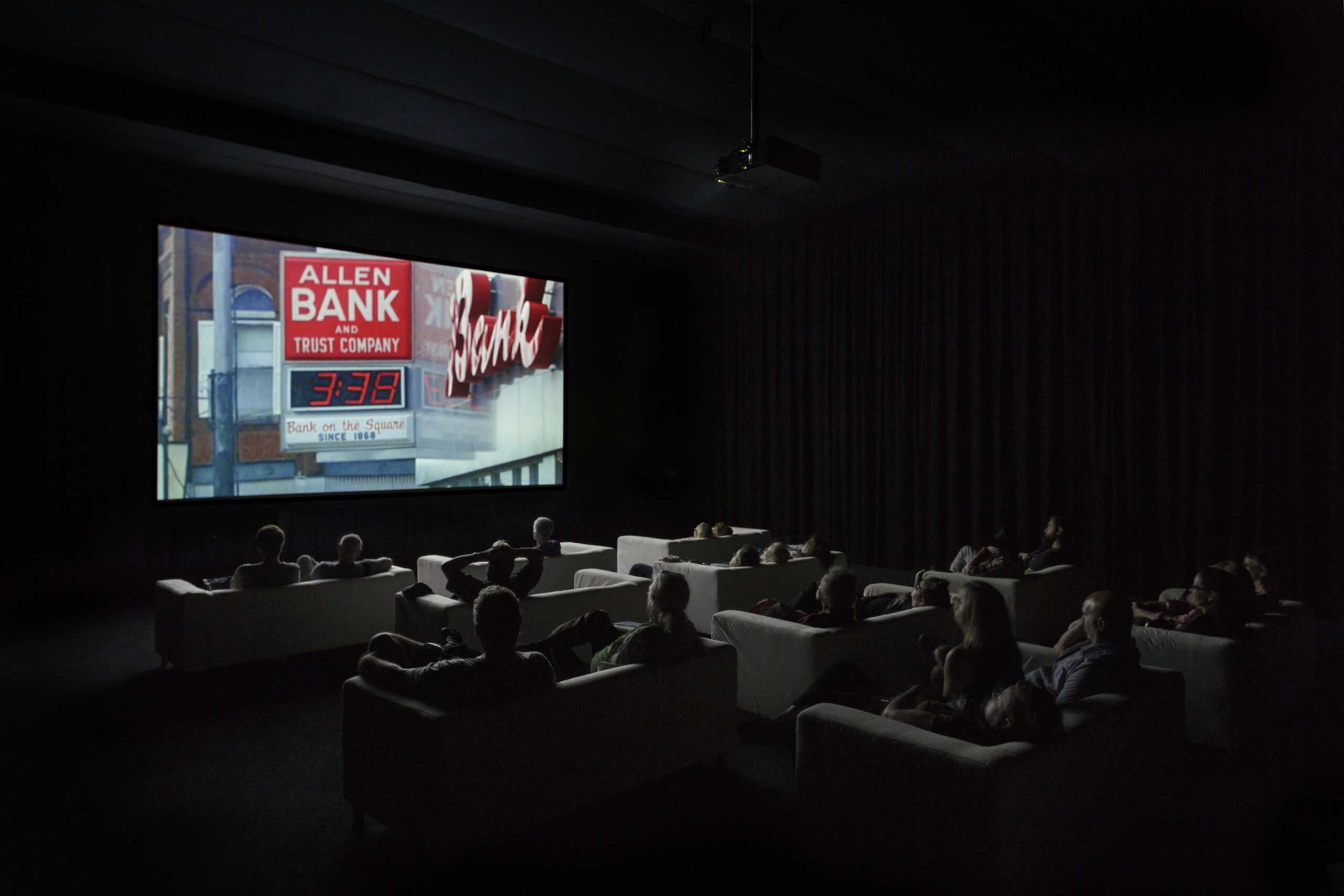
In 2012, Daniel Zalewski profiled Christian Marclay and The Clock (2010) in The New Yorker. The piece includes a single, throwaway reference to an assistant: “One fellow, who offered little but gunshots and ‘guys getting their heads chopped off,’ was fired.” Over the next month, The Clock returns to LACMA. –TC
From now till death do me part, from the moment my rigor-mortis-wracked corpse is tossed unceremoniously from the hollow arms of the crematorium to its fiery grave; from my non-death to the storybook end of all of our lonely days, when the last human takes their final parched breath, dreaming of that last drop of water fallen through the dusty air from that last withered leaf of the last climate-tortured tree; or, even better, when the sun finally gives up on its glowy pantomime, exploding in a nebula of suicidal bliss, a catastrophic chain reaction blooming from its nuclear heart, spreading in all directions at ungodly speeds, poisoning the void of space and pulverizing every planet and moon, asteroid and iceteroid, all land and sea, schools and cinemas, all moms and dads, kids and dogs, every clock, everything we’ve known and not known for all eternity, all time; until the end of endings, the abolition of beginnings, until then, I will be known solely as that “one fellow.” The fired one. “Ted with the bad taste.” “Ted who can’t follow the rules.” The passing reference. The footnote to “the greatest collage of all time.” Hah. They didn’t even beg-pardon the pun.
Yes, it is I, the fellow who sourced “too many horror films” and was fired as an underpaid assistant from The Clock, the great Christian Marclay’s now-canonical 24-hour art film made of watches and clocks, from bedside alarms to Big Ben, anything having to do with time and shot for the screen. Elizabeth Taylor smoking before a cobwebbed grandpa clock. Crocodile Dundee studying the angle of the sun. The Clock is a durational meditation on film history and a literal ticking timepiece itself, synched to the very minute and second of the city wherever it is shown. And it was a sensation, winning that year’s Venice Boring-ale and luring scores of eager audiences into lines spanning blocks so they too could catch a few precious minutes, even just a glimpse of Marclay’s “greatest work of the 21st century.” Lol. I never got that far. No, after just a few weeks consuming hours upon hours of horror movies, scanning for dismembered watches and blood-splattered clocks which the maestro could then weave into his labyrinth of time and celebrity—of course giving credit to neither me nor my fellow broke assistants—I was let go before lunch.
“We’re looking for the banal and plain,” said Christian. “Nothing outlandish,” said Christian. “Make it boring!” he said. And so The Clock the people got was the clock the people deserved: a mirror reflection of their dull days, with brief flashes of joy at the recognition of some actor, maybe some laughter at a clever juxtaposition. Then there was the infamous climactic midnight, the tick-tock chiming build-up into Big Ben blown to smithereens (V for Vendetta, 2005). Christian just had to give the vulgar hordes the explosive ending they desired. This would all be fine and good—the give and take, the withholding then bestowing and back again, is the way of “good” art—if The Clock weren’t so disastrously ignorant of the root truth of the matter: that boredom is just the beginning.
With Marclay, the clips follow one after another, some dissolving, some chopped and pressed together like lunch meat, but all devoid of meaning. They pass before us, and we watch them pass, trapped in our tiny cages of perception, audiences without the wherewithal to know they’re being duped. In essence, what we find is the banality of modern life confronting the banality of the clock: mirror facing mirror, emptiness reflecting emptiness, one frame after another after another after another until all that’s left is the same drab image. No more peaks. No more troughs. Just the stale beat of time.
But those who only know boredom are stuck in the world’s infancy, when the true horrors of time were merely waiting to be born, when God rode rampant over his delusional fields, oblivious to existence, bathing in founts of naught, reclining on hills of nil, until one non-day He tripped over what at first appeared a simple nothing-rock but instead held the markings of a sundial, the semicircular swing, the triangular lunge, the axiom that took an ax to the eternal bliss of nothing, and in that first objective instant brought death to the void, that fraction of a fraction of a fraction of a moment when the twin pillars of light and time were born, plunging out of nothing, setting off a chain reaction of quotidian terror and seasonal rot, the mute beat of yearly returns and epochal ruin. In that instant of time’s birth, God died and all shrieked into being, not in an idyllic, vegetal, manuscript-illuminating Eden, but a putrid swamp of motion and mood, blinking and body, person and place thinging, a horse neighing to no one in a wood that doesn’t care, the light slanting through imposing trees onto fronds that shit air and are forever tortured by the flat, incessant ring of water droplet after water droplet killing itself, one after another into the rivers of time.
God died so we could have time. So we could go to the market. Then to the store. Then to Terry’s house. Maybe Ellen’s. He shattered into every ticking chime and dinging bell, every reminder to get going, go, hurry up please, it’s time. He left so that we could dance disco across the wastelands of life. So that each of our little, precious egos, our singular, non-angular “I”s could join in the circular, dumb dance, so that we might try our own hand ticking along to the beat, tocking a song or two, ignorant of the murderous origin of time and space, of the truth which transcends all clocks, which appears in those strange moments when the nothing breaks through at the edge of your eye, or in a sound humming from the bushes, or a billowing vibration of pain in an empty room, felt echoes of the truth of what was, of the time before time, the nontime, of God’s laughter seeping from the cracks in the walls of life, pitying the clock, its whole numbers and clean lines, its smooth, white facade betraying a tidy certainty, a mute pledge of allegiance to the sovereignty of time, time, who without reason or notice, might reach out and snap each of its own tiny twin hands before dragging them, us, mind and matter, body and soul, thought and non-thought through the vilest cesspools of time’s graveyard.
Thus was to be my contribution to The Clock. A watch ticks. A wrist cracks. A clock tocks. The joint pops. Another ticks. The gun goes click. Another tocks. The head’s blown off. Tick. Lighting the wick. Tock. The concussive shock. Michael Myers raising his knife as the clock crawls toward twelve. John Malkovich playing John Silence bleeding out at the witching hour. For horror cinema tells the truth of time, capturing the contours of our disaster, our predicament in all its bloody, cosmic sincerity. And any self-respecting Clock would have given voice, or at least allusion, to this truth. That time is death. Death is time. To say otherwise is to speak fiction. To create a tidy story, however virtuosic, that is both about and of the mundanity of modern life but no more. Here we find a Clock devoid of time, ignorant of the hollow hours and minutes of the bone clocks clicking and ticking, scraping and creaking across the chalkboards of the mind, deaf to the shrieks of seconds and half breaths as the élan vital squeaks from the pores of time’s facade, as the pulse of bloody seconds drains to naught. Ignorant of the throbbing weight of years, of centuries, epochs, of the space of no time, where time sinks into the quantum state of all time, that chopping-block universe of a theory slicing body after body, dicing soul after soul into the finest grains of erasure.
And yet it went forth and will go on. For part of Marclay’s clever sale agreement was that any institution purchasing The Clock must exhibit it every ten years. Which is where we find ourselves today, with said film screening yet again at the Los Angeles County Museum of Art, Marclay profiles and think pieces popping up out of the digital ether by the hour, influencers lined up for selfies and hot takes, and your humble “fellow,” the one let go, “too-serious Ted” now working IT in an over-air-conditioned Stockley Park cubicle, keeping time with every jet passing over from our unfriendly neighborhood Heathrow next door, gazing up from time to time at the pale clock above Kate’s desk, its tiny hands spinning and swinging, sliding by as Trevor walks past or Pat delivers yet another tidbit of “friendly feedback” on last week’s inventory fumbles.
You might think such a scene would break me. That after hours, days, and years of such monotony I too would succumb to the hollow horrors of ennui, of life passing before one’s very eyes every second of the dull day, watching the hands wipe round and round that archaic analog surface. Thus would be the fate of one who lacked the truth, who had not done the work, who had not sought out the research and who was not moments away from getting up from one’s desk and grabbing the sharpies and the salt packets that Evan had so kindly refilled this morning, telling Kate you’re feeling kinda sick before shuffling off to meet Trevor and Liz in the bathroom, locking the door and accepting your cloak, drawing the circles on the floor, spreading the salt, hailing the four cardinal points before scribing the sigils and saying the blessing, raising the sacrificial bird and spilling the sacrificial blood, and yes, chanting the name of the great Choronzon, summoning the sleeping God to do his good work and finally, once and for all, truly killing time.