

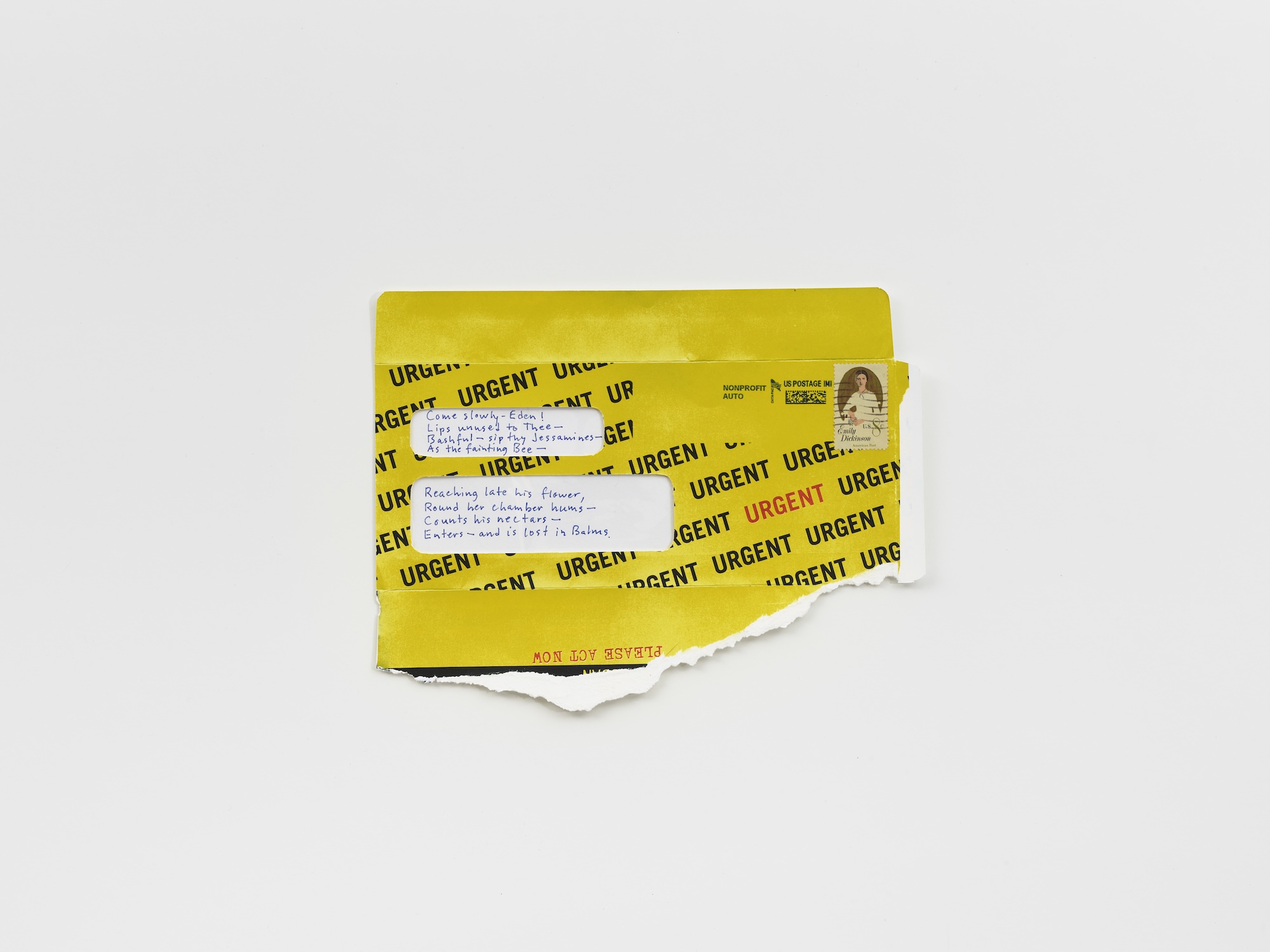
The soft, subtly enhanced lighting and sheer airiness of the main part of the gallery were the first indications that viewers were in for something slightly different in this exhibition — the artist’s first in Los Angeles (and first with this gallery). I had no idea what was intended in the exhibition title until the first work, Gorgeous Nothing 26, Come slowly—Eden! (all works 2026) reproduced the entire text of the famous Emily Dickinson poem—all but giving it away. The “Balboa of House and Garden” at one time (perhaps apocryphally) described Dickinson herself—intellectually adventurous, but preferring not to venture far from Massachusetts, or even her hometown of Amherst, yet regionally well-known for her no less botanically adventurous cultivation of the gardens and greenhouses on her family’s extensive property.
Finch draws inspiration here not merely from Dickinson’s poetry, but the physical materials she used to compose that poetry
—not infrequently envelopes she unfolded and kept after opening her mail. But what Finch does with Dickinson’s inspiration is a bit of magic entirely his own. Finch transforms the medium itself—in GN 26, a yellow International Red Cross (I think) donation request, with rows of black “URGENT” diagonally striping the ‘envelope’ (in actuality archival/artist papers cut to more or less duplicate the actual postal envelope or mailer)—into the ostensible subject of Dickinson’s elegiac arabesque. The resemblance may be closer to a yellowjacket than an actual “fainting Bee,” but we get where this “bee” is going. (Nor is the “urgency” inadvertent here—a subsidiary theme Finch develops throughout the show.)
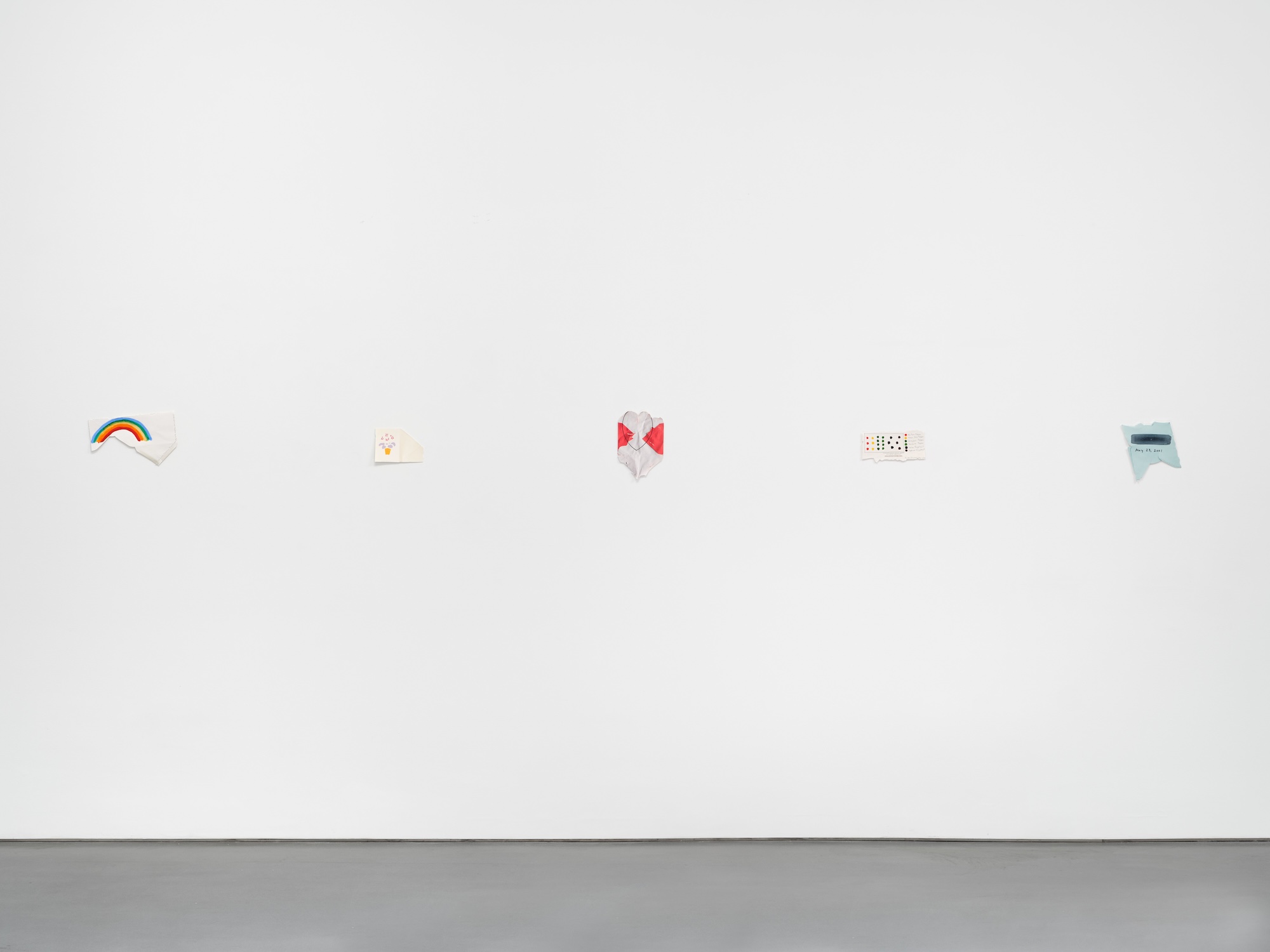
Or do we? Doubt and uncertainty softly color or cloud every illumination—occasionally by subtle calibrations. Finch’s mastery of atmospherics (well-known from prior work) is amply borne out here. But more importantly he grasps the tenuous uncertainty of transitory perception—the microsecond-by-microsecond leap between registration and perception, our conscious purchase on what is actually seen, or what we thought we saw—and what is recalled now in the “mind’s eye.” Consider the Gorgeous Nothing 38, Blindspots (left eye, right eye) that follows Dickinson’s fainting bee :the blind spots in gold leaf floating on a pale amethyst penciled ground simultaneously mask, signal, beacon. No rear or forward views, the sense of a split, or even suspension in perception, however fleeting, and what might escape entirely unseen.
He plays this out explicitly with a contained scatter of pastel dots in GN 53, Trying to remember the color of a bougainvillea (7 attempts), with affixed postage stamp and reproduced cancellation. He’s messing with his viewers—but not without purpose or reward (or simply, pleasure).
There’s a network of connections here, however elusive; somewhere between the optics and imagery, Finch constructs a kind of cartography of conscious perception and critical description. (There are parallels here to what we know of Dickinson’s own method .) He picks up the bee’s loopy meander to and from a collaged wallpaper rose (oblivious to the paper’s pattern of repeating arrows) in GN 14, Following a bee; and similarly, the trace of a fly’s alternately arching loops and obsessive micro-dancing around his studio in the very first of these Gorgeous Nothings. (Finch takes the title from one of Dickinson’s envelope poem/fragments: “Afternoon and / the West and / the gorgeous / nothings / which / compose / the / sunset / keep”.)
He also (speaking of sunsets) sees the willful disconnect. Contrast his magic hour solitary palm tree nod to Ruscha and a certain L.A. mythos in GN 28, Sunset from Sunset Blvd. 3/3/26, with the undulating and intersecting atmospheric waves of red, orange, yellow, cerulean blue and carnation pink he’s re-textured (in colored yarns) in GN 51, Sunset (Brooklyn)—dismissing that mind’s eye view for something entirely transformed.
Where Dickinson uses her envelope flaps and folds for subtle psychological and philosophical cross-examination, Finch expands upon the simultaneously earth-bound and cosmos-seeking aspects of these works. He can be expansively ruminative, or gesturally compressed, almost offhanded. GN 9, LA Gutter (ketchup, flowers, cigarette butt, poop bag, oreo cookie pack) compresses the entire noxious slick into a mini-Pride rainbow. Yet he conjures music of the stars with a scatter of rhinestones on a shard of a black envelope in GN 36, Orion; or in GN 16—with a tiny dust-devil cluster of gold leaf flakes on a deep indigo field (returning to the domain of human pollutions in assisted drainage ditches)—the ephemeral dazzle of Sunlight on the Gowanus Canal.
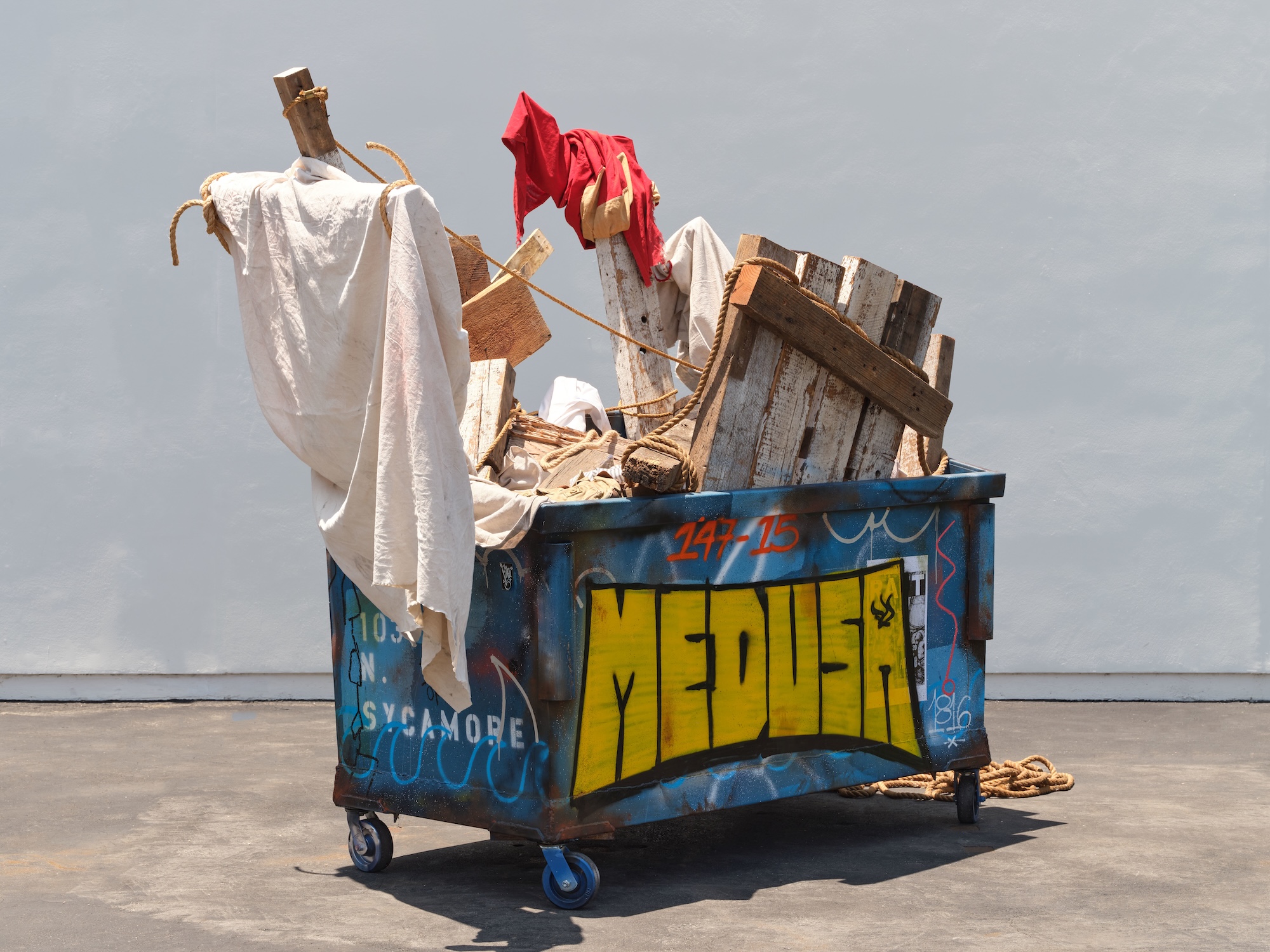
Still contemplating stars from the gutter, I almost missed the dumpster a few feet just outside the gallery’s entrance, graffiti-
tagged “MEDUSA”—the artist’s own. The connection between Finch’s pastiche (wood pallets, canvas, hemp rope, a cask, etc.—
all piled into, or draping off of, a standard commercial dumpster) of Géricault’s 1819 masterpiece, The Raft of the Medusa and the ethereal delights I had just viewed, seemed obscure until I began to consider that envelope flap we call history: the events surrounding that epic disaster and the dumpster fire that was the not-so-distant backdrop to Dickinson’s literary maturity—the first American Civil War. But Finch covered that base, too—with a large black cloud pooling into a graphically cross-hatched security envelope interior in GN 12, “I see better in the dark.” E.D. This may be an essential 21st century survival skill—not that it makes it any easier to see where we’re going.