

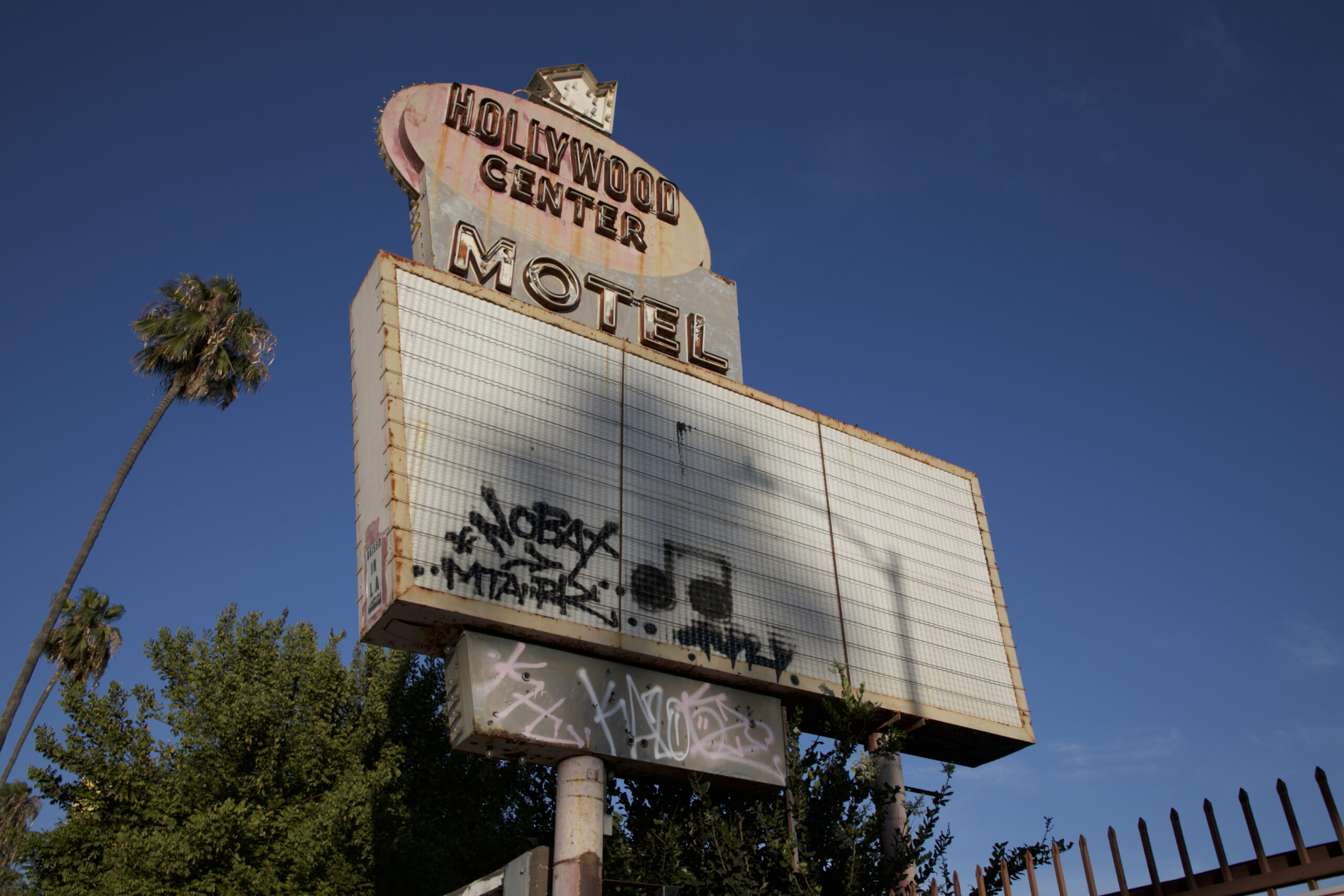
Today, Hollywood is like a ghost ship, an empty dream factory with abandoned equipment. Unmoored and directionless, Los Angeles shivers in the void of the fantasy it can’t forget. It can’t remember how to recreate what it has lost, or how to dream a new dream. So it lives in a somnambulist twilight, a suspended present that evokes only the hollow look of what it once knew and believed. Hollywood can feel something is missing, but it doesn’t remember the meaning of what was lost—only how it looked. In many cases, all over Los Angeles, only the façade remains.
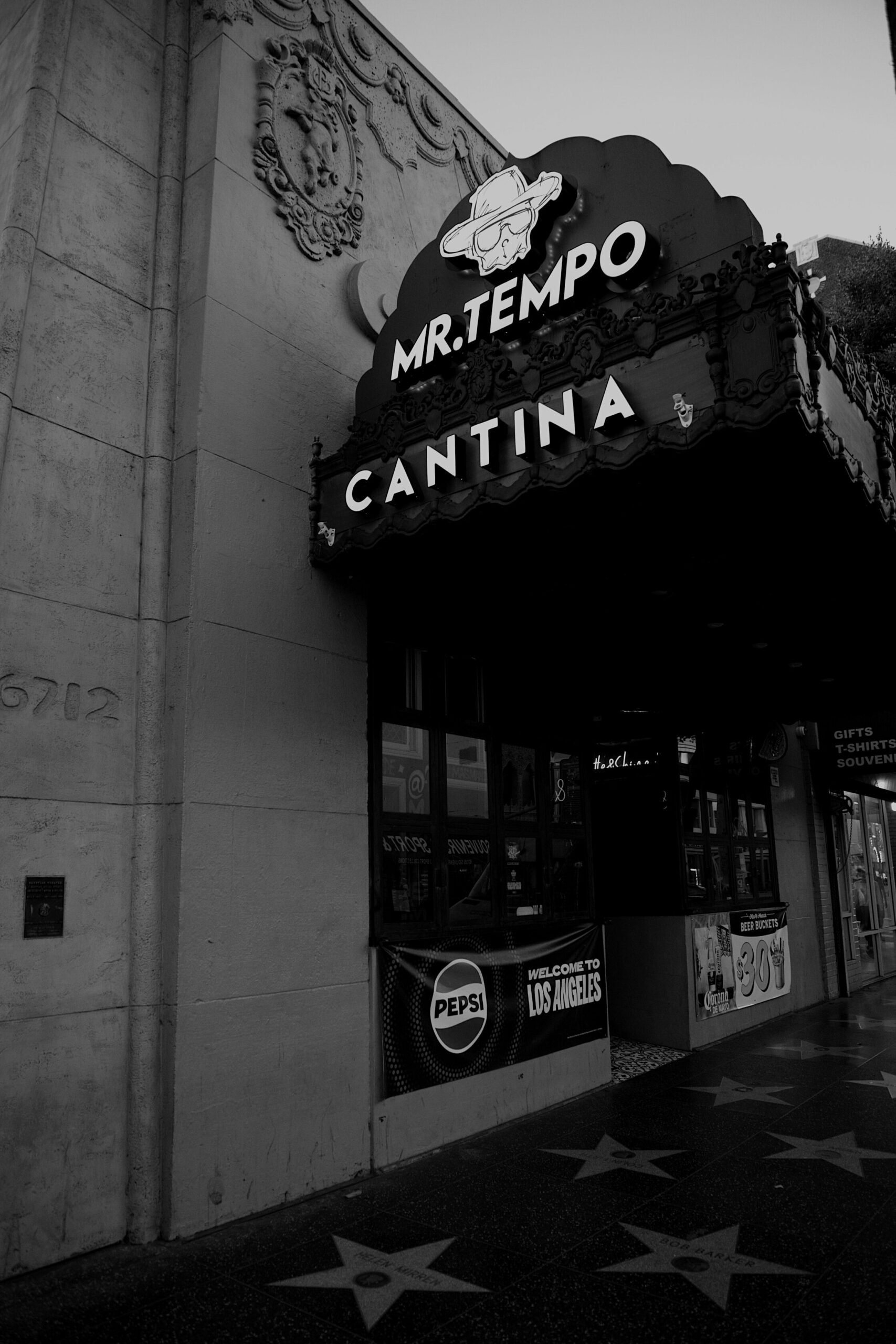
Pign ’n Whistle. Photo by Greer Sinclair.
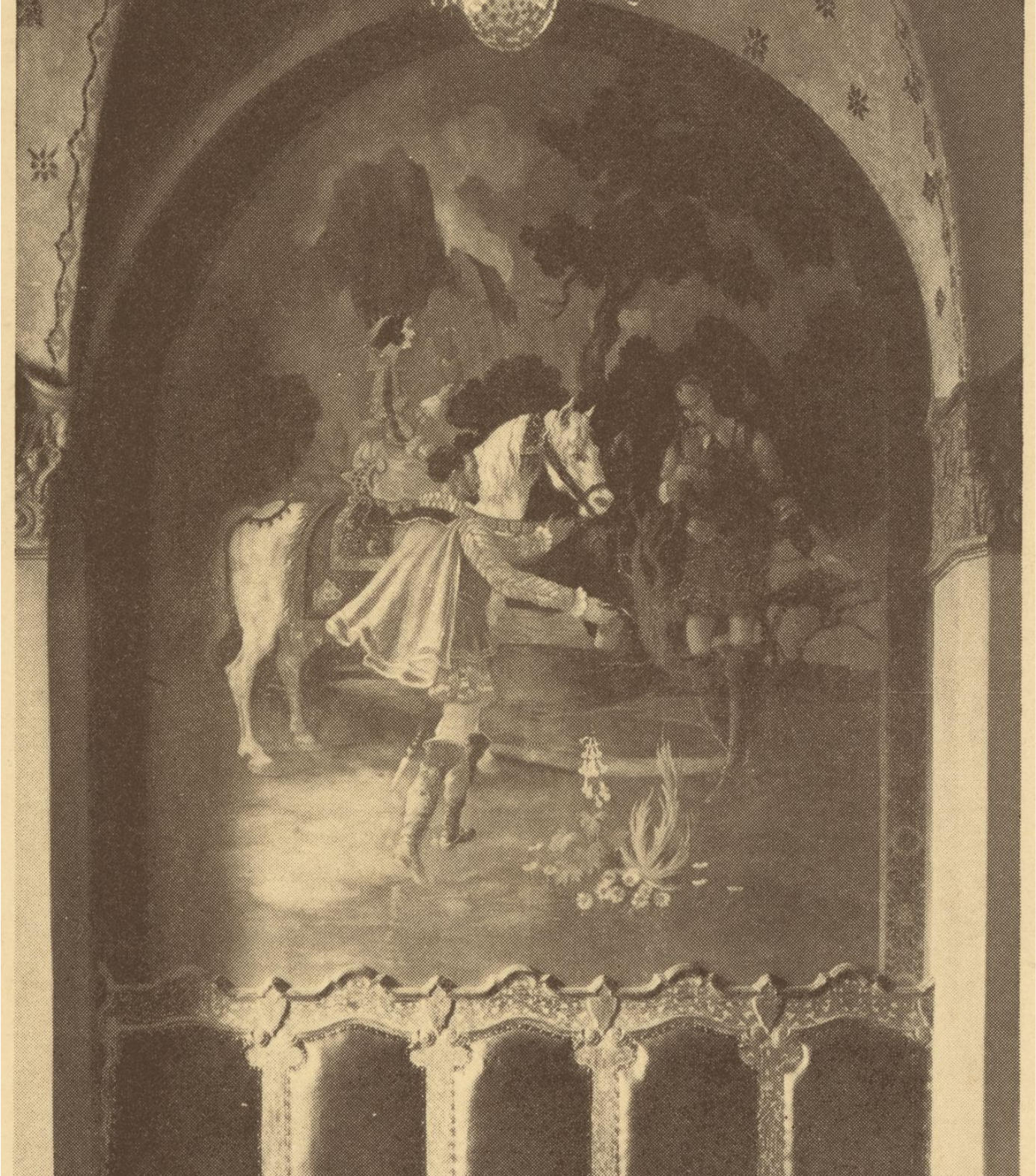
Above Right: Pig ’n Whistle’s contribution to filmland, 1920s. Courtesy of California State Library.
On Hollywood Boulevard stands what remains of the Pig ’n Whistle restaurant, built in 1927 alongside the courtyard of Grauman’s Egyptian Theatre. As was the style, the Pig ’n Whistle was built to foster artistic community and commerce in a thriving urban environment. Los Angelenos, waiting for the movie to start next door, or beginning a romance, or meeting to discuss a scheme or a screenplay, could find both comfort and mystery in the dark quiet beauty of the cavernous restaurant. Carved and delicately painted oak rafters suggested the romance of Spanish cathedrals; wrought iron balconies evoked the Gothic darkness of the Inquisition. Painted on the walls were large scale murals depicting images of courtly love, the medieval code of devotion and eros between a knight and his lady. In the tradition of courtly love, the knight revered his lady as an ideal, the human manifestation that gave him direction and purpose. It was for the love and honor of this woman that the knight was inspired to perform acts of bravery— to build, to find, to win. It was not from ego; it was from love. The same might be said of those who loved the motion pictures. It was a dream that inspired beauty, commitment, bravery. Among other motivations, it could be said that ultimately it was love that drove the most talented craftspeople, engineers, artists, and designers to Los Angeles and made them stay for a lifetime in pursuit of their ideal.
The town of Hollywood was incorporated into Los Angeles in 1903. The first Hollywood film (In Old California) was made in 1910. The life of Hollywood as a city, as a place, is inseparable from its destiny in the birth and evolution of the motion picture industry. For over a century, the lived intersection of reality and fantasy seemed possible. Millions have followed in this calling, and in the challenge to see if utopia, Paradise Found, could be realistically sustained. Philosopher Jean Baudrillard writes in his 1986 book America, the crisis of an achieved utopia is that it is inevitably “confronted with the problem of its duration and permanence.” In 2021, under the spell of the pandemic, the Pig ’n Whistle changed hands, and without any permits for modification filed, the interior was gutted. The murals are buried beneath black painted walls and flatscreen televisions, hypnotically projecting a 24/7 news cycle, movies without knights. Some of the original façade of the Pig ’n Whistle can be seen today, obscured by the neon name of a new restaurant that has no memory of what it has defaced, or what it meant. For miles, Hollywood Boulevard is haunted by the lack of meaning its empty buildings and streets reveal. The buildings are abandoned because the values they represented have also been abandoned.
At time of writing, on a building in downtown Los Angeles on South Olive Street the name of Clifton’s Cafeteria is still peeking through the peeling paint. Clifton’s was founded in 1931, the largest public cafeteria in the world. The founder Clifford Clinton operated his restaurant according to his own ethical values; the restaurant proudly invited guests to “pay what they wish and dine free unless delighted.” In addition to the humanitarian premise of Clifton’s business model, the restaurant was unprecedented in its aesthetic design: inside Clifton’s was a fantasy wonderland. An indoor faux bois redwood tree forest stretched as tall as the ceiling; a 20-foot waterfall cascaded into a gentle stream which curved throughout the dining room. It was as if one had visited Big Sur and the Seven Seas without ever leaving downtown L.A. The décor was “fake” in the way a film set is fake, but in the context of public dining, the ambiance provided the only vacation some visitors were able to experience. Clifton’s represented something more than just a business; it was a model of community engagement. With the principle that no one should go hungry, Clifton’s was also a venue that maintained that beauty and fun, like dignity, should not be treated as exclusive luxuries. That beauty, like culture, like history, was not privately held or owned, but to be shared with the public—for it was only the presence and engagement of the public that made it worthwhile.
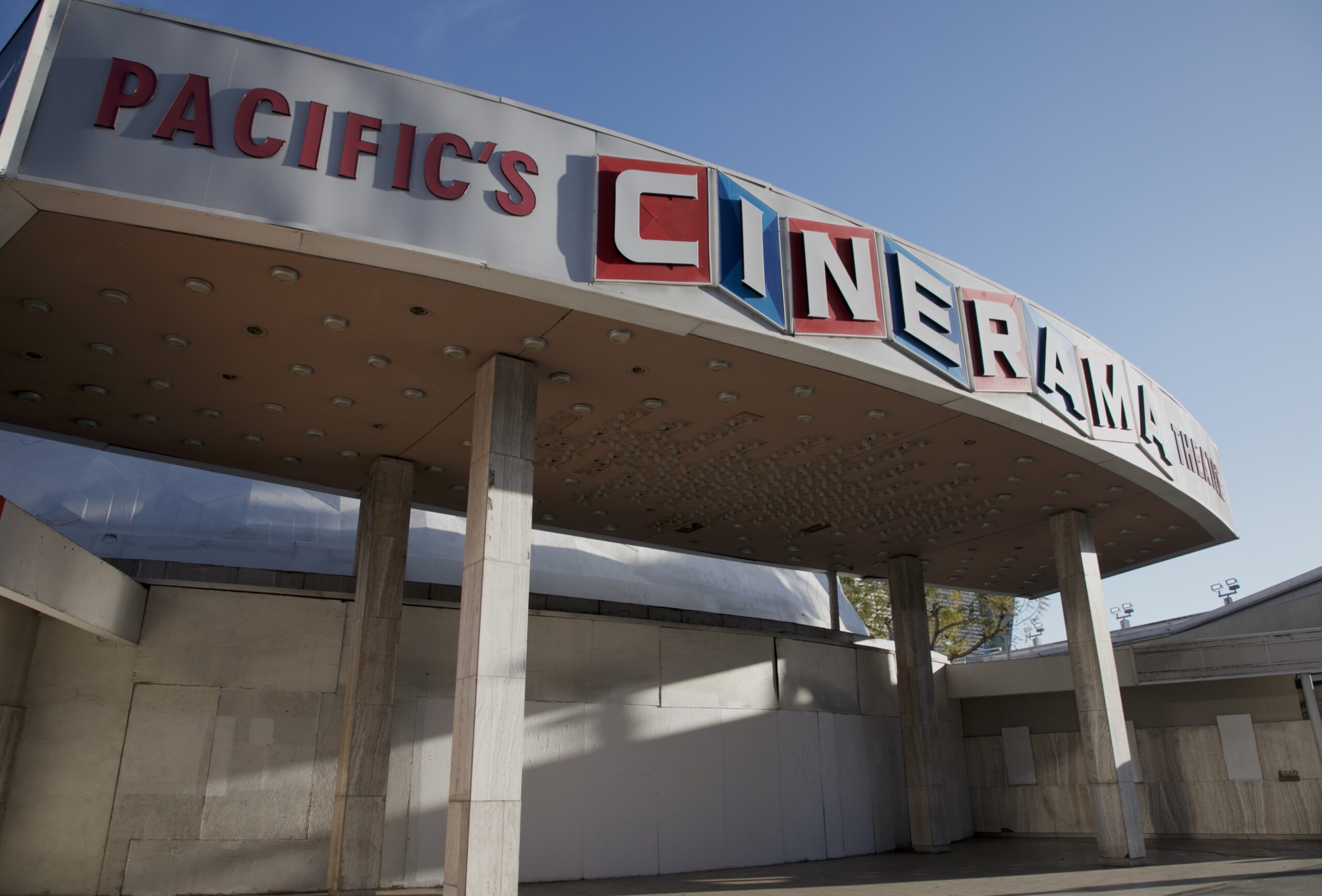
Cinerama Dome. Photo by Greer Sinclair.
When the Cinerama Dome movie theatre opened on Sunset Boulevard in November 1963, its unique architecture represented a new development in architecture that was functionally designed for the art it housed, specifically the cutting-edge technology of the Cinerama tri-projector widescreen. Designed by architect Pierre Cabrol, the theatre was the world’s first all-concrete geodesic dome. The first film to premiere at the Cinerama Dome (It’s a Mad, Mad, Mad, Mad World) ran for a record breaking sixty-six weeks. The Cinerama Dome has been abandoned since 2020, and it sits left to deteriorate on Sunset Blvd.
As if the architects of Los Angeles had taken only the best dreams, from all over the world, and brought them to the shore of the Pacific—a dream city that contains the memories of the whole world but made to scale and made for everyone. Public art, movie theatres, restaurants with design that encouraged a collective experience—these were monuments of pride and imagination. They were built in harmony with the landscape or the perfect climate, designed to be shared by the people who had come to Los Angeles to appreciate its beauty and to live within its collective dream.
If anyone visiting today came in search of “Old Hollywood,” that elusive seduction of craftsmanship and myth, they wouldn’t know where to look. There is nothing here that gestures towards its present-day existence. An imitator dressed as Marilyn Monroe walks down the street in a costume, sweating in her pantomime makeup. But it is not her. The hollowed-out reproduction declares that while its essence has been exploited into oblivion, the symbol has survived, thus the dream was real. That is important for advertising and tourism—if the dream is real, it is also possible—and maybe even eternal. The tightrope danger of Hollywood has always been that it sells itself on the chance that the dream might be real. And if the dream didn’t work out, someone could always just say with cynical righteousness, of course it was too good to be true.
The last decade alone has seen the façade of the Pig ‘n Whistle botched, the slow fade to black of Clifton’s Cafeteria and the Pantry, the Cinerama Dome left to ruin like an abandoned temple; that is only a selection of a recent fate shared by dozens of significant landmarks. These were cultural institutions that inspired and generated a way of life. But today it is the perceived value of these buildings which is in question. If something has no meaning, no value, there is no reason not to tear it down. It is in effect worthless. And that is what has happened to Los Angeles—not because there is intrinsically no value, but the dwellers of the dream city have forgotten what they were dreaming about. The turn of desecration into legend is a cycle almost as old as the city: we will never know what the Brown Derby was like, never the Coconut Grove at the Ambassador Hotel. There is no possibility of being discovered at the counter of Schwab’s Drugstore on Sunset; today Schwab’s is a CVS. How can we say we yearn for Old Hollywood when in reality it is treated so neglectfully? What is valued is reflected in the physical spaces that are erected, the psychogeography that makes a city’s destiny physical. The symbols, like the buildings, are made hollow by their lack of purpose.
Without its vision or a community for its workers, Hollywood is a mirage of memory. Like the fate of Detroit after the demise of its automobile industry, Hollywood is a place in transition between its history and its new reality. But in Hollywood the industry was the dream machine, and its passing is more ephemeral and tragic because it was fueled by the hopes and dreams of the world. Hollywood didn’t die of natural causes. As time goes by, we may find it was murdered, and the evidence is in its empty streets, its symbols without meaning. To know what its dream was is as important as knowing what the dream is now. That is the question Hollywood must answer if it will continue to exist as a place of life and innovation and not merely a mechanical and weary reproduction of its ghosts