

Though I grew up with pets, I’ve never taken to them. As a boy, we had a beast of a dog, Soxy. She was scary and insane, except for when my older brother could tame her long enough to let me ride her around like a pony. My mother preferred fish, silent and remote, almost like not having pets at all. But those fell victim to negligence. Overfed, bloated, and dead of gout. The cat my mother got us left the deepest impression. We named her Marshmallow, a nod to her four white paws. But Marshmallow was nothing like a marshmallow, not sweet nor soft. For weeks, she’d vanish into the woods surrounding our house, only to announce her return by delivering us morbid gifts: a mouse beheaded and quartered on our front doorstep or a rabbit on the garage floor, the creature gutted, its entrails surgically removed, its corpse floating in a puddle of blood.
Cats in all their majesty, brutality, and beauty returned to me while viewing “Room 8: A Cat in the Classroom” at the Central Library. An exhibition of 30 pictures shot by photographer Richard Hewett, “Room 8” immortalizes a single stray that stalked Elysian Heights Elementary for 16 years. Writer Brenda Rees curated the show from among the 297 images Hewett photographed for Look magazine back in 1962. The LA Library acquired Hewett’s entire archive in 2019. The legend goes that one afternoon, a cat slipped inside Room 8. The teacher shooed the animal into the hallway and shut the door. However, a few minutes later, the cat leapt back into the same room through an open window. The principal ruled the stowaway could stay. They named her Room 8, after the feline’s preferred classroom.
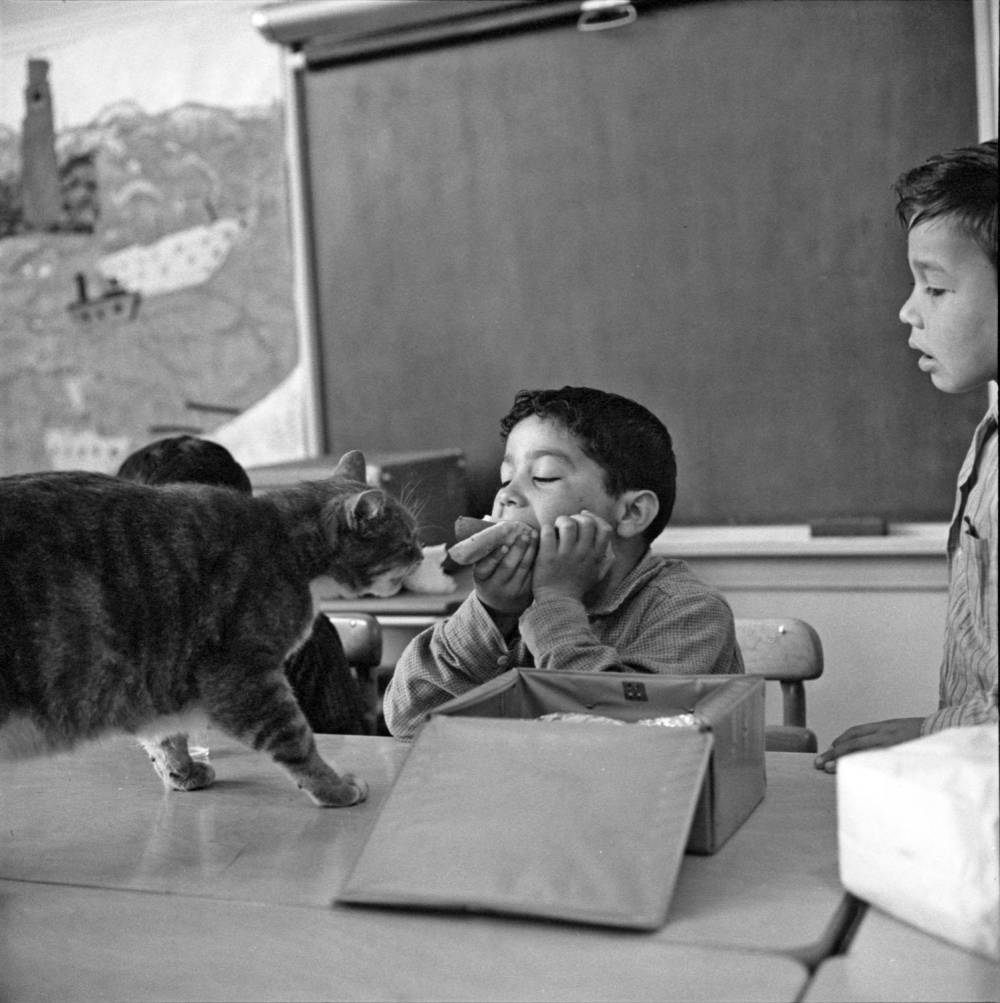
In our era of AI slop and desperate selfies, Hewett’s vintage photos feel refreshingly enigmatic, intimate, and poetic. Room 8 sleeps on desk as student draws (all works 1962), tightly frames the cat’s face. As in many photos, he’s napping, whiskers pointing to the ceiling, right atop a student’s worksheet. Attempting to color, the nameless pupil’s angelic face hovers above the cat’s, either mesmerized or resigned. In Room 8 eats lunch with students, the strongest piece in the exhibition, a boy bites into a hot dog while Room 8, on all fours, sinks her fangs into the hot dog’s back end. It captures the deliciously entitled attitude cats have towards humans, boldly eating from the master’s table without a second thought. Room 8 rests with students, shows three children arrayed on the floor, their bodies bordering the cat, all of them asleep. The tender photo evokes a childhood dreaminess, but I can’t help but read its darker subtexts. Society has always presented childhood as a playful period of learning, growth, and games, but it’s just as much one of trauma and nightmares. What are kids if not glorified pets, totally lacking in autonomy and freedom, subject to their owners (parents) whims? This noirish complexity animates many of the black-and-white photos in the show. Room 8 goes out a window follows the school’s janitor tossing the cat outside, where he was forced to return each day after the school closed. Unlike kids, at least Room 8 could rely on his instincts to kick back on when cast out into the world.
Still, by and large, the photos reveal Room 8’s privileged existence, loafing about and feasting on kids’ lunches. The photos give testament to Room 8’s appetite as he grew rather Rubenesque and corpulent from generations of student generosity.
“Time spent with cats is never wasted,” Freud is rumored to have said. Of all of humanity’s domesticated pets, cats, without a doubt, are the most maddening and bewitching. Their very domestication feels tenuous, like a lover with one foot out the door. Just like my childhood pet Marshmallow fled into the Kansas plains, Room 8 too lived half its life in the hills of Elysian Park. It’s easy to imagine Room 8 curling his tail around these young kids by day and then going feral after school, like my own boyhood cat, sadistically torturing weaker creatures for sport.
The tenderness of Hewett’s photos—their snug framing, creamy lighting, the street cat cozying up to squeaky clean cut ’60s kids—grows seedier by being on view inside the LA Library. One must descend into the Central branch’s lower bowels to visit the show, which unfolds along a single long wall in the Genealogy and History Department. Nearby stacks hold tissue copies of the Yellow Pages. Like many public spaces in LA, the library’s a de facto homeless shelter, daycare center, fashion runway, cruising spot, and insane asylum. And sure, some people also read books. But the library could not be further from the artworld’s museums, white cubes, or even its punky artist-run spaces. The contrast is stark. When I went to the bathroom, I stumbled upon a half-naked man smoking a cigarette. The Central Library is both full of books and an essential source of culture, but it’s also in its own way similar to the cat profiled in the exhibition: noble, but lurid and untamed. Showing the photos in such a context enhances their gauzy, soft-lit nostalgia (what could be more anachronistic than a library with photos from a long-since-dead magazine?). Yet the location and context also tease out the wildness lurking just beneath the surface of Hewett’s photos—and inside us as well.