

R. Crumb’s “tales” (even filtered through psychedelics and cannabinoids) weren’t always so paranoid—though they were frequently calamitous. The street-hip graphic domain Crumb freely improvised during the 1960s and 1970s across densely cross-hatched black-andwhite panels, was borne out of a counter-cultural stew as manic as it was laid-back—occasionally approaching the catastrophic—suggesting that paranoia was never more than one bad acid trip away. In the decades since those early picaresque romps and darkly surreal chronicles, human history has seemingly overtaken its potential for pathological distortion. It’s always worse than we think.
It is also frequently more complicated than we think. Crumb’s current exhibition at David Zwirner is essentially given over to the original artwork for the contents (and covers) of his latest Fantagraphics book, Tales of Paranoia, along with a separate Crumb Family Covid Exposé drawn and scripted jointly by Crumb and his late wife, Aline Kominsky-Crumb, in 2021, as well as a number of thematically related comic pages.
The trigger here is the COVID-19 virus, but more crucially, the vaccines for it. Crumb compulsively gathers facts, but even as he acknowledges the innate complexity of disentangling such a genetic puzzle—of vaccine synthesis—he remains inclined to attribute the lot of it (and certainly the public narrative around it) to all-encompassing conspiracy. What part of that adds up to paranoia? Or is Crumb just “BATSHIT CRAZY”—as he seems to inquire from the book’s cover, in one of his most densely crosshatched self-portraits to date, gazing over his shoulder at a cell tower with an almost palpable sense of apprehension?
The work is hung more or less sequentially around the walls of the second Zwirner gallery (at 616 N. Western), interspersed with recent portraits and studies (a few of which stand with his very best work). The title is blown up and fairly vibrating off the taxicab-yellow painted rear wall, and there’s a table of Crumb authored publications to actually sit down and read in the center of the gallery space. The show closes almost nostalgically with work scanned from a late-20th-century sketchbook and recent etchings from drawings. (A few from decades ago, including a great and thoroughly unforgiving self-portrait.)
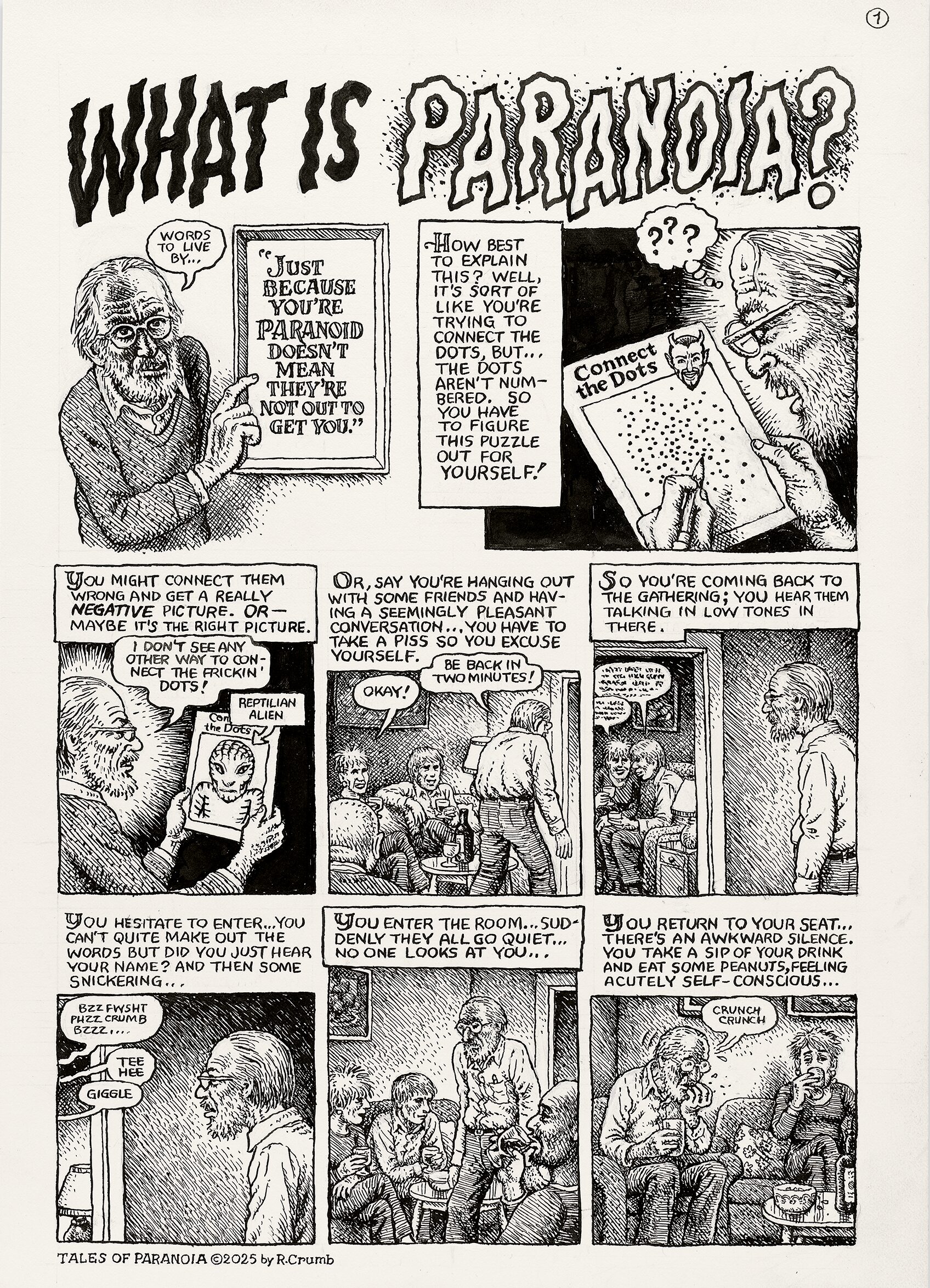
He introduces three characters of dubious origin, plus a more generic “Bunch”—standing in for the mass of conspiracy-avid and rabid ruminators and fabricators—to his Tales. They include a presumably medical “Doctor” friend, a “Deep State Woman” (based on an actual person—a distinguished Harvard-trained physician, former FDA Commissioner, and public health expert he chooses to leave unnamed), and a former would-be LSD guru/drug dealer, identified as Pete Cornell. But each of them is really nothing more than “triggers” for the presumably real panic that sets in as his sense of connection, control, and certainty slips from his grasp. This is concisely conveyed in just a few frames on the second page: a remembered domestic incident gone very dark and closing in on him as imagined prying eyes judge him from behind the black scrim of his imagination.
He doesn’t need his Doctor friend to bring the “informed” view, or even point out his paranoid tendencies (which, in preceding frames, he acknowledges are probably inherited). But the networked concentrations of government power, the “medical-industrial complex,” the pharmaceutical industry, and major financial institutions—all moving in concert at warp speed to bring the mRNA COVID-19 vaccine to market within less than nine months—are just a bit too much for this ever-apprehensive artist. We can almost hear the nocturnal wheels spinning: Forget about live markets or rogue labs! They were planning this!
The Doctor leaves the page, and Crumb retires to bed, which delivers the viewer/reader to a dimension both (graphically) new and very familiar. Expressions of frenzy are not exactly uncommon across the cumulative body of Crumb’s work. But with the lights out, Crumb renders himself in a state of terror approaching lupine transformation. The hatching is denser, darker—and he’s only just getting started. He pulls back only to home in on that most contemporary of settings: the Zoom/podcast-ready draperied office-study-library-living-room backdrop. His paranoia-adjusted narrative: “fear-mongering” intended to “neutralize” conspiracy-oriented and social-media propagated disinformation. He seizes on a Rand Corporation report to illustrate his point, becoming more aggravated with each frame, finally leaping from behind his desk to rage at the Rand experts’ idiocy. But two preceding frames, evocative of pre-21st century Crumb city street exteriors, have already short-circuited this rant—one more or less dismissing the utility of a coherent world view, the next bemoaning the “predatory universe” (featuring three “classic” 21st century urban “predators”: bespoke-suited “venture capitalist,” hoodied “drug dealer,” and iPhone-fixated “P.R. girl”).
Crumb offers a familiar-sounding caption: “Well, one unpleasant truth is, we live in a predatory universe, in case you haven’t noticed. Predation is just part of nature.”
The truth, of course, is that we live in an indifferent universe. The earthly biosphere, alas, teems with predatory species, none more so than our own at the apex of apex predators. Complexity—not nature, or even predation—is Crumb’s nemesis here. Crumb is on more secure ground, graphically as well as narratively, levitating in a nether-sphere of darkness, fear, and quiet desperation (that is to say, the human condition’s ground zero). He may be relatively unintimidated by the Covid virus, but confesses freely, “I’M AFRAID!”, eyes spiraling like pinwheels, comets (or cranial sperm?) of dread shooting from his sleep-tousled hair. Even from his idyll in the south of France, quotidian existential dread gives way to a dead of night fairly bristling with corpuscular dark matter (or is it just random high-frequency waves?) We have seen variations on this incarnation before—specifically in his treatment of LSD and psychedelic experience (which fittingly, he revisits in another sequence, “THE VERY WORST LSD TRIP I EVER HAD”).
In the sequence of pages that follow, he awakens from his visit with the “REALM OF THE BEAST” (closer in spirit to Blake than Sendak), to put faces to 36 of what must be an ever-growing roster of predators. They include those we might call “the usual suspects”—a certain tech mogul, President, trillionaire, etc.—and several less familiar specimens. Here, his focus shifts from “deep state conspiracy” to the not-unrelated phenomena of “playing the game” and “working the system”—a more complicated intersectionality with complexity; also, power structures and sheer coincidence.
Ultimately, Crumb remains more comfortable in the “realm of the beast”—whether the foibles and antics of human social behavior or human-generated mythologies—than the stationary stand-ups and headshots he’s given us in many of these pages. The portraits and character studies exhibited here give ample evidence of his nonpareil draftsmanship and undiminished illustrational power. Flipping through his sketchbook, it’s hard to resist the wish that he would once again unleash that virtuosity to play freely in that dangerously complicated world outside his studio.
For those of us who have never associated him with a religious belief set (The Book of Genesis to one side), the 21st century expatriate Crumb contradicts or at least qualifies this impression in two pages, “God help Me” and “I’LL JUST STAND AND WRING MY HANDS AND CRY,” in which a solitary stand-up Crumb, equal parts Marc Maron and Richard Lewis, vents to the void, “What IS it with the human race???” The void answers back—a puffball burst of light—“You’re DISTRAUGHT, which impairs mental clarity…” and leads Crumb through some controlled breathing. Crumb’s first expression of faith here and elsewhere is for his feelings. He can never break that. The indifferent universe (to say nothing of earthly power elites) may never “see” Crumb, but—in the uncompromising faith of his graphic tale-spinning—his readers/viewers will always feel him.