

Who could ask for anything more exquisite and tasteful than Nancy Holt’s rhythmic and spare documentary artworks, installed in R.M. Schindler’s Kings Road house, a place that LA loves to love so much? The land art goddess fits right in among its sun-dappled redwood joists and tilt-up concrete walls. But there’s a great big red herring in Holt’s work. The problem is with Sun Tunnels (1973–76), a monumental desert installation that is so well-known as to have become synonymous with Holt herself, to the detriment of the rest of her multifarious oeuvre, consisting of photo, audio, and smaller-scale installation work that is often stranger, subtler, and ultimately more profound.
Four twenty-two-ton concrete tunnels, lined up with solstice traversal arcs, perforated with holes in the shapes of constellations Draco, Perseus, Columba, and Capricorn, and plunked in a remote corner of Utah, Sun Tunnels makes an impression. But its hypervisibility is also partly explicable by its openness to misreadings as an interchangeable variation upon Minimalist-adjacent monumentality rendered yet more palatable by its added attunement with earth, light, and the universe’s other great woo-woo powers, without destabilizing the institutional and blue-chip commercial appeal of its Dia-core aesthetic (to coin a term for the repeated post-conceptual redeployment of the Big, Solemn Object. The Dia Art Foundation acquired Sun Tunnels in 2018 ). A passing glimpse at Sun Tunnels might easily lump Holt into a particular austere, late-Modernist formal language that proves eminently manipulable: think “Judd furniture” in Kim Kardashian’s house, or the watered-down minimalism that is now most familiar as corporate architecture’s lingua franca.
“Nancy Holt: Light and Shadow Poetics,” curated by Lisa le Feuvre and Beth Stryker, offers a small cross-section of Holt’s work at the MAK Center. The exhibition is installed in the Schindler House, an architectural landmark which has been subject to a similar aesthetic blur. For visitors to the house, or at least for Reyner Banham, the first and most often echoed thought is a wondering sentiment of primordiality: built “as if there had never been houses before,” in that LA mythmaker’s formulation, a quote that still takes up the whole front cover of the MAK Center’s visitor brochure. But this primordial fantasy oversimplifies and hinders appreciation of the house’s subtle syntheses of practicality and radicalism, its cost-saving innovative construction, seminally nonhierarchical plan, and life-shaping deployments of space architecture.
In much the same way, Holt’s work suffers from getting caught up in that sort of mysticism of the elemental sublime, which proves an untenable standpoint from which to appreciate her work or, for that matter, Schindler’s. For starters, there’s more than a light whiff of Californiaism that pervades the space—an exhibition about sunlight!—something that a non-believer at the time might have called “hippie shit,” and which today reads as a sign of the place and times, if a charming one. Holt’s 1920s were the 1960s; she practiced Vipassanā meditation though “not a Buddhist.” Which is only to say that even the most austere, the most monolithically self-contained artworks age too, and the traces of the passage of time—vanishingly faint though they may be—are almost always exaggerated by being set off against so pristine a concrete surface. To the same point, there’s an illuminating anecdote that the Kings Road house had, for a brief span in the 1970s, a pink tile kitchen installed by Pauline Schindler. A subsequent renovation replaced the finishings with a more orthodox palette of raw wood and magnesite. (Just for the record, I think I’d like the pink, but taste aside, the fact that it was changed back rings just a hair disingenuous. Let the place live!)
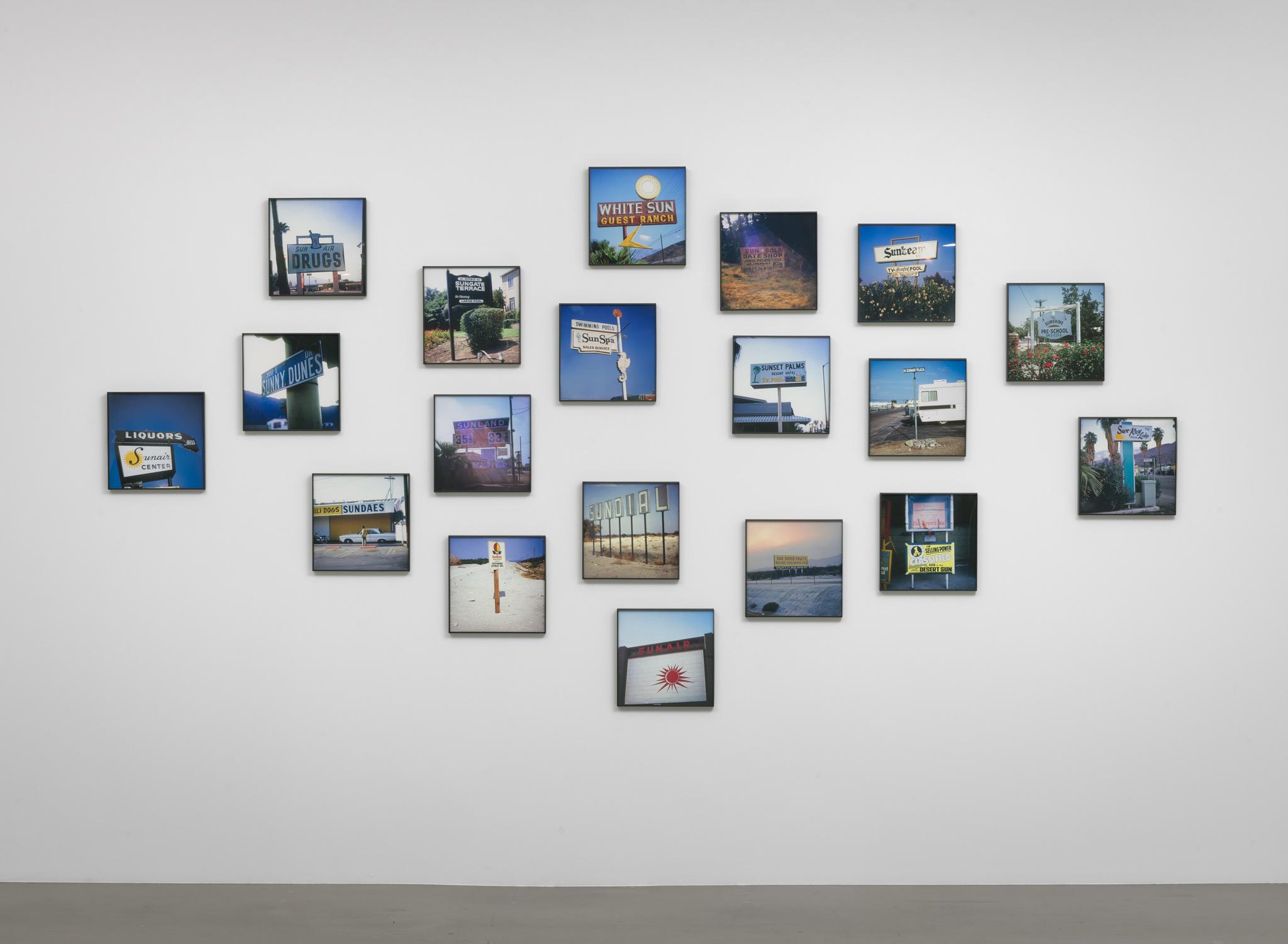
How to square the demiurgic creator of Sun Tunnels with the wit and patience of a series like California Sun Signs (1972), the present exhibition’s most resonant work? It’s an open-ended repetition of deadpan photographs of the word “Sun” sighted on California streetside signage: “SunSpa Sales Service,” “Sungate Terrace – No Vacancy – LARGE POOL,” “Sunkist – Grower Member,” “Sunair Center LIQUORS Deli,” ad nauseam. Sunlight never gets old, for the consumer or, therefore, for the advertiser who constructs our lived environment. Installed here as a cloud of prints on a single wall, Holt’s photographs cohere by their identical format and shot-from-the-hip aesthetic. They offer a unique vantage from their capacious pattern recognition and condensed presentation, the fruit of an immense patience that emerges, across the exhibition, as an identifying quality of Holt herself. What that affordance is, in this case, is a unique glimpse of what exactly the genericized American can be expected to do with the sun, that erstwhile ur-element: We yoke it to the hawking of our wares. Holt herself pronounces no judgment, but she holds up her camera and lets it be a mirror. The abstract invoker of the California sun’s prestige comes off a little petty and self-serving, venal humanity distilled to our venal core.
Holt’s prodigious attention is not medium-specific, and it translates well to an audio work, a 13-minute loop of one segment of U.S. 80 SOLO: NEBRASKA (1976–1979). The greater work consists of clippings of observations recorded behind the wheel on a four-day solo drive from Utah to New Jersey. She keeps her narration direct, dry—“Just passed Turkey Creek,” or “The grain storage places out here are much more impressive than the churches”—yet touching traces of her subjectivity cling to her words. The voice is hardly immaterial or disembodied; it has an accent that marks her gender, her regional upbringing, and her generation, a cadence that registers the ebbs of boredom and the necessary little enthusiasms of a road trip’s slow seep of novelty-monotony, and even a snippet or two of Willie Nelson on the radio. The work’s premise registers her ingenuity in devising new means to muster an ever-refreshed gaze on the world, and the American landscape in particular, as a nature-artifice coproduction. Thanks to the transparency and faithfulness of her means of representation, the narration offers insights that are as fresh today as they were in 1976. On top of this, not against it, we feel the presence of a Buddhist-leaning East Coaster who’d gone out West. Holt’s work doesn’t transcend the artificial or the personal. It casts it in crisp relief, and then it shows us where beauty really lives after myths are shed.