

DAY ONE
It is the cardinal sin of every writer who’s been based in LA long enough to wax poetic about the various versions of the city that seem to exist in conversation and contradiction with one another at any single point of time. A dilemma that filmmaker and film critic Thom Andersen more or less had the final say on when it comes to cinema through his, now canonical, essay film Los Angeles Plays Itself (2003), which posits that the city will always exist in a perpetual identity crisis because of how often its been remixed, redressed, deconstructed and destroyed on screen. Yet somehow it feels appropriate to exhume these questions about identity and depiction at a time where local film and television production seem to be dropping to historic lows with each passing day, with LA at risk of becoming the “Detroit of entertainment”. A development that seems to place somewhat of a blow to Andersen’s thesis: we can no longer understand the city that exists fetishized on our screens because it so rarely seems to even cross our screens. In this way the LA of today seems to rest far outside of the imaginary, crossing into far scarier territory that many are unable, or maybe unwilling, to confront, that the LA of today is the LA you actually live in.
Now in its third year the Los Angeles Festival of Movies has continued to give dimension to the fractured film culture that exists in the city, a condition that seems inconceivable in one of the few global hubs that seems synonymous with film, but which reflects a larger systemic failure to foster younger talent and more outre voices in an entertainment industry that continues to seem far more interested in venture capital money than actual artistry. In a call earlier in the day with an industry professional she remarked something to the extent of “Oh LA festivals are great, you have AFI Fest and um… LAFM”, the former known to host the premiere of films such as The SpongeBob Movie: Search for SquarePants (2025) and the latter mostly held at 2220 Arts and Archives. Just as alt lit and alt comedy seem to have coalesced around the margins of their respective industries, LAFM has created a similar platform for film, with incredible overlap between all three scenes. Perhaps this is best reflected in the tote bag that adorns the festivals merch stands which reads “Los Angeles Festival of Movies Remembers Taix, LA’s Oldest French Restaurant 1927 – 2026” a wearable memorial for a now bygone hub for LA based creatives who expect you to recognize them from their Instagram handles which has elicited all sorts of reactions from festival goers. “The reaction to the Taix closure is a pseudo event and anyone who cares sincerely about it should redirect this energy to something more important” opines archivist and actor Noah Brockman. “RIP Taix, OG fucking LA establishment, I don’t care what anybody says, I am entitled to feel sad about it” replies Tee Park (director of Cece’s Interlude) Everyone has their own version of LA.
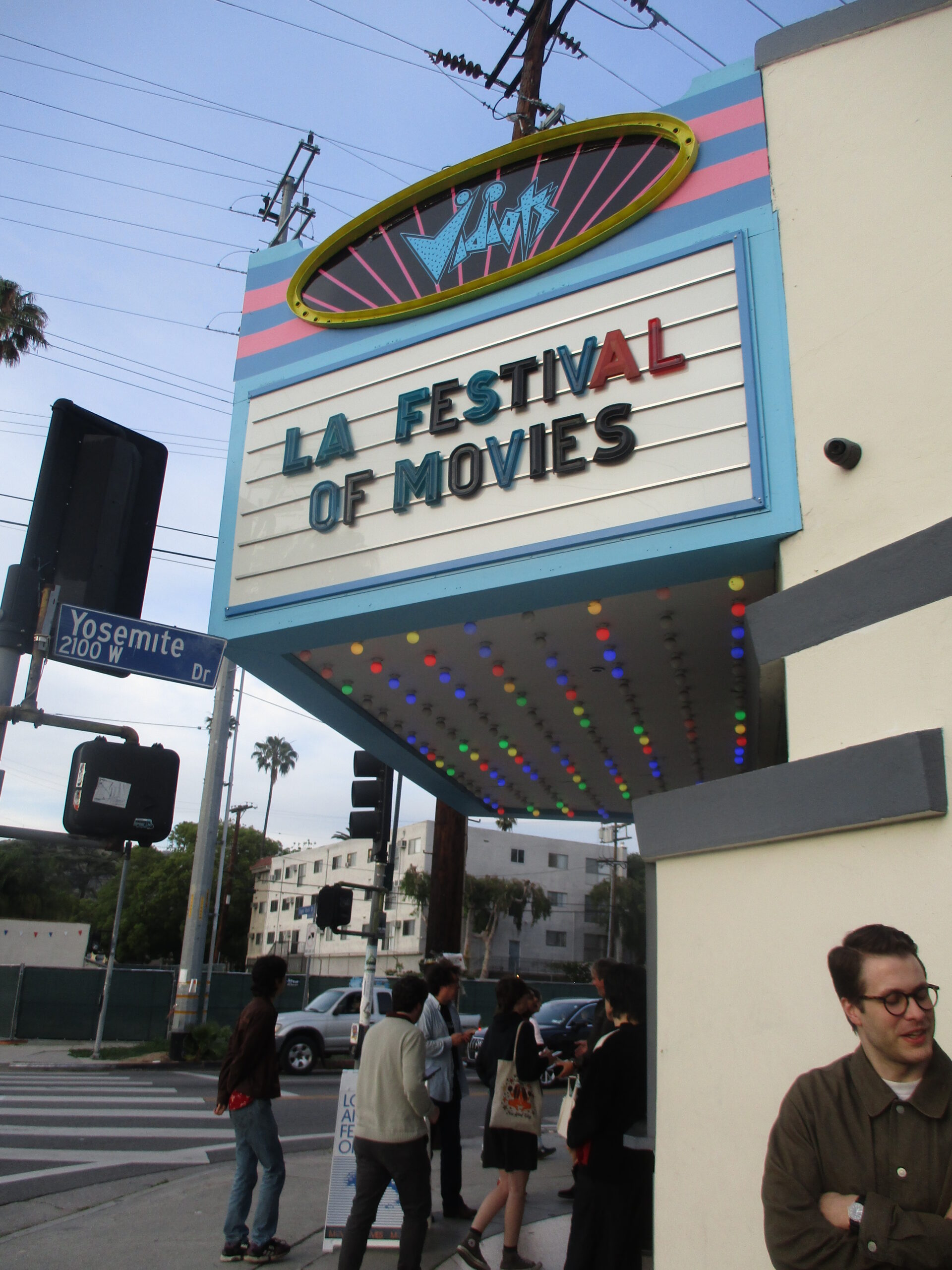
But perhaps the actual LA of today is better reflected in John Early’s Maddie’s Secret (2025), the festival’s opening film which had its US premiere at Vidiots in Eagle Rock last night. In its opening minutes Maddie, a bulimic aspiring cooking influencer played by Early jogs through Silverlake all the way to her dish washing job at the Gourmaybe test kitchen, a food content creation hub obviously modeled after Bon Appétit, before being greeted by her conniving boss Zach (played by Conner O’Malley) who screams to the staff “Who’s ready to make some content!”, a fitting reminder of what actually gets produced in LA.
With Maddie’s Secret, Early, an alt comedy mainstay best known for his surreal, wry sense of humor and, among other things, starring in cult streaming series Search Party, makes a prodigious leap into the world of cinema, flexing an emotional sensitivity and formal ambition that rarely coexists with the post ironic tenor of most contemporary alt comedy. Early’s film borrows liberally from the conventions of both 1950s melodramas, most notably the work of Douglas Sirk, and 1980s after school specials, particularly (and perhaps obviously) Kate’s Secret (1986), genres known to exaggerate and embellish but which, otherwise, were willing to tackle contemporary social issues in a straightforward manner. By drawing from these influences Early’s film defies easy expectations, of course it is a frequently raucous comedy but underneath it all what you’re met with is an extremely frank film about bulimia. Comparisons are bound to be made with Todd Haynes, who similarly recontextualized the melodrama and more broadly, the idea of the old Hollywood “women’s picture” as the domain of the queer filmmaker, with the piano stings of Michael A. Hesslein’s score in Maddie’s Secret being reminiscent of how Haynes deployed repurposed Michel Legrand compositions in May December (2023) Yet throughout the film I couldn’t help but be reminded of the work of British filmmaker Mike Leigh who made his name in the somewhat contradictory world of kitchen sink realism. Stylistically Early’s film couldn’t be further from Leigh, approximating the expressionistic visual language of Sirk, crafting various pillowy frames with cinematographer Max Lakner. Yet like Leigh Early possesses an overwhelming empathy for his titular character, going to great lengths to sketch out how their underlying condition colors how they perceive the world and how they exist within various different communities, from the Gourmaybe Test Kitchen to the Presbyterian hospital she undergoes bulimia treatment in. With both of these locations filled out by a who’s who of alt comedians, from a never been better Kate Berlant to a nervy Vanessa Bayer, characters who tumble through mentions of therapy apps, streaming TV shows and short form video content, as if they can understand themselves better, or maybe understand how they exist in LA, when they get out the other end.
It should also be noted that Maddie’s Secret marks the second time production company Dogma 3000, run by Harris Mayersohn and Danny Scharer, who both serve multiple roles on the film, have secured a major spot within the LAFM lineup, previously closing the festival with Conner O’Malley & Danny Scharar’s Rap World in 2024. The success of Dogma 3000 gestures towards the larger ethos of the festival, highlighting how independent producers can fill in the gaps of cultural production that larger studios have failed to satisfy, with Conner O’Malley’s comedy shorts, many of which hosted on YouTube shorts, becoming a mainstay for people of a certain age. A fact that was made clear to me when a blonde sorority girl with vocal fry told me that Conner O’Malley was as good live as he was in the YouTube shorts. That is to say that the work of Dogma 3000 feels uniquely resonant to Gen Z, a jaded generation who’ve grown up in a post modern culture, in part shaped by TV writers like Dan Harmon, where most comedy seems to operate under the smug assumption that everyone already knows every trope, and who’ve decided to instead find solace by blasting their brains with short form video content. In truth Maddie’s Secret is no different, as it operates with a full post ironic understanding of what it’s satirizing, but underneath this lies both a reverence and a pronounced sincerity, which in my eyes is worth celebrating.
Though it’s not lost on me that as film, not just in LA, but in the world has become more marginal, I’m writing to more and more of a niche audience, preaching to an ever shrinking choir. On Lyft to Vidiots I decided to listen intently to the radio and between The Kid Laroi and Justin Bieber’s Stay and Chappell Roan’s Pink Pony Club I was reminded that the weekend of LAFM coincided with another major event, Coachella, which may be one of the few monocultural juggernauts we still have, and which made my world feel all the more small. If you notice a dearth of young people at LAFM this weekend maybe you can find solace in the idea that they’re off somewhere hopped up on molly at Justin Bieber’s headlining set rather than thinking about what’s probably actually happening. At the LAFM opening party at Grand Star Jazz Club in Chinatown I asked one of the few partygoers my age if he was seeing any movies this weekend, to which he replied “Yeah I just saw The Drama it was awesome” and when I followed up about the actual festival he replied “No, what’s that”. And just when I thought that for movies and mega music festivals, only one of which people in my age bracket seem to really care about, neither the twain shall meet I look at my phone and discover the titular Digger, from Alejandro González Iñárritu and Tom Cruise’s Digger is at Coachella.
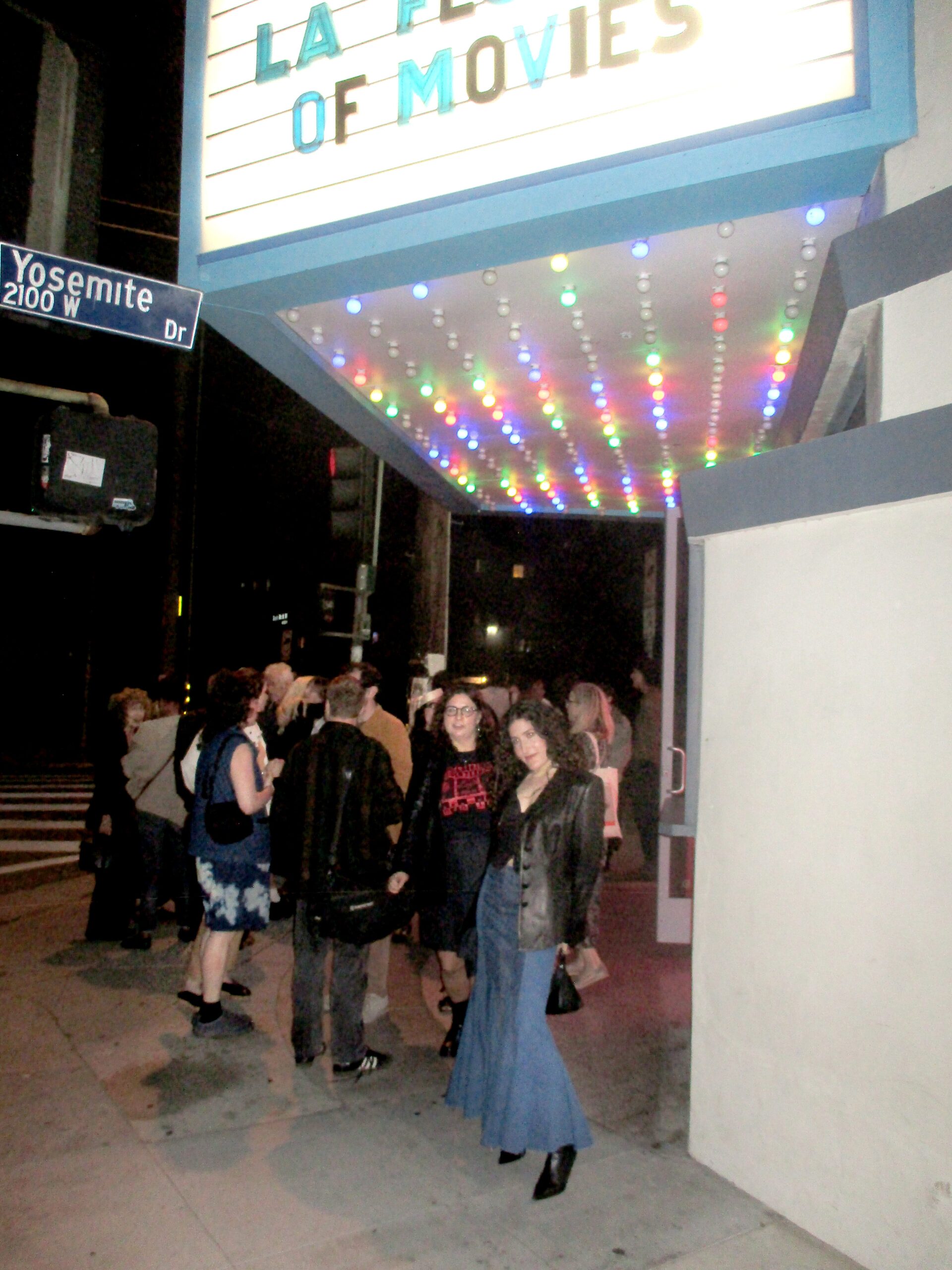
Kate Berlant at Vidiots
DAY TWO
For those reading these daily recaps for industry scoops and inside baseball indie film jokes rather than thoughtful cultural analysis I am happy to report that on the second day of the Los Angeles Festival of Movies I overheard Matt Grady, the founder of Brooklyn-based film distributor Factory 25 and bad boy of American independent film distribution remark: “Contrary to what people think, I like LA”. With that out of the way I was struck yesterday by both the diversity of programming this year and the festival’s continued commitment to platforming local filmmakers from many disparate, seemingly contradictory, circles within the city. An ethos best captured by a curio being sold in the lobby of 2220 Arts & Archives: an encrypted USB from new distributor Video StoreAge which carried the two films that premiered that day, Christine Haroutounian’s After Dreaming (2025) and Tucker Bennett’s In the Glow of Darkness (2025). Two films that could not be more different, the former an austere Armenian historical film which borrows from the tradition of slow cinema and structuralist filmmaking, the latter a cyberpunk comedy baked in the perma-fried visual language of the internet, with the only connection seemingly being that both filmmakers are based in LA. This unlikely double feature is indicative of the variety of programming one can encounter on an average day at LAFM, which, by virtue of having such a tightly curated selection, has forgone the tight parameters festivals today tend to organize films by, usually through vague selection titles like “Perspectives” or “Midnight Madness” which neatly demarcate exactly the type of film an audience member will see.
This approach to programming reminded me of a piece by Richard Lorber, the original bad boy of American film distribution, and head of Kino Lorber, and by proxy the head of streamer Kino Film Collection, this year’s festival sponsor titled “Launching Substack With a Controversial Take: Film Is More Than Storytelling” In his debut Substack piece Lorber embarks on a crusade against the idea that cinema as a medium is synonymous with linear storytelling, stating that “If that’s a filmmaker’s main creative objective it risks foregoing the greater non-linear sensory arsenal that can make a cinematic work a truly transformative experience.” Instead Lorber goes to great lengths to suggest how we should see films as Gesamtkunstwerk, a German term popularized by Richard Wagner referring to a total work of art that seeks to engage all of the senses, and a term that helpfully allows us to understand things outside of genre lines. Now I’m not here to play what is and isn’t Gesamtkunstwerk but I think I can safely say that all three films I saw yesterday were Gesamtkunstwerk, as works that defied easy categorization and presented fresh modes of expression.
The first of which was Palestinian filmmaker Kamal Aljafari’s With Hasan in Gaza (2025) which had its West Coast Premiere at 2220 Arts & Archives. Aljafari’s film presents three mini DV tapes found from a trip to Gaza from 2001 around the second Intifada and follows the loose narrative of Aljafari searching for a man he met in prison as a teenager. In an introduction by comedian and former director of USC’s Middle East Media Initiative (MEMI) Hisham Fageeh he made sure to stress that With Hasan in Gaza is, by definition, a found footage film, a mode of filmmaking he contextualized within the genres of comedy and horror, tracing its origin to Cannibal Holocaust (1980) and This Is Spinal Tap (1984). By situating the documentary in a familiar strain of mainstream filmmaking Fageeh did not just call upon the audience to separate genre from medium but made them aware of the affective modes in which they view a film, suggesting that found footage usually tends to require active participation from the viewer in disentangling real from fake which creates a sustained tension. Though with regards to With Hasan in Gaza Fageeh’s statement seemed more so aimed at wresting the viewer out of the complacency that usually comes in hand with watching archival material, particularly the, at times, disempowering feeling of viewing a static document of the past, especially in the context of Gaza where one is fully aware of the devastation that is to come. In this way Aljafari’s film operates not just as an invaluable document of quotidian life in Gaza, one that could have only been facilitated by developments in consumer grade digital cameras which made depictions of the quotidian accessible in the first place, but as a very direct representation of how Israel has continued to systematically destroy Gaza and dehumanize Palestinians, rendering the city, as Aljafari declares, the world’s largest prison. Fageeh also made sure to note that what the film captures is a Gaza right before the start of Israel’s blockade on cement and we bear witness to the ways in which Israeli forces dismantle domestic infrastructure which color the edges of everyday life as a family lays out pieces of shrapnel found in their roof for Aljafari to film. Aljafari’s film, in essence, not only serves as a memorial to a Gaza of the past but a document of the horrific cyclical violence Israel has continued to enact on Palestinians for decades with very little recourse.
Following With Hasan in Gaza I caught the U.S. premiere of Armenian American filmmaker Christine Haroutounian’s After Dreaming (2025), an elliptical road movie that begins in a familiar mould, with a setup that recalls Terrence Malick’s Badlands (1973) and repetitive, regimented imagery reminiscent of Claire Denis’ Beau Travail (1999) before letting of the reigns of narrative altogether and pushing everything to a point of abstraction, a beguiling turn which made the work feel wholly original. The film opens in the aftermath of an unspecified war in Armenia as a young soldier is tasked by a family to flee with their daughter. Though as the film progresses this inciting incident begins to feel more like a pretence to explore imagery that underlies the Armenian imaginary, of marriage, war and family and of disappearance and recurrence in a country marked by constant destruction and reconstruction. As a member of the Armenian diaspora in Los Angeles Haroutounian’s relationship with the country’s history seems to similarly rest in abstraction. In a Q&A with filmmaker Courtney Stephens, Haroutounian stated: “You just hear about the war. And in a way, it’s like the memory of the gulag outlasts the gulag. When the place itself that you’re calling into question seems like it may not be there tomorrow, or whatever remains is part of a larger whole that was taken during a genocide. I’m just using the fragments” Haroutounian’s approach points towards a mode of diasporic filmmaking as obsessed with the texture of second hand memory, both unreliable yet undeniably potent, as much as it attempts to understand the motherland firsthand. To achieve this Haroutounian and cinematographer Evgeny Rodin craft a very specific visual vernacular, one obsessed with imprecision and indeterminacy as every shot seems to be in the process of inching towards focus, an effect that Haroutounian stated was conceived through a “detached photo lens that we were holding in front of the body of the camera.” offering a physical dimension to the filmmaking process despite shooting digitally. The most memorable sequences in Haroutounian’s film seem to move even further beyond the usual reference points of contemporary arthouse filmmaking and into the wheelhouse of structuralist film as we are met with seemingly endless tracking shots moving between doorways and a disorientating rotating landscape akin to Michael Snow’s La Région centrale (1971). Yet the film’s centerpiece is undeniably a continuous, prolonged unbroken shot of a band performing at a wedding which transitions into an equally hypnotic dance sequence centring on a tower of soldiers, moving in sync one stacked on top of the other as the camera spins around them. Just as Haroutounian finds a way to lose herself within images of home, both real and imagined, the audience is invited to wander in the morass of movement and texture.
Though if you’re going by optics alone, the real triumph of the day was the West Coast premiere of Tucker Bennett’s In the Glow of Darkness (2025), which was the most full I’ve ever seen the 2220 screening room. For years Bennett has been a mainstay within the DIY LA filmmaking community, producing various low budget experimental films like Planet Heaven (2019), being known for his hyperkinetic one of a kind editing style, which he has leant to other productions like Eugene Kotlyarenko’s The Code (2024). Though In the Glow of Darkness represents a remarkable leap in his filmography as a bona fide ensemble epic which juggles dozens of characters and plotlines throughout its 80 minute runtime. It is hard to describe the plot of In the Glow of Darkness, in fact they were giving T shirts to anyone who could, but broadly speaking it follows the various residents of San Zokyo, a dystopian future city of mid rise apartments and crummy AI advertising (which just so happens to resemble contemporary Los Angeles), as they navigate a hyperreal world of capital run amok and corporate overreach intertwined with a deeper conspiracy revolving around a drug called meme, ingested via QR codes, which features unskippable ads before trips. It is fair to say that out of any film at the festival In the Glow of Darkness most deserves the title of Gesamtkunstwerk.
Bennett had written the script for the film a decade prior and had spent the time since piecing it together, stealing shots when he could and slowly assembling his ensemble cast. He was initially put off by how unachievable it seemed in scale but had the fire reignited at him by the omnipresence of mid rise apartment buildings, as he stated to me “Every time I see these buildings I’m like, damn it. Someone’s going to get to that idea before I do” As opposed to most films about contemporary life, which feature such long gestation times that they appear irrelevant the second they release, Bennett has made a film that feels completely in line with our current moment, with an editing style that moves at the speed in which we consume brain rot and a deep understanding of the ways in which the world has been designed for efficiency rather than pleasure, a thought process that accounts for the mid rise apartment as much as the glut of AI generated content we view daily. Bennett’s filmmaking model reflects what has quickly become the de facto mode of production for many independent filmmakers in LA: of weekend shoots that can span years, run and gun on the go shots with no concern for permits, strange plasticky locations from Peerspace and continued collaboration with a whole community of friends. Bennett describes the filmmaking process of being akin to a Katamari ball, one that keeps on rolling as “you just go and collect weirdos. The true freaks find their way to each other. They’re either on a wavelength or they can just smell each other in the wilderness.” Which accounts for the film’s expansive ensemble cast which ranges from long-time collaborators like Groovin, Bennett’s own brother Lucas Bennett, local filmmakers like Devon Daniel Green, alternative musicians like Matthew Danger Lippman and film students like Kabir Malhotra. One such weirdo (I can request to change this in print if he complains) was producer Adrian Anderson (writer-director of Pomp and Circumstance) who had met Bennett at repertory screenings throughout LA and became inspired by his ingenuity and DIY spirit. As he put it succinctly: “Tucker is my sensei”. In a city where aspiring filmmakers seem to be constantly stonewalled in their careers, whether from a lack of funding, a lack of opportunity, a lack of time or a lack of institutional recognition Bennett offers a refreshing alternative model, that, if you have enough of a drive, you can quite simply just make a movie.
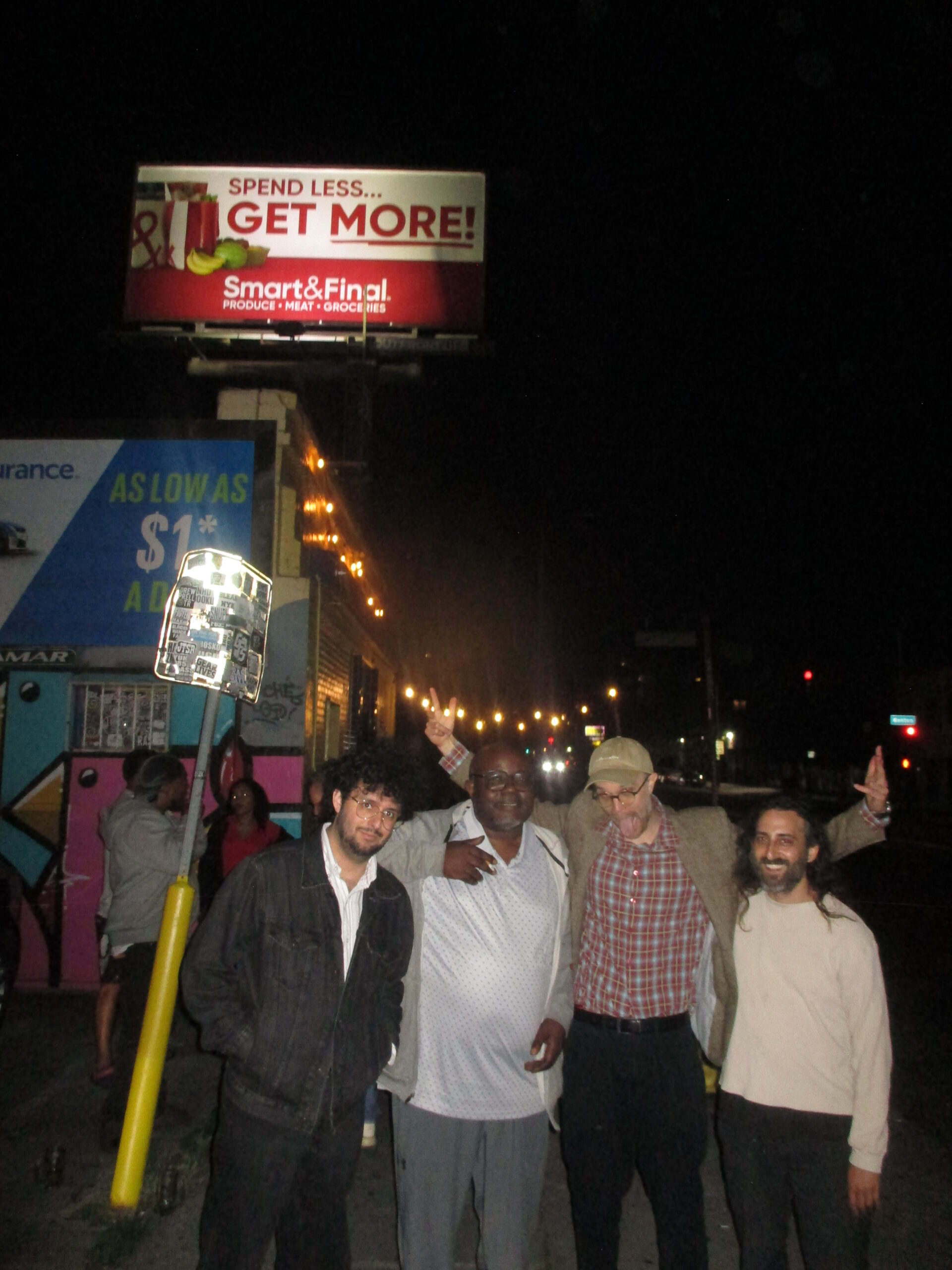
Tucker Bennett, Adrian Anderson, Groovin and Zach Shipko from In The Glow of Darkness.
DAY THREE
At this point questioning the waning relevance of cinema in the popular consciousness feels like beating a dead horse, with the inevitable answer always being some combination of decreased attention spans via the instant dopamine hit of social algorithms and the convenience of streaming, which has excised the idea of physically going to a theater from the minds of many altogether. Which feels strange to me at a time where the boundaries between avant garde and mainstream feel more porous than ever, with even Justin Bieber engaged in an experimental multimedia performance on the Coachella main stage, pantomiming to YouTube videos in a performance akin to Zia Anger’s My First Film. In any case for many festivalgoers a place like LAFM can seem like a thoughtfully curated oasis in a desert of slop. Which may especially be the case this year since many of the film workers I’ve encountered in the past couple days seem to be working almost exclusively on “Verticals”, a word usually uttered with some ounce of shame. Verticals, or rather microdramas, have seemingly absorbed the many disenfranchised film workers in the city at a time where local production has hit an all time low. With mega Chinese companies pumping millions of dollars into these one minute non-union productions, crafting algorithm friendly tales of cheating billionaires and steamy werewolf romances. A whole system which, from a distance, reads like a cruel and unusual punishment for Americans who’ve held onto their soft power cultural hegemony for too long, with aspiring filmmakers in LA now forced to create content in a black box for streaming apps they’ll never see and for bored retail workers in Southeast Asia to watch.
In this way it seems like the term “Vertical” has morphed into a shorthand for a sort of sloppified anti-cinema which has replaced actual film production. Which is why I’m happy to announce that my first film of yesterday, Frédéric Da’s Isaiah’s Phone (2025), which had its West Coast premiere at 2220 Arts & Archives, may be the first great vertical (or at least predominantly vertical) film. Da followed an unconventional path towards filmmaking, teaching film theory and production classes at New Roads School in Santa Monica before finding a way to incorporate his profession into his personal practice. The result was Teenage Emotions (2021), a verite style work shot entirely on iPhone which captures various conversations between his actual students. A film which can occasionally feel like a miracle to watch as it comes so close to directly scraping reality, depicting uncomfortable adolescent experiences that we tend to make ourselves forget and which, probably for that reason, we rarely see depicted onscreen. With Isaiah’s Phone Da brings his filmmaking practice into fresh, genuinely dangerous territory. The film begins with a disclaimer that what we are about to watch are videos from a phone seized by the police, which was owned by a boy who captured an act of violence and what follows is a new type of coming of age film, one entirely constructed from “found footage” diegetically shot on an iPhone and one fully immersed in the socially maladjusted perspective of its title character played by Isaiah Brody.
The setup of Da’s film recalls the violent alienation of Gus Van Sant’s Elephant (2023) or Larry Clark’s Ken Park (2002) though in practice the film more so resembles the work of The Dardennes or Lukas Moodyson, being fiercely committed towards understanding its title character through an empathetic lens. Though from the initial title card I was immediately reminded of the fatalism of Robert Bresson, with the foreknowledge of catastrophe coloring every scene in the proceeding work. A comparison that Da himself echoed to me, bringing up Bresson deep cut A Gentle Woman (1969), stating “He tells you that she committed suicide at the beginning and you see the entire thing leading up to it, it’s a very similar movie” Though to Da the disclaimer seemed to have more of a practical use: “If you’re not into the movies or you don’t know Teenage Emotions or anything like that a lot of times you’re going to think. Where the fuck is this going? So it grounds you a little bit”
Da’s candid, laid back attitude, which I gleaned from our interview, seems to have endeared him to his students, many of whom were in the film and who milled around our conversation. It was, frankly, uncanny to see so many teenagers seemingly moulded into devoted cinephiles by a particularly effective high school teacher, including actor Max Vadset who wore a hat brandished with the title of Abbas Kiarostami’s Taste of Cherry (1997), though these relationship Da has formed seem to be the cornerstone of his unique production model which operates on a level of mutual communication and respect. To build the performances Da would go back and forth with the then 16 year old Brody, who also served as the film’s cinematographer, assessing iPhone footage through DropBox and selectively adding and excising detail in a process Da compared to writing a screenplay. This modular approach to performance is wholly unorthodox, one that Da attributes the success of which from the fact that he knew Brody “from fifth grade, sixth grade, seventh grade, eighth grade, ninth grade and we did this when you were in 10th grade so there’s five years of knowing him, his family, his sister”, a sentiment echoed by long time student Brody who stated “I think he recognized that at that sort of point in my life I was really looking for a way a way to prove myself and you know a way to put myself out there” Though Da made sure to note: “I would still argue like that is not Isaiah in the movie, that is not the guy you have in front of you, the wonderful Isaiah Brody, in the movie. That is a performance, keeping the names is also part of it but there’s some trickery in there” And the proof is in the pudding in Brody’s unnerving, resonant performance, which seems to synthesize the strange adolescent neuroses of director and actor.
My final question to Da was admittedly lighter as I pointed out his beat up Yeezy Waverunners, asking if he made a point to, in words his students may understand, stylemogg his students. To which he replied: “My relationship is them just making fun of me most of the time”, recalling a time where he came into class in grey pants and grey sweatshirt, which made a student comment “Nice groutfit Fred”
My evening ended with a first for LAFM with a series of shorts guest programmed by Creston Brown under his screening series Presidium Overactive. If you’ve attended any screening, party, social gathering etc within or adjacent to the LA independent film scene you’re more than likely to have encountered Brown who has become somewhat of a figurehead within the “scene”, a title which may seem embarrassing to some, necessary to others. Though it is hard to deny that Presidium Overactive has become a staple in the community as a place to platform daring, unconventional work from local talent. Last night’s screening was no different as Brown presented 6 shorts which ranged from convincingly eerie (Conor Scheinberg’s Hollis), slightly groanworthy (Josephine Decker’s A Stable Marriage) and concerningly expensive (Alex Pabarcius’ Code Rouge, but more on that later) With Brown himself bookending the block with live skits involving a preshow encouraging jacking off in the theater, confetti cannons, overzealous New Beverly programmers and the world’s longest standing ovation for a short film.
When asked about his approach to programming and how it contrasted with LAFM programmers Micah Gottleib and Sarah Winshall, Brown remarked: “I understand the intent of the festival to be platforming filmmakers that have international releases or have their shorts showcased in other like, you know, screenings abroad, but we have so many talented and gifted filmmakers here that are looking for a platform that can truly present their work in a way that is absolutely transcendent. That was the mission that I initially had with doing my own screenings at Presidium. To elevate work that I found to be incredible and really make something memorable for an audience.”
Brown’s mission is valiantly anti-slop, and more than many programmers focused on ideas of prestige and institutional significance, he seems to be more so engaged with trying to highlight the communal aspect of moviegoing, which has been lost post pandemic, stating: “I have to take into account how these films play in a live audience setting. I think that a lot of programs that I see their weaknesses are that they don’t provoke audience reaction. And I feel like that is so much of what movies are. It’s provoking that audible response. It just heightens any experience in a cinema, right? Having this, like, oh, holy shit, like, this is an amazing just, like, I’m experiencing something with a collective body, right?”
By the end of Brown’s programme I did admittedly feel worn down by the quick cut editing style and faux-sexual provocation of most films selected (though that’s not to say some of them didn’t have real sexual provocation) But I nonetheless felt grateful that the block existed in conversation with the rest of the festival. We could all stand to loosen up a whole lot more. The one film that did stick with me however, in the sense that it raised more questions than answers, was Alex Pabarcius’ Code Rouge which packed more in 26 minutes than most features do over a 2 hour run time and which spanned 3 global cities from Shen Zhen, Paris to LA. It is hard to give a logline to Pabarcius’ film which moves at a speed faster than most people can think, but roughly, it follows a gym bro in Shen Zhen who has a crisis of confidence in a city that seems to exist without a past. Pabarcius’ maximalist style evokes The Daniels (a comparison that can read as negative depending on how you see it) and Stephen Chow (mostly positive) with the sheer density of visual gags he packs into every scene. Though what stuck with me was the scale of the project, filming in 3 different countries with heavy VFX in every shot, which suggests a sort of, typically incredibly costly, ambition that many would never consider devoting to a short film.
Though speaking with Pabarcius, I was regaled with the story of the film’s production, which spanned 6 years and started with a stint working at a production company in Shen Zhen, filming roadblocks during the pandemic and 2 years of post production work. One anecdote that stuck out was one regarding the decision to film in Paris (Nicolo Baravalles suggested this), which occurred because of an inability to shoot in China. Because so much of the film takes place around a faux Eiffel Tower in Shen Zhen’s Window of the World theme park (also featured in Jia Zhangke’s The World), Pabarcius crew suggested: “There’s lots of footage of him around the Eiffel Tower talking about Paris. And it was one of those things where I was like, that’s so crazy It might just work. And anyway, managed to find people in Paris who saw the possibilities and managed to get a visa for the actor who had never left China. He was street cast. And we put together this like ragtag production with no money and were able to get him into France. And that was a very chaotic experience.” The time and logistical finesse Pabarcius and his crew put in speaks to the sort of single minded ambition, which can easily be confused with Marty Supreme (2025) style lunacy, that gives life to independent cinema which we’d be nowhere without.
It must also be noted that Pabarcius’ film ends with a commercial for something called “Trove” which I was informed was his own new streaming platform for short films meant to fill the void Vimeo staff picks left behind. Or in his own words: “All of the short form platforms are built to be free because they make all of their money off of ads. And it creates this whole problem with the incentives where it’s about quantity of videos, not quality. If you want to build an audience as a creator, you have to keep posting and performing for the algorithms. And it doesn’t matter if it’s good or bad. It just matters that people watch the ad before it. And we’ve expected all this stuff to be free. But like it’s valuable and has value and artists should be able to price their work and earn from it. I mean, we have that with music, with Bandcamp, writing with Substack, podcasts with Patreon.”
It goes without saying that I appreciate Pabarcius’ crusade against slop. But only time will tell if people would rather watch Trove or the new Dramabox microdrama where the billionaire CEO’s son cheats on one of the AI fruit ladies.
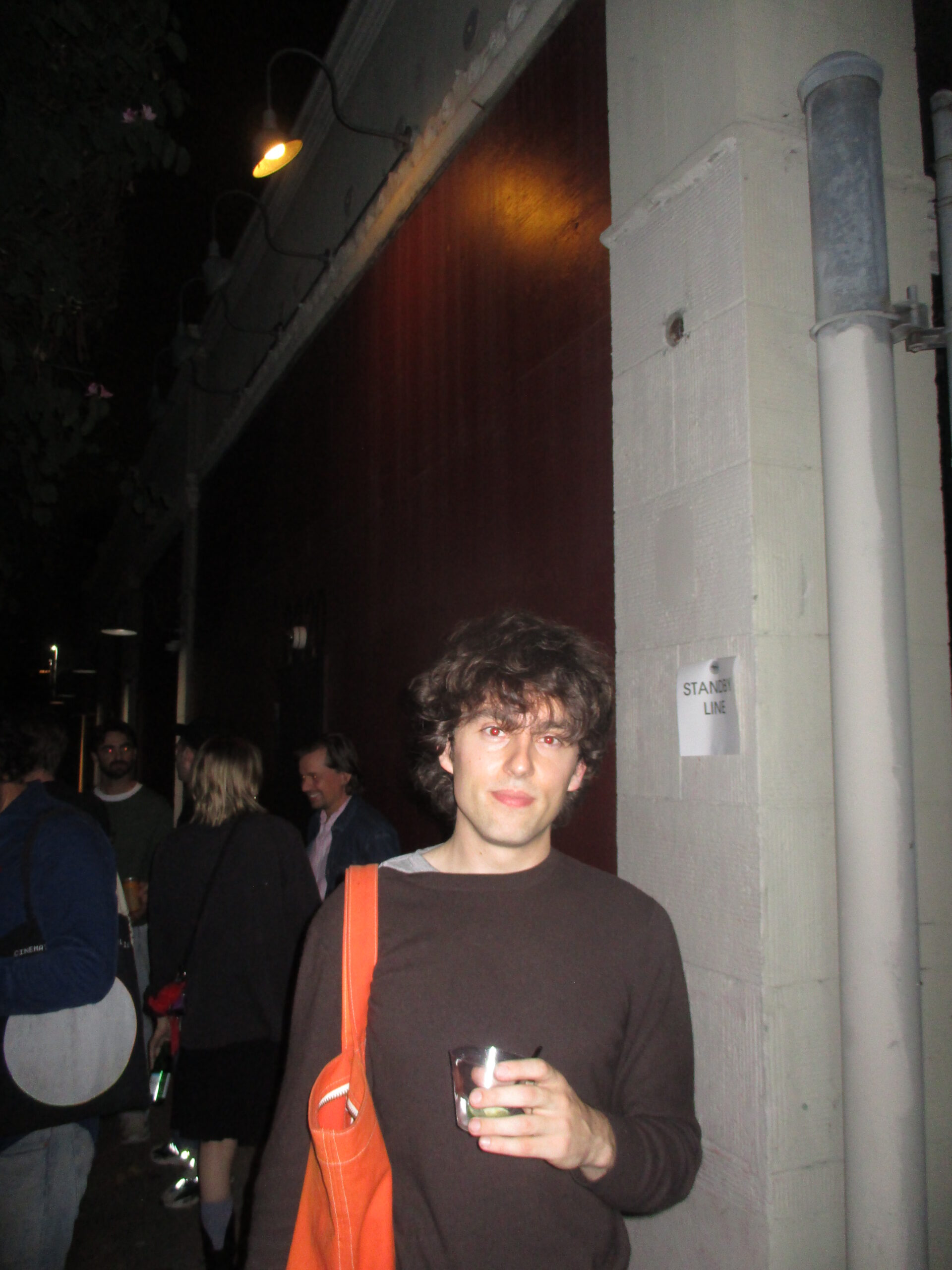
Alex Pabarcius
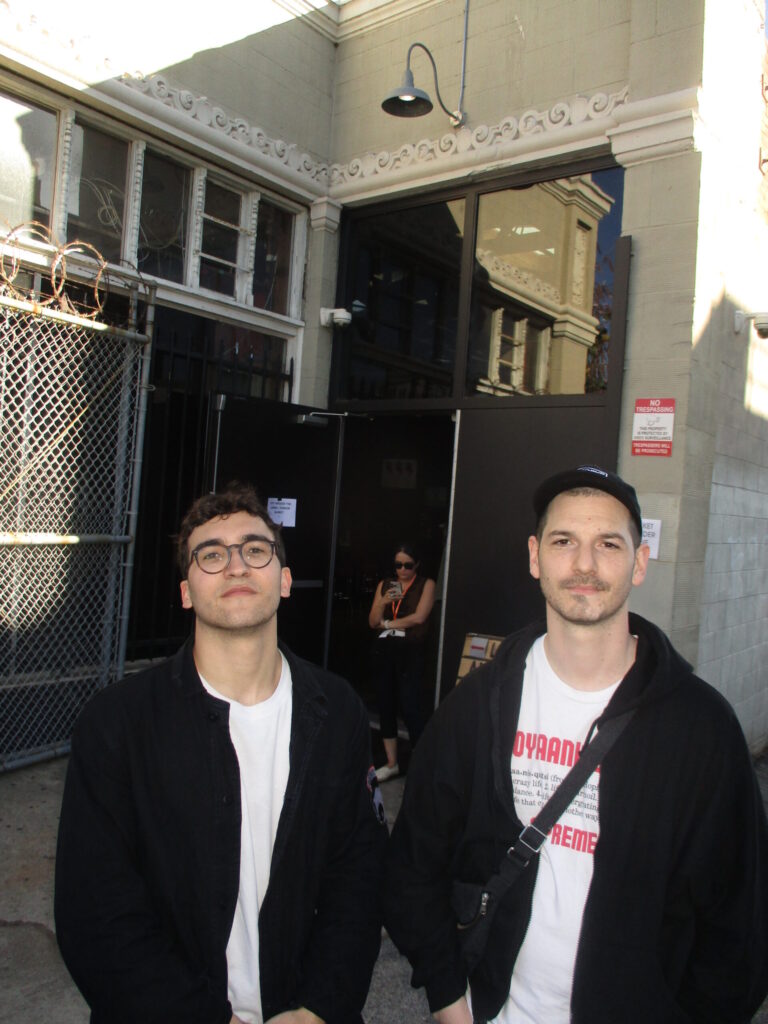
Isaiah Brody and Frederic Da
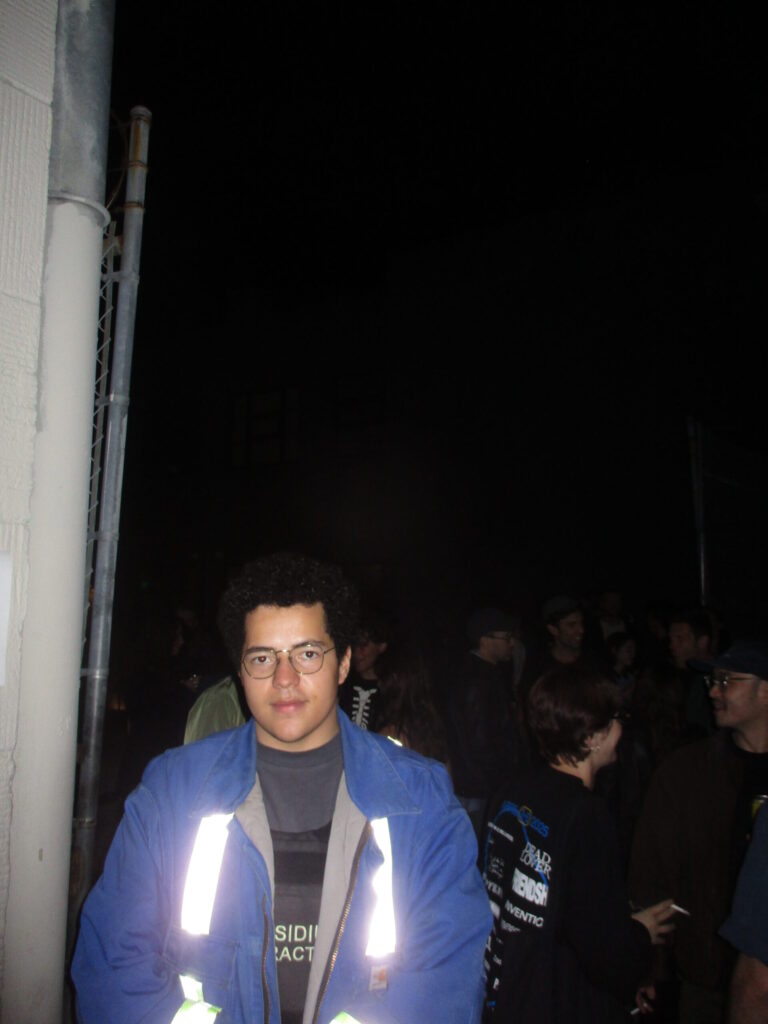
Creston Brown
DAY FOUR
It is sometimes hard to see the forest from the trees when attending a film festival, especially one as compact and community driven as the Los Angeles Festival of Movies. The concept of festival hype is one frequently discussed within cinephile circles (though the past couple days have convinced me the term cinéaste doesn’t feel as dirty coming out of your mouth as cinephile), the idea that the bubble of exclusivity and the general air of mutual enthusiasm for cinema concentrated in festivals tends to make one overrate a film. The sort of mutual delusion that made Jacques Audiard’s Emilia Perez (2024) a triumph at Cannes and an immediate object of ridicule once it broke containment when it hit Netflix. It is nice, however, to sit in this bubble and pretend that everyone cares as much about cinema as you do, which these days tends to be as far as possible from the truth. The morning after the last night of LAFM I was met with a rude awakening when I sat down to read the trades, which, as the trades tend to do, were locked into panic mode with headlines about studios courting Saudi Arabian money and updates from CinemaCon, the largest trade show for movie studios, wherein Sony CEO Tom Rothman remarked that their strategy for theatrical moving forward was “Longer, Shorter, Cheaper”, each word seemingly contradicting the one before.
The world of cinema seems to exist today in extreme, polarized, states, between the mega studios, which have historically formed the backbone of Los Angeles, who view theatrical exhibition as something in a state of perpetual existential spiral and well, actual filmmakers, for whom what seems to matter is the ability to get funding for any project whatsoever. What a festival like LAFM seems to really get about moviemaking in Los Angeles, and broadly moviemaking in North America, is that, on a local level, it has almost nothing to do with big business and industry. But the unavoidable question when it comes to cinema will always be about financing because it is, and probably always will be, incredibly expensive to make a movie. Which brings us to the Saudi Arabia of it all, as studios seem more than eager to accept money from a territory desperate to expand their portfolio and entertain their restless masses, regardless of their many well documented human rights violations. In a world where it seems like there’s perpetually less and less funding for the arts it stands to reason that many are not in a position to be so picky. Though the larger dilemma around accepting money from less than perfect sources will always be whether it can sit right with your conscience.
A dilemma that LAFM itself had to field when it dropped last year’s presenting sponsor Mubi, which had an incredibly public PR crisis over its $100 million investment from venture capital firm Sequoia Capital, which also invested in Israeli military startup Kela. In its place is Kino Film Collection, the streaming service of Kino Lorber, one of the most prolific arthouse distributors in the world, and whose primary investor GF Capital Management & Advisors, LLC seems to predominantly have a stake in skincare and Italian luxury handbags (though in the web of global capital there is inevitably something to pick on).
When asked about their partnership with LAFM, Alicia Lu, Senior Director of Partnerships and Creative Content at Kino Lorber had this to say: “We love LAFM’s mission, ethos, curatorial vision, and programming. It’s totally aligned with Kino Lorber’s mission and the curatorial vision and programming behind our streaming service, Kino Film Collection. Some of the stuff that Sarah and Micah have said about the festival—“everything is carefully curated,” “intimate stories that are trying something new in their storytelling,” “a healthy balance of international arthouse and US indie”—these are all things that you could say about Kino Film Collection too. So when we heard that LAFM was looking for a new sponsor, it just made a lot of sense for Kino Film Collection to be the festival’s presenting sponsor.
Kino Film Collection champions independent film and filmmakers, we’re always on the lookout for emerging voices from around the world (who often go on to become the next big thing), and we champion restoration of repertory classics. We know that LAFM audiences are adventurous and our streaming service is for adventurous movie lovers. We are curated for the curious”
There is perhaps, something reassuring, that despite all the head space I have devoted to corporate jargon and international investment one of the best films I saw at LAFM was a genuine miracle of microbudget filmmaking, that being Avalon Fast and Jillian Frank’s Drinking and Driving (2026), which had its world premiere at 2220 Arts & Archives on Saturday. In recent years it has become abundantly clear that some of the most daring and vital indie cinema is being produced in Canada, a notion more or less formalized within cineaste circles by the rapid popularity of Louise Weard’s Castration Movie, which Fast also features in, and which has managed to gain the approval of institutional gatekeepers, being programmed on the Criterion Channel despite its gargantuan 5 hour runtimes and lo-fi presentation, being entirely shot on Hi-8 cameras. Everything about Castration Movie feels antithetical to notions of cinematic propriety peddled by US institutions like Sundance, and it is precisely because of its form that it’s able to capture an unvarnished rawness in its depiction of trans lives, the same rawness that Fast and Frank tap into in Drinking and Driving which was shot on a Canon handycam. At only 26 Fast has amassed a prolific filmography with 3 feature films under her belt, specializing in what she refers to as “Girl Horror”. Her prior two films Honeycomb (2022) and Camp (2025) took on a more explicit genre bent, being preoccupied with the spectral and occult, but with Drinking and Driving, which also serves as Frank’s feature debut, both Fast and Frank look inward, crafting an autobiographical hang out movie which speculates on what their lives would have looked like if they never left their hometown. The film follows Iris (played by Frank) and Palmer (played by Fast) two aimless twentysomething year olds who spend most of their days wandering aimlessly around their small town looking for new ways to get fucked up, they encounter Levi (Ethan Hawksworth) who has returned home from the city to get some distance from his troubled mother, and from there a love square of sorts forms between them and Levi’s cousin Phoenix (Henri Gillespi), trapping everyone in a phantasmagoric web of tender emotions and imprecise feelings.
Whenever I encounter a film made by someone in my age group there tends to be some trepidation, because, by virtue of youth, or rather by virtue of the stunted maturity informed by losing 2 prime years of socialization to the pandemic, very few young filmmakers seem to possess the vocabulary to clearly articulate the complexities of their experiences, defaulting to an irony that suggests a permanent embarrassment at having to live in the world today. Drinking and Driving, however, manages to unearth a very specific resonance latent to said experiences, capturing the dissociative social isolation characteristic of Gen Z, for whom no better future seems to be promised. It’s maybe the only film I’ve seen that truly understands the feeling of being at the party for too long, of your mind buffering on the come down as you begin to wonder why you even went out in the first place.
It is this idea of stunted adolescence that served as the genesis of Fast and Frank’s film, one which was conceived, as recalled by Frank in our interview: “In winter 2023 we started thinking about it. We had both been living in Vancouver for quite a few years at that point and would pay visits home, you know, separately or together. In that town, there’s no bar except for a strip club. It’s the only bar that exists. So we kind of, like, grew up going to the strip club. We had a night where we were both back at home for Thanksgiving, which was rare. And we had a pretty shitty night at the strip club as per usual. Then in the morning, we were just dragging ourselves down the one main road of the town feeling really sorry for ourselves, imagining that this is where we’d be at if we had never left”
For Fast and Frank thinking of this stasis also required interfacing with the versions of themselves that existed before they left their hometown, with Fast stating that she thought about: “All the ways that you are when you’re 16 but then you’re forced to grow to be an adult and you’re just choosing to not learn from anything that comes your way. Choosing to be a victim in your own life.” And is it precisely within this dysfunction and emotional turmoil that Drinking and Driving carves out its own slice of reality, capturing the shared world of ticks and specificities that emerges through a friendship, one that can at times, feel essential to maintaining your sanity in a world you have very little control over. On the topic of these specificities Fast elaborated that: “I feel like I make movies out of those specificities because, if I watched this movie and somebody else had made it, I would be so floored. I look for that in other films. It’s what I like about books, it’s what I like about music. It’s those things that’s like, oh, other people feel that way. It’s just a tiny moment where you’re, like, oh, I belong here or I’m seen” Suffice to say watching Drinking and Driving made me flash back to various moments in my recent life, ones that I cherish and others I wished I forgot, but no moment of recognition hit me as hard as when I heard a remix of Lil Uzi Vert’s unreleased classic Free Uzi play in the film. Now that’s really something special.
On Sunday, the last day of the festival, I caught the West Coast premiere of Jack Auen and Kevin Walker’s Chronovisor (2026), a film which, following its premiere at International Film Festival Rotterdam in January, has amassed a fair amount of hype amongst people who make a point to know the lineup of International Film Festival Rotterdam. Though this hype is mostly warranted because Chronovisor stands as one of the most unique American debut films in recent memory. The film follows Columbia professor Béatrice Courte (Anne Laure Sellier), as she embarks on an investigation into the titular Chronovisor, a device discovered by a Benedictine monk in the 1950s said to possess the ability to peer into the past. The great formal play of the film is that as Courte digs deeper into her research, unearthing various magazines and academic papers, the audience is directly there with her, with most of the film consisting of shots of blocks of text on paper, with specific passages highlighted via an unnatural glow, with words either translated or specifically presented to the audience. As a result the experience of watching Chronovisor mostly consists of reading, in a manner which formally evokes the films of Michael Snow, specifically So Is This (1982), but experientially recalls parsing through the labyrinthine texts of Jorge Luis Borges and Umberto Eco.
In a Q&A with cinematographer Leo Zhang, moderated by filmmaker Sandi Tan, they revealed that almost everything in the film was real, indicating that real life research came in tandem with that depicted onscreen, and that for Auen and Walker, as Zhang recalled: “The thing that interested them the most is these research scenes in movies, these montages that you get really quickly in Harry Potter or National Treasure. But they told me: What if the whole movie is like this? And I was like, huh, ok. Great. I’m immediately interested.” Zhang referred to Chronovisor as existing in the new genre of “Academia Noir”, a term also peddled in its press packet, and one which immediately called to mind two films in last year’s LAFM lineup, Julian Castranovo’s Debut, or, Objects of the Field of Debris as Currently Catalogued (2025) and Courtney Stephens’ Invention (2024), in addition to various other films throughout the past decade, from Apichatpong Weerasethakul’s Memoria (2021) to Olivier Assayas’ Personal Shopper (2016), all of which foreground the process of investigation in search of some inarticulable spectral ideal. The term “Academia Noir” formalizes films of this ilk into their own genre, yet I can’t help but feel that calling attention to this trend cheapens Chronovisor, as if to suggest it exists in a more homogenous lineage. It doesn’t exactly help that the film’s closing moments exist so heavily indebted to Chris Marker’s Sans Soleil (1983), in a manner so prolonged that it seems to eclipse homage. In watching Chronovisor I got a glimpse of the past but I’m not so sure if I saw the future.
Another interesting wrinkle to Chronovisor however, is its mix of formats, being shot on 16mm but incorporating eerie VHS footage. Though the film’s investigation is decidedly physical I couldn’t help but be reminded of the online trend of analog horror, which contain similar hallmarks of feverish file digging and obsessive quests for lost media. A genre that has found its home on YouTube rather than the cinema, which is surely about to change with the looming release of Kane Parsons’ Backrooms (2026), which is likely to be the most successful film ever directed by a 19 year old, and which finds itself indebted to a very specific strain of J Horror a la Kiyoshi Kurosawa’s Pulse (2001) Which is to say that despite all its intellectual vamping Chronovisor may indeed find populous appeal amongst teenage analog horror obsessives, proving there can be an overlap between International Film Festival Rotterdam and r/SCP. It doesn’t hurt either that once you get through all the reading, the mystery of Chronovisor does seem to resemble Dan Brown’s The Da Vinci Code more than some may like to admit.
The festival closed out with the US premiere of Sophy Romvari’s Blue Heron (2025) at Vidiots, the type of debut film that marks the arrival of a fully formed auteur and the type of film that in today’s world could only be made because of production funding from Telefilm Canada and the National Film Institute Hungary (which served as a reminder that most governments outside of the US actually fund the arts). Romvari, a Canadian director born to Hungarian immigrants, is best known for her documentary Still Processing (2020), a work which explores her own unresolved grief regarding the death of her brothers through the physical act of digitizing old photographs. This autobiographical bent continues into Blue Heron, which, in a more direct manner, explores her memories of her brother, as Romvari recreates her own childhood in Vancouver island in the 90s, following a family as they struggle to understand the various behavioral issues exhibited by the eldest son Jeremy (Edik Beddoes). Yet as the film progresses the threads of Romvari’s filmic reality start to unravel and the boundaries between recreation and recollection start to muddy. On paper one is reminded of Abbas Kiarostami’s Koker Trilogy, where, from one film to another, the base reality of the prior film disintegrates and actors start to inhabit more realistic approximations of themselves, directly calling towards the fictitious nature of Kiarostami’s films, yet in practice Romvari’s work functions a lot more like Jacques Rivette’s Celine and Julie Go Boating (1974), as characters seem to directly cross over into the realm of fiction and recreation. Though unlike Rivette, who playfully stretches reality, Romvari inserts herself into the narrative for far more devastating ends, suggesting how impossible it is to recreate the past and comprehend the unknowable, and more broadly, how film can be used not as a means to rewrite memory, but make one feel close to it as a means of personal reconciliation. Romvari’s film is one of remarkable complexity, yet one that never loses the audience throughout its various threads, never distances them from its intimate core. It is a wholly original work.
And with that closes my coverage of LAFM this year, a process that has evolved into something far more personal than I would have ever expected, and far more concerned with the state of cinema as a whole beyond the scope of the festival itself. Of course I think these existential questions are bound to crop up when you live in Los Angeles, a storied place supposedly at the frontline of cinema, but really at the frontline of entertainment, and all the forms, disappointing, strange and unsightly that can take. I have hope for the future of independent cinema, especially with institutions like LAFM around to champion it, but I recognize it’s gonna take a lot more support, whether from unions, state subsidies or alternative distribution models, to keep it afloat. Lest we live in a world where the only people who can get an indie funded are the lucky few who end up in a high stakes poker game or late night hot tub chat with an eccentric, easily manipulated crypto billionaire. Though one can always imagine a future where indie luminaries like Alex Ross Perry or Andrew Bujalski sell out to make Saudi propaganda (which would produce films I would very much like to see despite being opposed to the idea conceptually). Perhaps the past weekend can be summed up with a quote from Dakota Johnson during the 2025 edition of the Red Sea Film Festival in Jeddah, Saudi Arabia: “In the States it feels really grim. [But] even in the less than 24 hours that I’ve been here, I have a renewed faith in cinema.”
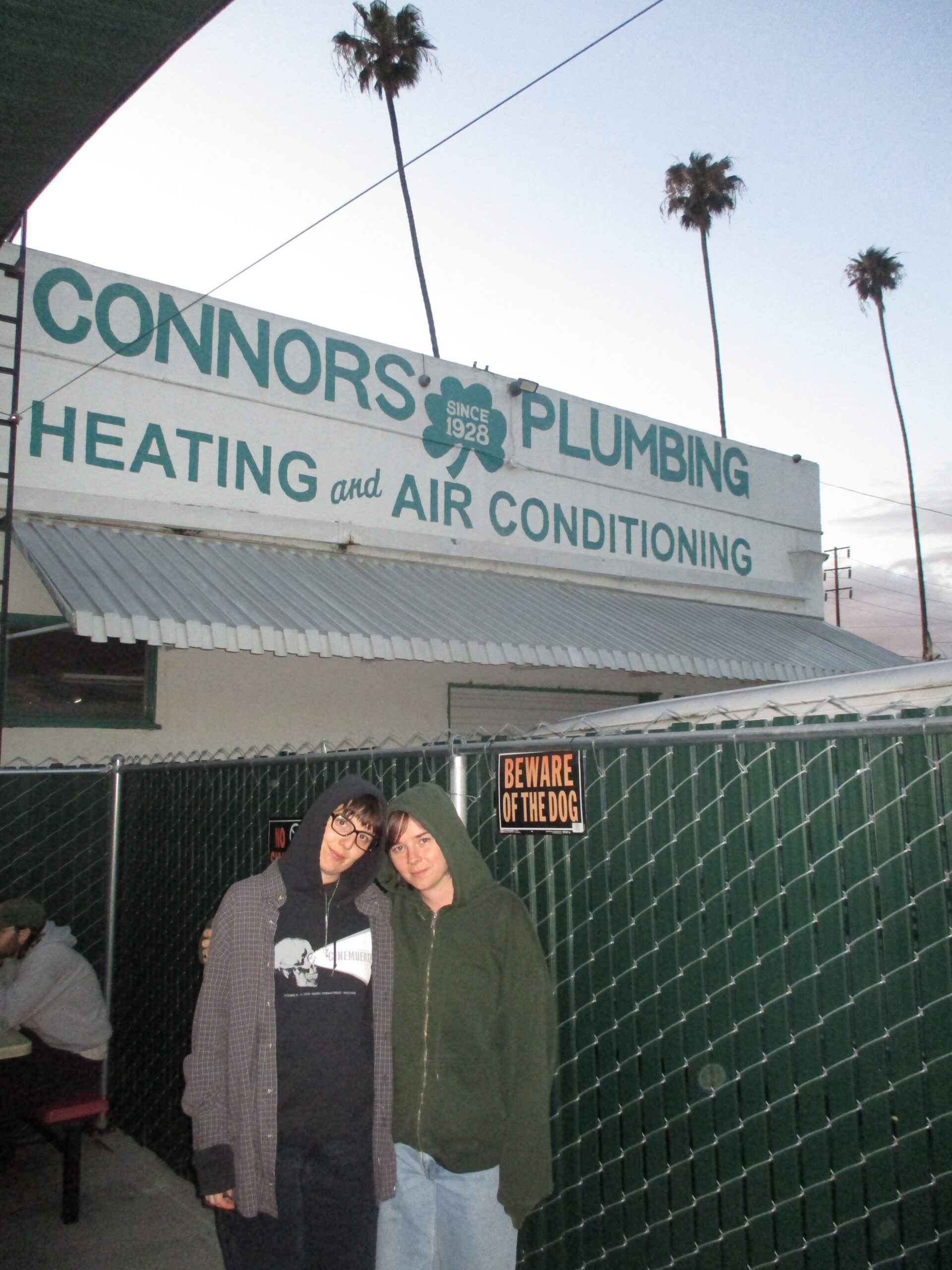
Avalon Fast and Jillian Frank