

In the March/April issue of Artillery, I argued that the subversion of cutesy cartoon aesthetics is almost always compelling, since the notion of a visual language with the power to connote primal emotions through ancient, universal strokes remains resonant despite the protests of the ego. After spending time with the Japanese artist Ken Kagami’s Snoopy sketches at Post-Fair (Misako & Rosen), I would like to revise my opinion.
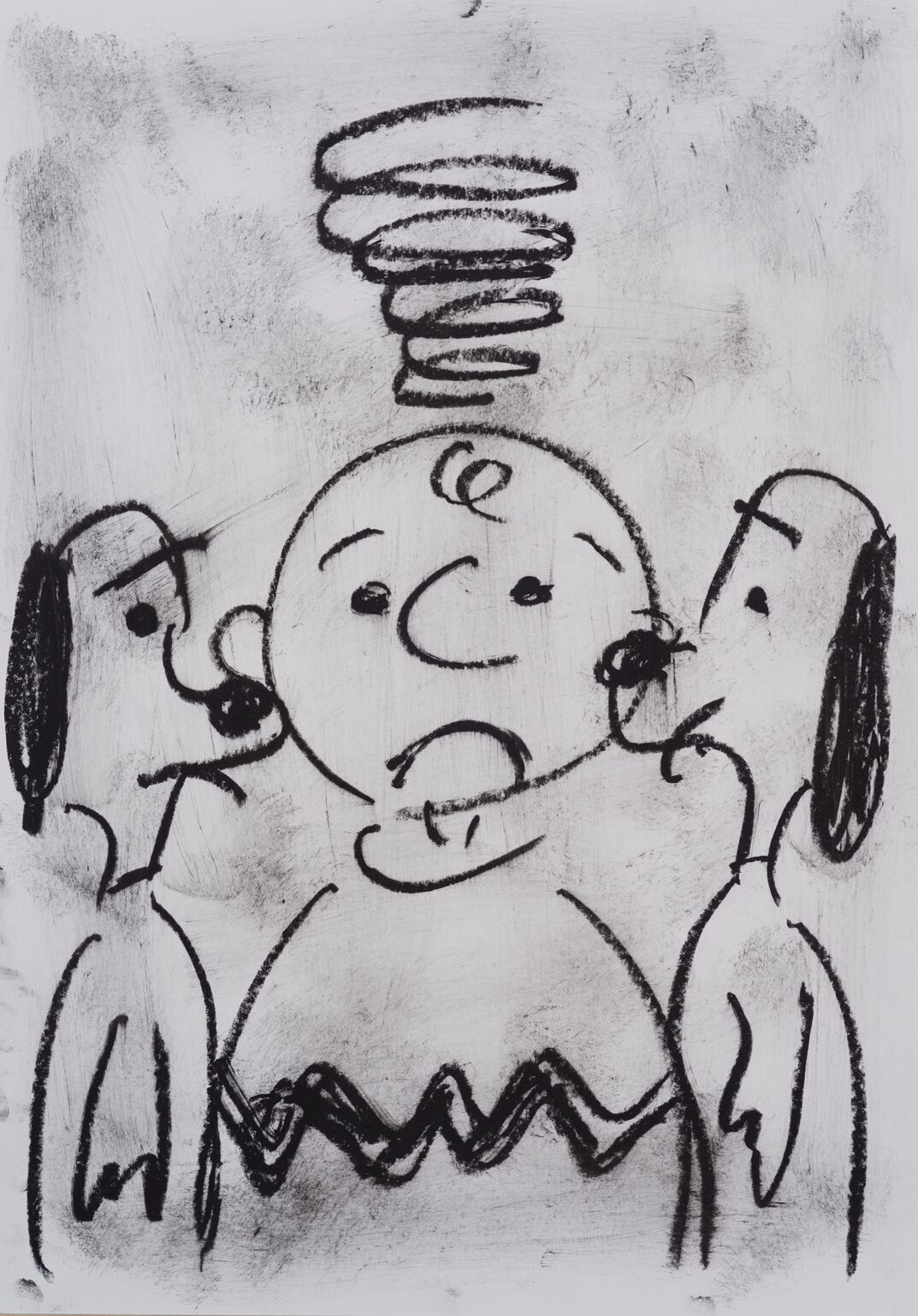
Much of Kagami’s oeuvre centers Charlie Brown and Snoopy, so I’ll specify: I’m not talking about Kagami’s series depicting the two engaging in acrobatic intraspecies intercourse, but a more comprehensive collection including various scenes of the former being tormented and/or humiliated by the latter, in addition to more ambiguous representations. Here are some examples for reference: 1) a Snoopy shark chasing Charlie Brown as he flails in the ocean; 2) Snoopy pointing at a pair of tighty-whities bearing Charlie Brown’s visage; 3) Charlie Brown’s and Snoopy’s heads stacked on top of each other in a totem pole configuration.
I’m not critiquing Kagami’s choice of muses. Poor Chuck, painted in muted tones, has long inhabited a peculiar no-boy’s-land: he’s too cerebral to embody the childhood whimsy of his peers (and that of comparable cartoon characters), yet he registers adult matters as incomprehensible (cue the tuba player). His friendship with Snoopy provides some comfort, although Snoopy’s interiority is never fully accessible to him (anthropomorphism be darned). In theory, his liminal existence should render him apt for adaptation,but Kagami’s distortions have nothing to do with his positionality in the Charles Schulz comics or specials. Snoopy isn’t “out to get” Charlie Brown in any Peanuts media. Their relationship isn’t overly saccharine, either. That is to say, the characters in Kagami’s sketches aren’t hyperbolic funhouse mirror versions of Charlie Brown and Snoopy, nor do they represent inversions of their personas. So why bother with their likenesses at all?
Kagami offered an answer, albeit a curt one, in a 2015 interview with The Hundreds. When probed about his “obsession with Snoopy,” he simply responded, “It’s both an easy character to draw and to customize.” This straightforwardness seems to be Kagami’s M.O. Back in 2015, the artist drew volunteers’ penises (based on pure speculation) in an interactive installation at Frieze London. One could describe this project as commentary on the symbolic sword-measuring contests that take place in the art world, or as a skewering of polite “subtext” in favor of unapologetic artistic confrontation—but Kagami certainly would not. “The work is not really a response to the fair—it’s more important to entertain myself,” he told The Guardian at the time.
Considering Kagami’s disavowal of figurative frameworks, the sketches that stand out most are those that refuse to construct any conspicuous relationship between boy and beast, instead serving as absurdist experiments in form—which is basically the essence of cartoon logic distilled, anyhow. If we can drag and drop Charlie Brown from holiday to holiday, send him to space or ship him away on the Mayflower, why not turn him into an octopus? Why not make his ears into miniature Snoopys, each bearing two floppy black ears of its own? By disassembling Schulz’ designs and removing the looming specter of narrative (which admittedly can stifle comedy), these examples force us to judge Kagami’s work by his own rubric.
I can admire Kagami’s iconoclastic tendencies. I’ll always take an artist who owns his lack of self-seriousness over one who demands the audience hallucinate meaning in its absence. Yet his insistence that his work be perceived in a vacuum sometimes feels like a tease—the pilot episode for a show that never got picked up, or sex with “just the tip.” From this critic’s perspective, the pop icon/[insert-archetypal-image-here] as disruptor is typically effective because of its preexisting associations; attempts to shed them entirely can feel more frustrating than cheeky. Then again, if Kagami set out to corrupt rather than disrupt, my frustration may be the point; perhaps this review is just one extended tuba solo.