

Over Memorial Day weekend, I trekked up to Altadena to visit “Field Set,” a two-day exhibition of works by sculptor Kelly Akashi and sound artist Phil Peters. I was hesitant about visiting Altadena. The sheer emptiness of the area is oppressive and as a longtime fan, but never a resident of Altadena, I was worried my presence was more interloper than exhibition visitor. The exhibition was located on the remains of Akashi’s home. There is little left standing beside some rusted steel beams, slabs of concrete, and a mailbox. My feelings of discomfort only grew. And for the best, the work seemed to sense that.
Akashi’s work is defined by a tension between the ephemerality of process and the fixity of sculpture itself. Her work is delicate, precarious, and often made from material subject to degradation—twigs, wax, flowers. At the Whitney Biennial earlier this year, Akashi applied these principles to grappling with the loss of her Altadena home. On the Whitney’s terrace, Akashi crafted a glass-brick replica of her home’s fireplace, the only structure that was left standing. Monument (Altadena) (2026) is a sizable memorial but the glass betrays its monumentality. It is ghostly, present but transparent. The historic brick buildings of New York’s Meatpacking District, visible through the sculpture’s glass brick, are mournful reminders of what was lost on the other side of the country.
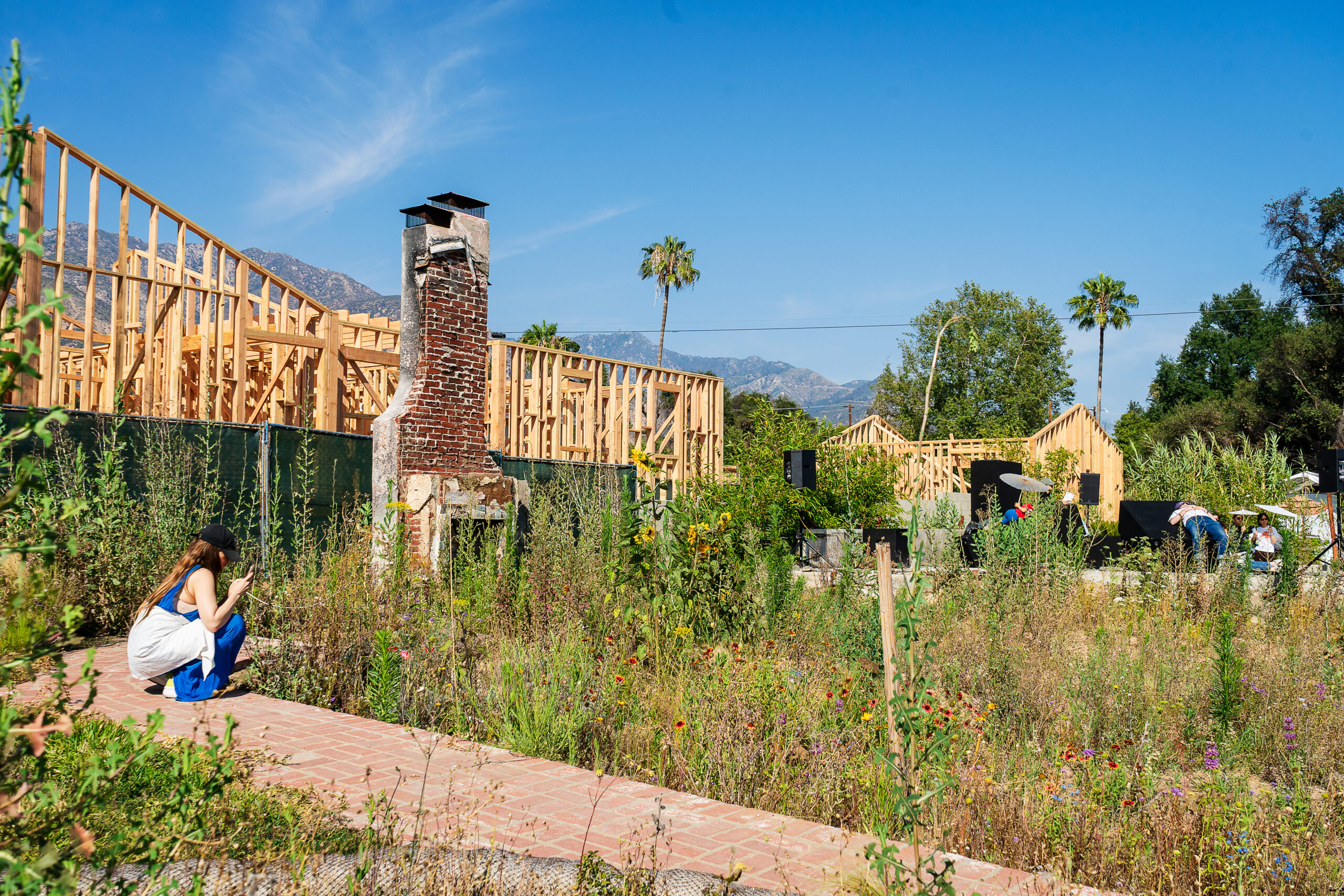
At her home in Altadena, the original chimney still stands. The mantle is cracked and burn marks run up the bricks. It is the tallest structure remaining on the property, but Akashi’s work redirects our attention to what is in front of it, where her living room once stood. After the fire burned through the floor and the rubble was carted away, Akashi invited friends to help her plant a small garden. When I visited, the flowers were just beginning to bloom. Akashi then surrounded the flowers with glass sculptures. Each sculpture blends so naturally into the garden that their existence risked going unnoticed by a distracted viewer. At their bases, the sculptures are ovular, like heavy raindrops hitting the ground. The flowers appear to grow out of them and the glass follows, working its way up the stalks like support stalks. In opposition to the monumentality of Monument (Altadena), these glass sculptures are delicate. While the Whitney sculpture focused on what was lost, these emphasize what continues to grow.
Towards the back of the property, Akashi collected a cluster of charred tree branches into a V-shaped nest. At the V’s vertex, Akashi placed a glass sphere delicately among the wood like an egg, a potential life growing out of blackened remains. Nearby, Akashi affixed more charred branches to a row of upright, steel I-beams, the last evidence of the home’s skeleton. As the branches bend against their own weight, they form a simple archway that recreates the passageways of a home in a simple but powerful architectural gesture.
It is difficult to imagine creating art both from and about a loss as devastating as that of a home. Akashi achieves this, not by seeking to fill the void but by gesturing at the emptiness that hangs over Altadena and the future possibility that that emptiness contains.
If Akashi’s work circumscribes a silence, Peters’ sound installation fills it. At the center of a concrete platform where an enclosed porch used to be, Peters installed three monolithic black speakers. One sits horizontally on the ground, another is propped up against it, and a third stands upright beside them.The speakers play the sounds of demolition and reconstruction at the site, which Peters has been recording for the last year. At times, the recording crescendos into a booming collage of saws buzzing, concrete smashing, and trucks idling but for long stretches, the work is near silent. In these slower moments, one can sometimes discern the voices of workers chatting idly on break but with a winking conceptual flair, the voices are occasionally those of the artists themselves.
Peters’ work is, in a sense, indescribable. This is a feature of the work itself. Peters has long been concerned with deep earth systems. In a 2019 exhibition, he used the same massive speakers to play the subterranean sound of west Texas fracking. Because the frequency of these sounds is below the human auditory range, it would be wrong to say one listens to these sounds. Rather, we absorb them somatically. We are not listening subjects but receiving objects. This generates a physical response in the body, similar to the panic one experiences during an earthquake.
Peters’ work for “Field Set” is different from this prior work in content if not in form. The sounds recorded in Altadena are above ground and discernible. We can make quick sense of what we are hearing. Yet there is a throughline that connects this installation to Peters’ past work. It is still about power—the power of the environment and the human actions against or on it.
By applying his sound practice to a subject as intimate and emotionally raw as the destruction of Akashi’s home, he raises new ethical questions about art’s role in responding to tragedies such as this one. First, it is important to note that Peters’ recording of the site will continue for another year. “Field Set” itself becomes part of the sonic archive of rebuilding. I don’t want to think of myself as a mere gawker, but the conscious awareness that my presence at Akashi’s home will be inscribed permanently brought this discomfort to the fore. Similarly, it was difficult not to notice while visiting that the construction crew next door was diligently working on raising the frame of a neighboring home. The sounds of their labor formed a chorus with the similar sounds emanating from the speakers, and there were moments where it was unclear whether a given sound was art or labor. Just as Akashi’s work blurs the lines between art and the found environment, Peters’ work blurred the lines between art and the menial process of rebuilding. Peters also explained to me that because the area is largely deserted since the fire, property theft has skyrocketed. When thieves stole a stone fountain from a house nearby, Peters’ recording equipment captured the commotion.
One could make a case that this sort of silent observation is, in a sense, voyeuristic. The sound equipment passively records as people grapple with loss. I didn’t see it that way. Rather, the recordings force an important responsibility on the listener to not turn away. Being in Altadena now is uncomfortable, heartbreaking. Like Peters’ installations, this discomfort enters you somatically and settles in the pit of your stomach. Akashi’s sculptures can’t help but foreground the process that created them—burning, charring, destruction.
It would be easy to frame this show as a trite story of death and rebirth. This would be saccharine though and both Akashi and Peters are too smart for that. Instead, both artists interrogate the failure of representation itself—a prescient question in Altadena. After all, how can anyone truly represent the tragedy of the Eaton Fire? Akashi and Peters both suggest it can simply be gestured at.
The artists suggest we must simply sit with our feelings and absorb the devastation. This is not to suggest that the show completely lacked any hope for the future. Instead of trying to force that into the work itself, the artists looked to Altadena itself. On Saturday night Celia Hollander, an Altadena-based composer, performed to a small crowd using Peters’ sound system and on Sunday night, Paul McCarthy, who had used Akashi’s studio long before Akashi lived there, played a set with his band. If Altadena has been ghostly silent post-Eaton, the sheer liveliness of these performances provided an optimistic concluding note.