

John Giorno seems like a fun guy to have been around. Lively, ready for hijinks. I mean, anyone who’d turn his slumbering nakedness over to Andy Warhol’s camera for six hours must be pretty game.
A long-time cultural purveyor within NYC demimondes, Giorno’s narrowcasting, varied-media wordplay always struck me as a bit thin—mostly deliberately thin on affect and mostly non-confrontational. One exception was the faux-surly Who You Staring At?, a 1982 vinyl record collab with downtown noisemonger Glenn Branca, a copy of which is one of a cache of artifacts simply laid out in several vitrines in “No Nostalgia,” an exhibition spotlighting wall-hung pieces in the Marciano Art Foundation’s modestly-sized Window Gallery.
Among Giorno’s early, eventually abandoned stabs at political relevance was Seale. This 1969 spraypainted green monochrome features a staggered, stenciled two-column text describing manacled and gagged Black Panther Bobby Seale’s return to a Chicago courtroom in a take that’s wan and matter-of-factly literal—saying much less politically in its aesthetic choices than, say, Steve Reich’s intense, co-signed 1966 tape-piece Come Out?
The focus of the Marciano show comprises such text-based representations, mostly abbreviated—like just titles themselves in standard font as primary visual element. Beyond a calling card but less than, well, a poem.
Dial-A-Poem (1968–2019), possibly Giorno’s most notable project, dates back to landline days: low-fi recordings of poets reading their work. The poems murmured and hectored through the Bakelite telephone at the Marciano exhibition offer quick audio hits detached from visual or larger context. This gimmickry extends to the bunched display of Giorno’s matchbook poems, whimsical if found scattered around a bar, perhaps, but fundamentally shtick-y in format, a weak play on commercial culture that doesn’t escape the trivializing black-hole gravity of promotional delivery systems.
Regarding systems, there’s something quaintly arch in Giorno’s branding of his larger creative enterprise as Giorno Poetry Systems. Meant as a parodic poke at industry and capitalism, it also points a bit to his ambition to become somewhat far-encompassing in multiple media (mindful, again, of Warhol, Giorno’s former lover, and the simultaneous expansiveness and cheapening of his Factory products over the decades—joking/not-joking—devolving to a numbing sort of celebrity worship in his Interview magazine mass media aspirations and later portraiture).
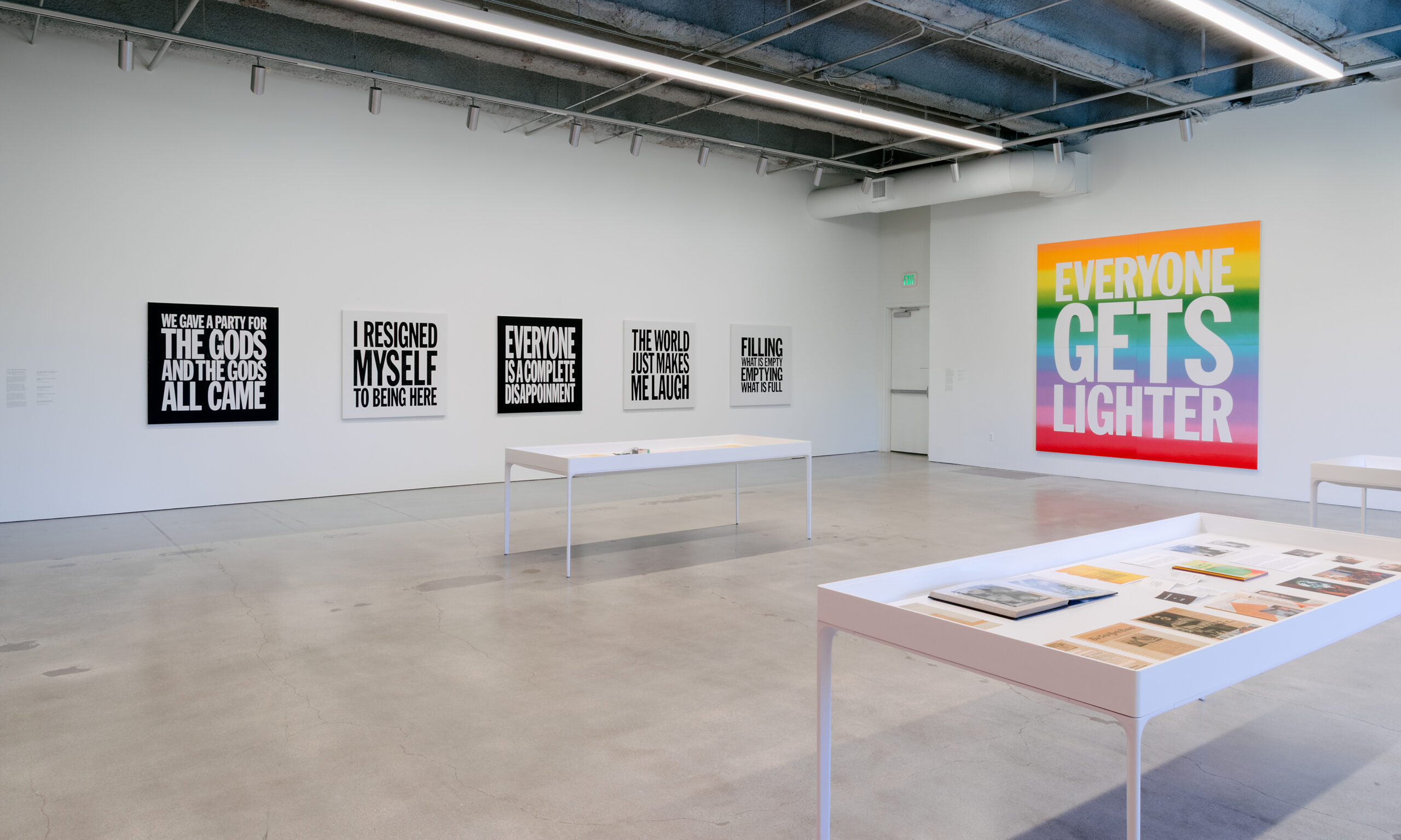
The visual outcomes featured in this show are basic—no formal legerdemain or conceptual pushing of boundaries. Coming in the wake of 1960’s Pop, Minimalism and word-based Conceptualism, a veneer of conceptual-lite adheres to Giorno’s efforts—mostly from superficial treatments of black-and-white or faux-rainbow painted backgrounds populated with motto-like phrases that careen from the would-be cosmic (“We Threw a Party for the Gods/And The Gods Came”) to micro-phenomenological (“Hit My Nose with the Stem of a Rose”), mostly occupying a non-committal and/or contradictory range of middle-ground whateverisms: “Everyone Gets Lighter” v. “Everyone Is a Complete Disappointment.” Streaks of fatalism (“Life is a Killer)” and cynicism interrupt positive, Buddhistic vibes. Large-scale paintings such as Thanx 4 Nothing (2007) might intend to confront and provoke viewers, but there’s no real aftermath.
Ultimately, most of the texts come off as banal truism, without the psychological twists and morphing media of Jenny Holzer, the political in-your-face-ness of Barbara Kruger or Glenn Ligon, the conceptual rigor of Sol LeWitt, or Bruce Nauman’s tricksterism. Thinking of, for example, Nauman’s 1967 The True Artist Helps the World by Revealing Mystic Truths (Window or Wall Sign), whose semantic irony and innovative use of neon lighting—most commonly used in retail commercial advertising—and how it communicates greater spirals of knowingness. Giorno’s bons mots, meanwhile, occupy the realm of ice-breaker wit or pseudo-Zen koan, momentarily diverting at old-fashioned cocktail parties but soon becoming… tedious. While the visual treatments add some presence, nothing here proves more catalytic than mass-market sloganeering that might decorate college dorm walls or family rumpus rooms.
The truncated texts all vaguely suggest Madmen-era advertising taglines. The straightforward designs channel that energy—block layouts, squares within the squares of each canvas, filling most available space in text-first fashion, prompting the question: why paint these? Must they be so monumental or tarted-up in saturated hues and rainbow gradients? Put forward with billboards’ assertiveness, the stripped-down qualities signal little interest in histories of painting or conceptually-based art.
For an exhibition titled “No Nostalgia,” there sure are strong whiffs of a lapsed bohemian New York—and the impact is faint and diluted. The claim on eyeballs with this much would-be canonizing feels a stretch: the total decidedly less than the sum of its parts. This feels especially true having to first pass by more spectacular contemporary work from the Marciano collection to reach the show’s small-ish tucked-away second-story space. There’s a sweet, slightly embalmed quality to Giorno’s showcase, like maybe this ephemeral whimsy could have been buried with the artist himself, rather than put on display to steer visitors into the cultural cul-de-sacs of bygone eras.