

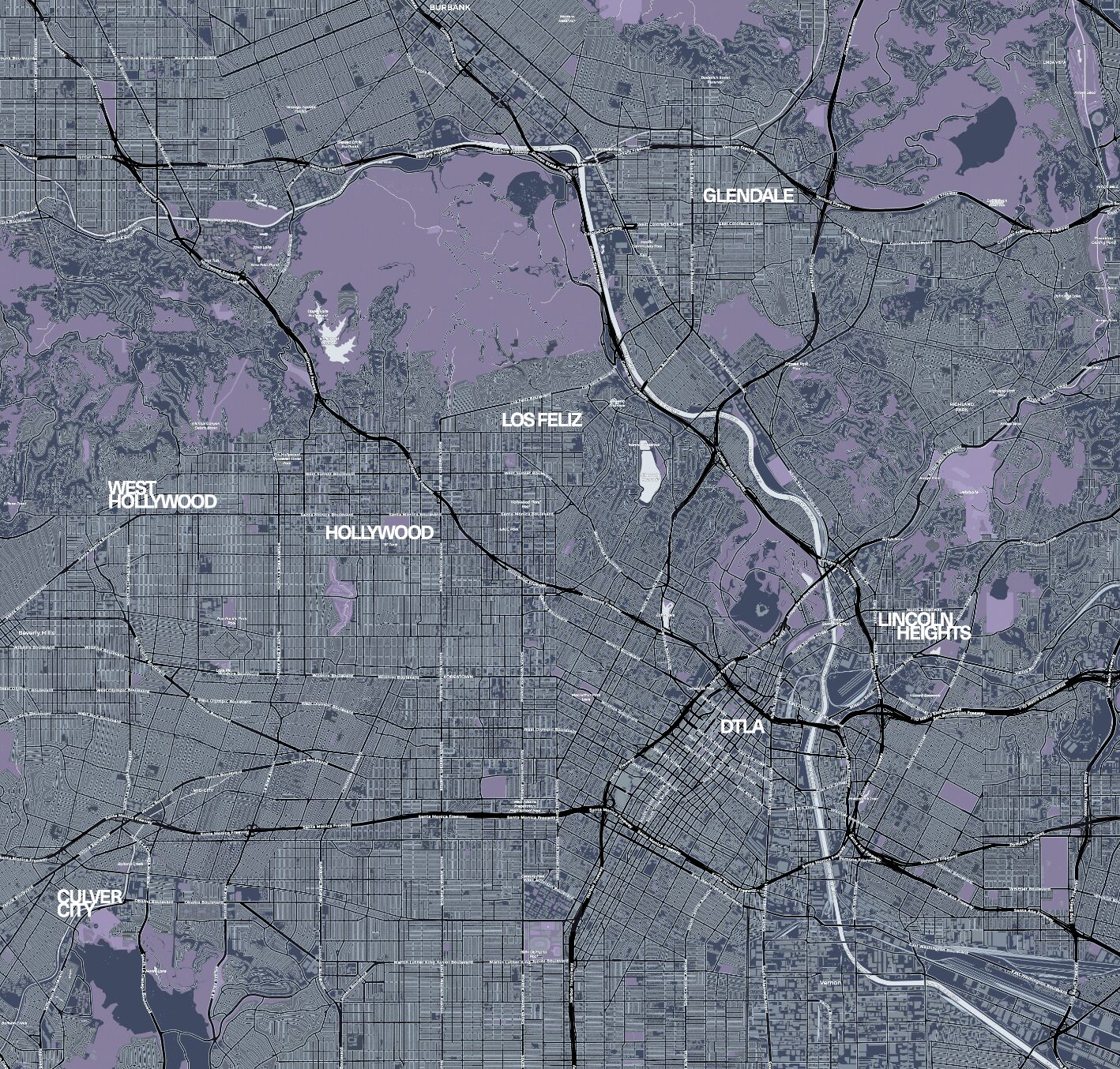
“Los Angeles is 72 suburbs in search of a city.” —Dorothy Parker
“We need blood. Quite a bit of it.” I was growing desperate; this was probably the eleventh kosher deli I had called that morning. “Don’t worry, it’s not for anything antisemitic,” I clarified. “I’m Jewish, too.” They hung up.
It was 2007, I was on the clock at my first gallery job at the now defunct Kim Light/LightBox in Culver City. We were prepping for “The Early 90s,” a group exhibition celebrating the greatest hits of the gallery’s previous incarnation. Kim’s first gallery had an inspired run, exhibiting burgeoning local talents like Kim Dingle, Anya Gallaccio, and Monica Majoli, so this exhibition was a bit of a “Don’t Call it a Comeback” flex. (Jeff Poe, her director in the ’90s, had since gone to partner with Tim Blum in Blum and Poe, who were still housed in a relatively modest structure a few doors down on La Cienega—they’d open their behemoth flagship across the street a couple years later.) I was sourcing materials for an Anya Gallaccio piece which sandwiched a quantity of the red stuff between two large, clear panes of glass that rested atop a bed of rock salt. As a nice, somewhat naive Jewish boy, I figured that all the blood drained from kosher meats was stored somewhere safe in case someone like me came calling. I was wrong.
As with each of my art world jobs over the past twenty years, I had stumbled into my role there. A year-and-change prior, Nick McCarthy was in town with his band Franz Ferdinand at the peak of their US popularity, and we bicycled to see a show at Kim Light/LightBox. When we arrived, Nick told a starstruck Kim that I was studying to be an archivist in graduate school at UCLA. Kim said she needed one of those. I started the next day and worked with her till I finished my masters.
Within my first week at the gallery, an artist walked in and handed me a folded piece of paper. I opened it. The words BLOW JOB were printed in large block letters. “We should do this,” he exclaimed in a thick Greek accent, enthusiastically. I politely declined.
On his next visit, he handed me another note: HAND JOB, it read.
We were a small operation, but the work we were showing and the community of which we were a part felt vital and important. The Los Angeles art scene, at least to my romantic, mid-20s self, stood on the shoulders of larger-than-life transplants from other places, artists too loose, too weird, and often too crass to fit within the confines of the stuffier, older money on the opposite coast. Los Angeles is the land where John Baldessari moved to start fresh after cremating his archive, where Ed Ruscha announced his wedding with a photo of himself in a threesome, where Raymond Pettibon elevated street punk poetry into fine art, where Lita Albuquerque’s Malibu Line (1978) merged her audience spiritually with the natural endpoint of Manifest Destiny.
Existence within the Culver City art scene in 2005–2007 felt rich in that legacy, not to mention Kim’s own early ’90s legacy, like it was our duty to be provocative and a little dangerous. Reckless, even. Anyone who has created art as a means of income or worked in a smaller art gallery understands the fatalistic precarity of commercial existence. Emerging art, and art in general, has never been an easy sell. However, art dealers are so self-righteous and stubborn that, on a given opening weekend at Kim Light/LightBox, we honestly believed that a multichannel, heavy-metal ballet video piece by Kirk Nelson could reorient the contemporary cultural compass, and while it probably wouldn’t make anyone rich, it might at least fill the coffers enough to allow us to stage another exhibition six weeks later.
It was in this vein that our small but ambitious cohort of Los Angeles contemporary art lovers carried the banner against the status quo and east coast art hegemony. Some of my memorable early crusades include Analia Saban’s first solo exhibition with Kim; falling under the spell of Frohawk Two Feathers (aka Umar Rashid) at his first gallery show at the short-lived Taylor DeCordoba gallery in the adjacent building; being paid cash to jack off for a Dash Snow film at Peres Projects in Chinatown; discovering a stash of illicit Gregg Araki polaroids stuffed into an envelope on a bookshelf, initially believing I had uncovered an underground sex ring; procuring weed, cocaine, heroin, mdma, and other party favors for a number of artists and clientele; receiving a phone call from the cell someone found in the pocket of an artist who had just collapsed, dead; performing in a “synchronized swimming” video with Keith Boadwee where we filled our colons with jets from a hot tub and shot the water back out of our asses at each other. It’s very possible I did some archiving, too.
Twenty years later, the landscape has evolved, some players have changed, and the city finally has its own established, major international art fair. Personally, after a seven-year stint as an archivist, librarian, and art book fair curator at Gagosian in Beverly Hills, then an eight-and-a-half year tenure as a partner and director at Nicodim in the Arts District, I’m a Senior Director at Perrotin in Mid-City. The Los Angeles art world (and my own place within it) may be on more stable ground than it was two decades ago in Culver City, but our existence within the world itself feels considerably more precarious—it was just a little more than a year ago that the federal government staged a military invasion of the city, and less than two years since a plague of hellfire tried to incinerate us. On top of it all, foreign wars, tariffs, geopolitical unrest, and political sensitivities have caused a national inclination to cocoon and play it safe in fear of provoking noisemakers on both the right and the left. But that’s never been how we do it in Los Angeles.
“It needs to rest directly on the floor, it’s kind of the point,” insists Isabelle Albuquerque.
We’re at Perrotin installing “SUMMERLOVE SENSATION”—a hyper-sensual, hyper-sexual group exhibition. It’s the first one I’ve curated in the gallery. Isabelle has created To be the wood, to be the water, to be with you (2026) for the show, a gorgeous bronze hermaphroditic flower making love with itself that appears to grow out of a live oak wood burl cap. We expect a large turnout for the opening, and if we don’t place the piece on a platform, there’s a significant possibility it will be kicked, stomped-on, and damaged. We ditch the plinth and place the work directly on the floor.
Over 800 people show up the next night, many of them drunk on free cocktails, and Isabelle’s contribution remains erect, in full bloom, unscathed. The piece sells to a brave collector who plans to display it in his new public art space located in Culver City, of all places. The world turns, fires burn, regimes change, but we’re still out here at the natural endpoint of Manifest Destiny, shopping for blood.