

Days before the opening of the 61st International Art Exhibition of the Venice Biennale began, there were news reports of protests and disruption due to the Biennale’s inclusion of pavilions from Russia and Israel, two countries that are each involved in highly unpopular wars.
This quickly shaped the media narrative of the entire Biennale. The Associated Press reported that “Protesters in pink balaclavas swarm Russia’s pavilion at Venice Biennale and release colored smoke.” The Guardian: “Dark clouds, protests and resignations dampen start of 61st Venice Biennale” and “Pussy Riot protest at Venice Biennale forces Russian pavilion to briefly close”; NPR: “Protests and boycotts rock prestigious Venice Biennale.” The New York Times ran several reports on the flashpoints surrounding this year’s controversial exhibition, stating “the 2026 Venice Biennale has experienced waves of uncertainty that have only grown in strength as the public opening of the world’s most prestigious international art exhibition nears on Saturday morning.”
Social media algorithms sent protest post after protest post across art world social media feeds. The art and global news outlets laid out an intense on-the-ground narrative that this version of the Biennale had been “disrupted” and not in a peaceful way. Friends who knew I was going warned me to be safe.
As I sat in the airport waiting for my flight to Venice, I began to fully expect to experience smoke bombs and police batons at one of the world’s most prestigious art exhibitions. I began reading through the reports: several mentioned that a protest by members of Pussy Riot and the Ukrainian feminist group FEMEN had flooded the ground of the Russian pavilion on May 6th. Reports described activists in balaclavas, setting off multi-colored smoke bombs and playing punk songs from a boom box. As of this writing, news updates report that the protest has been turned into a music video for the song that was playing.
Other reports started to filter out that an hour after the Pussy Riot protest, the Art Not Genocide Alliance (ANGA) staged a demonstration outside the Israeli pavilion.
After arriving in Venice, getting a good four hours of sleep, I prepared myself for a day of disruption and headed out towards the venues. Walking along the Riva dei Sette Martiri, I encountered no protests, only lots of people dressed in art world requisite black walking the same direction as myself. In fact, the mood on the ground didn’t seem disrupted at all. The disconnect between what I had read and what I was experiencing on the ground frankly confused me and I was reminded of something I had read months earlier—a post on the Pussy Riot Instagram feed that had something to do with the Biennale and a request. I went searching and found it—a letter to the Biennale’s President Pietrangelo Buttafuoco posted around March 2026 which read:
Just sent this letter to the President of the Venice Biennale, requesting Pussy Riot’s access to the Biennale grounds on May 6, 7, and 8.
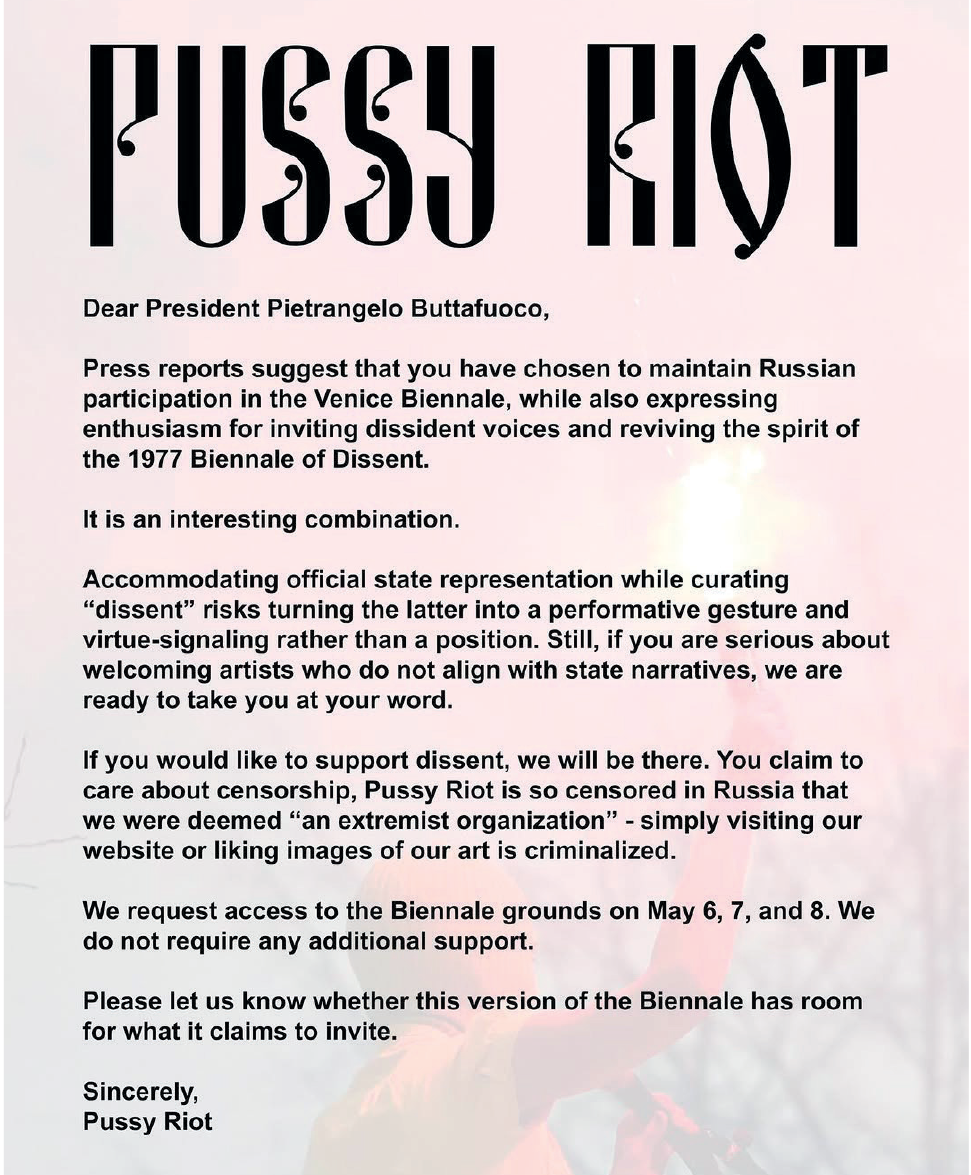
Instagram: @pussyriot, March 19, 2026.
For those unfamiliar, the Biennale takes over the city of Venice, Italy, every two years and centers on two main exhibition venues, the Giardini and the Arsenale, along with numerous side exhibitions and open-air installations (Chihuly had several glass installations along the Grand Canal).
The protest and disruption happened during “preview week,” a time when the press and invited guests are allowed access to the venues prior to the opening to the general public.
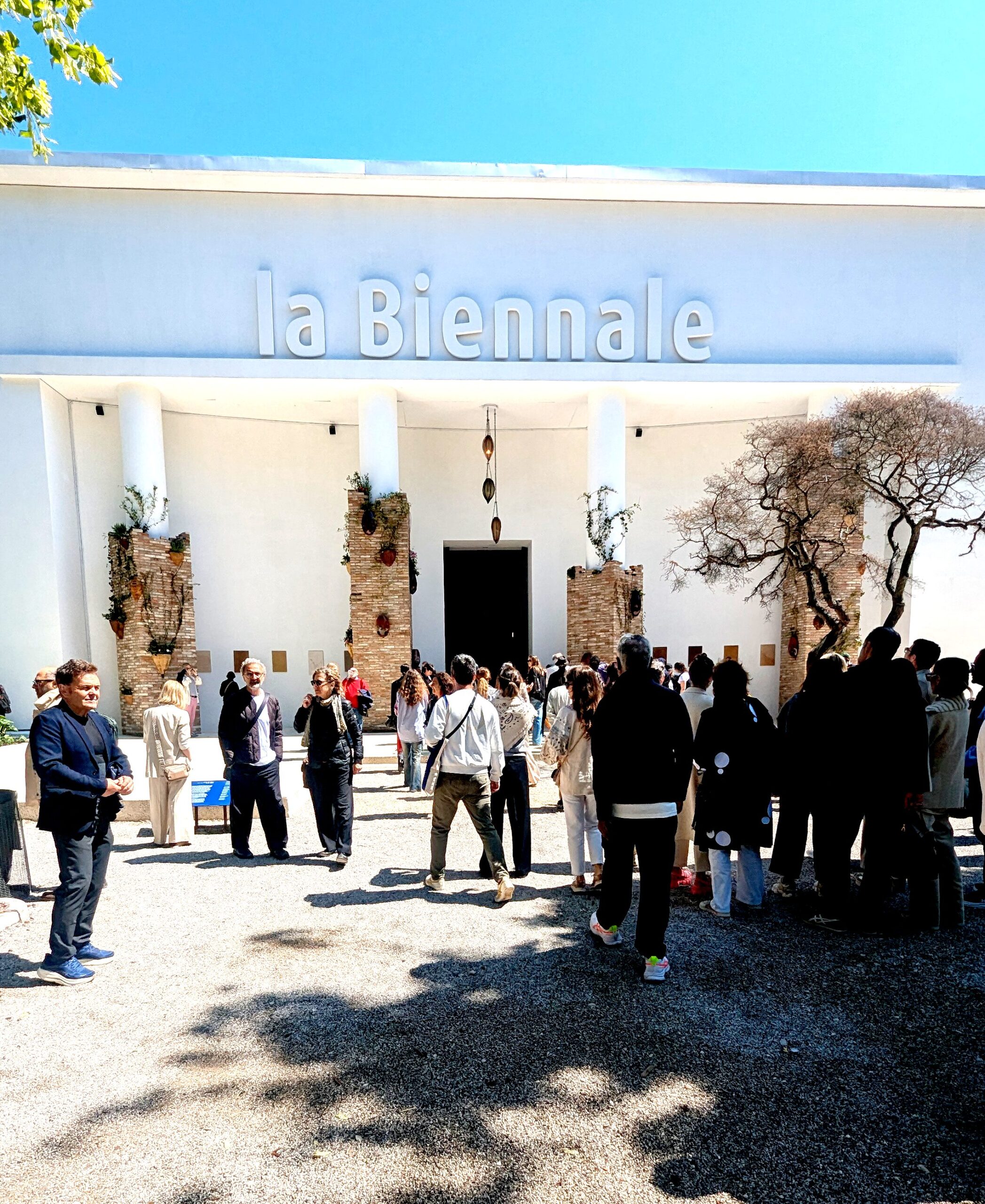
As I continued on my way to the Giardini to see the pavilions, with particular interest in the commotion surrounding the Russian one, I had expected to see an influx of police presence and protest accoutrement—the barricades and increased infrastructure that cities put in place to help “manage” and or dissuade disruption—particularly since there were multiple protests the day before. But when I got to the Giardini, passing other Biennale events along the way, I saw none of that, nor did it appear at the Arsenale the following day. No noticeable increase in police presence, no barricades, nothing. The only real inconvenience was entirely typical: really, really, long lines and what seemed to be a pre-existing established infrastructure to make getting into the Biennale difficult and annoying.
Each venue was built like a small commercial fortress (a Venetian tradition) with only one or two ways in with a security check point that seemed like any other security check point at any other art fair in the entire world. It is, after all, their sixty-first year doing this.
These checkpoints control access to a cluster of pavilions. Each country’s pavilion within the Giardini looks like a small one-to-three room pre-fab cabin/structure (some of these structures have been re-designed by an architect) though in some cases a pavilion simply means a shipping container. In other words, they are much smaller, and much less impressive than the reports and press coming out of Venice would have you believe. They are akin to small and mid-size galleries in LA.—The David Zwirner compound could have swallowed several.
Russia’s pavilion is a two-story structure and was filled with flower arrangements, DJs and little else. It is located along the main thoroughfare close to Japan, Korea, the US, Germany, and Canada.
If one were to stand outside of the Giardini or Arsenale and look in, all you would see would be crowds in lines, under the Italian sun, waiting to be herded into these architectural fragments to see often half-assed, worse-than-Disney-style installations that leave you less than half-impressed. From the ground, any “disruption” would feel less like an apocalyptic centerpiece rewriting the exhibition’s narrative than a rumor of familiar urban noise somewhere a street or two over.
As I stood in lines and navigated entry, I began to wonder how it was that the protesters and disrupters could have gained entry and in the numbers that were present and reported on. I didn’t imagine they scaled walls or stormed past security—both highly unlikely given the layout of each venue.
The only disruption I noticed was a group protest march to Free Palestine along the same Riva dei Sette Martiri on my way back to my Airbnb— which took up the entire walkway, sweeping up protesters and tourists alike as people tried to navigate through the crowd to take photos and get to dinner.
I began to wonder if the Pussy Riot letter actually worked. If they (and other organized protests) were in fact granted and allowed entry by the Biennale organizers, not so much to create a staged protest, but possibly to embark on a sanctioned one.
The coverage of the protest events suggesting an unexpected “storming of the castle”-stye narrative may have been an exaggeration or distortion. It seems more likely that security simply let it happen, knowing that it was better to let Pussy Riot and company protest in front of a pair of despised national pavilions than to have activists protesting the Biennale itself.