

Ah, yes, the front room at Hauser & Wirth: the room you usually walk past on the way to the better shows in the back. There’s a certain type of painting one expects here: Blue Chip filler, the type of young artists who get mentioned in Vanity Fair articles. Where Hauser & Wirth tends to stage their exhibitions of historically important artists in the rear gallery space, the front room can feel like the retail endcap stocked with Oreos you walk by on the way to buy stuff for a nice Sunday dinner. While there have been exceptions to the tendency (the gallery exhibited John Chamberlain’s crushed cars alongside Larry Bell’s transparent cubes in the front room in 2022, for example), Flora Yukhnovich’s solo exhibition of nine paintings toes the line.
Our top-heavy economy has resulted in the hollowing out of the middle of the art market and the endless expansion of mega-galleries. This has created a situation in which relatively untested artists (Yukhnovich was born in 1990) are launched vertiginously into fame. Blue Chip galleries leverage their own prestige, a large PR budget, and the puffed-up language of press releases to inflate the value of flashy but hollow art. The fact that fame is determined in this way, from the top down, feels like an egregious disservice to a great many mid-career artists who have slogged away for decades making more modestly scaled works which might be less marketable but are ultimately more meaningful.
To make matters worse, the type of work that Blue Chip galleries typically favor from emerging artists can seem quite narrow. Usually, this means painting of obvious appeal and overblown scale—as if fitting themselves precisely into rooms like this one: work with more professionalism than originality. The bloated size of these spaces themselves, which can dwarf the art, is part of the problem.
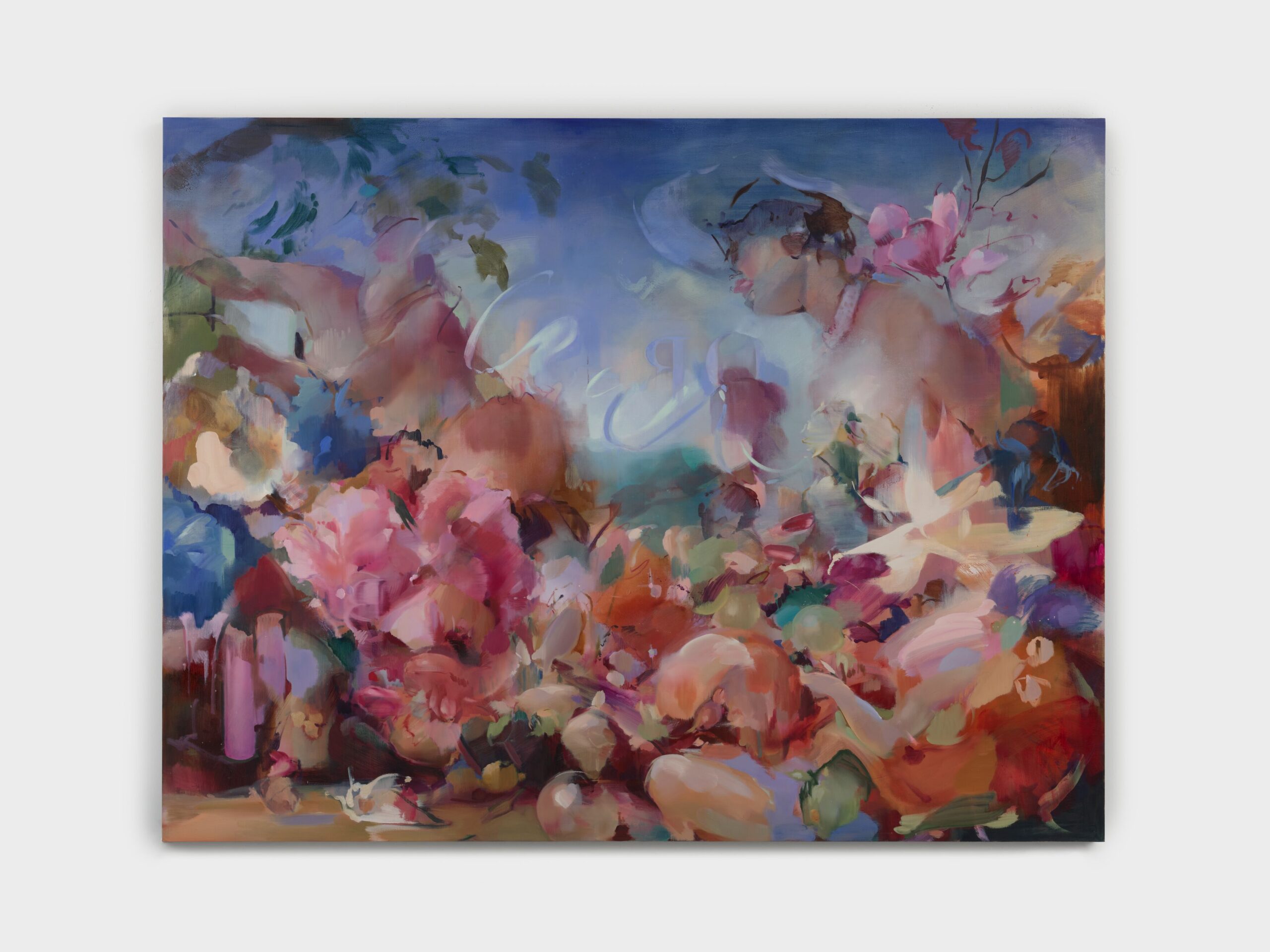
Compositionally, Yukhnovich’s paintings borrow the grand scale and structure of history painting, albeit semi-abstracted and semi-improvisational. The busy swirl and massing of abstracted figures might recall Rubens, married to Rococo flamboyance, and rendered in huge flat brushstrokes. The figures appear as much through their colors—bright pops of peach and pink—as through their occasional allusion to an arm, leg, face, or the thrust of a torso. The deep blue skies and verdant green foregrounds, likewise, hint at the landscape through color and composition rather than rendering.
Yukhnovich has a good sense for the massing, compression, and dispersion of forms, although the results are inconsistent. In Seeing Pink Elephants (all works 2025), for instance, the movement of the fleshy pinks across the canvas expands and contracts, clumps up, then disperses into the greenery on the right, which continues its trajectory. Like the swirl of leaves being blown across a yard, this has a general momentum and chaotic internal variation, which is quite satisfying. Likewise, the spatial relationships in this work are more clearly defined than the more confused proliferation of marks in the other works. The relative restraint of the color palette also helps make Seeing Pink Elephants the best painting in the show.
In other paintings, this kind of semi-improvisational approach can result in a jumbled half-mess. The Last Days of Disco is a veritable inferno of magenta and tangerine. It is hard to take seriously, which could be the point (more on that later). The treacly blue skies of Fever Pitch, likewise, merely form a backdrop for the confused patches of peach and magenta. Where Seeing Pink Elephants tows a fine line between the surface effects and the clear suggestion of recessive space, Fever Pitch, and some of the other work here, can feel both histrionic and muddled.
Far from being an interesting synthesis of two opposed modes of painting, this seems like a hazy middle-ground with a lot of wiggle room, speaking neither a rigorous abstract language nor meeting the technical demands of representation. Mostly, they just seem like a flashier Cecily Brown or downstream Karen Kilimnik. If I’m being even less generous, I would say that these are just “brushier Will Cotton”. She’s not really doing anything new; she’s just doing this at a larger scale and with brighter colors than anyone else.
Yukhnovich intends a wink: the candy colors are clearly meant to be an intentionally hedonistic allusion to Rococo art. I don’t mind the hedonism or the attempt at implicit critique, but there’s an obviousness to Yukhnovich’s approach that more dissonance and clangor might improve. Even where the backgrounds verge on moody gloom, it’s clear enough that the whiff of portent is still just a harmless backdrop for the pops of cheery color. The color combinations themselves tend toward chintzy cliches, eager to please and comforting in their familiarity: phthalo blue skies modulated with blue-greens and crimson purple; flesh-tones accentuated with the rosiest of pinks, creamsicle peach, lavender, and magenta.
For painting, which relies so much on the appeal of huge brushstrokes, the paint itself tends toward an all-too-consistent flat opacity. These are painterly in an obvious way, but too tightly controlled. The paint itself doesn’t look more interesting up close, which is always a bad sign. The sense of immanent light tends toward a bombastic Romanticism that, even in historical Romanticist painting, like Caspar David Friedrich or J.M.W. Turner, can grate. The chipper floral tones recall Jean-Honoré Fragonard’s pinks and peaches but without the élan of his lightly worn virtuosity that carries them off.
The historical references can feel like an avoidance of the present and a misguided gesture towards the canon. For instance, one of these paintings is loosely inspired by the Columbia Pictures logo. Another one depicts several cherubs swirling around a plate of peaches and grapes. The general affinity with the Rococo reminds one that a shift of society marked the period and taste away from the court of Louis XIV and back toward the provinces. Something like that might be happening now, too.
If there’s a historical lesson to be gained here, it’s that the relative hedonism and blinkered perspective of our ruling class perfectly rhymes with that of pre-revolutionary France and Roman emperors. Unfortunately, we already knew that, which makes this show a kind of self-parody. As the press release says, “Among the works on view in the exhibition, two key references reflect this process. The first is the story of Heliogabalus, the young Roman emperor who, while ruling between 218 and 222 A.D., allegedly drowned his party guests in rose petals. The second is Lawrence Alma-Tadema’s 1888 painting The Roses of Heliogabalus, depicting this fantastical scene.”
“Ruling elites drowning in rose petals” would be an apt metaphor for this show except that it feels like fake flowers and not real ones. Our aristocrats are not even as good at decadence as their antecedents. In the same way that contemporary “palazzos” are generally just middle-class McMansions but even more bloated, this show ends up feeling less like elite art or a smart satire of it and more, simply, like a middle-brow approximation of the real thing.