

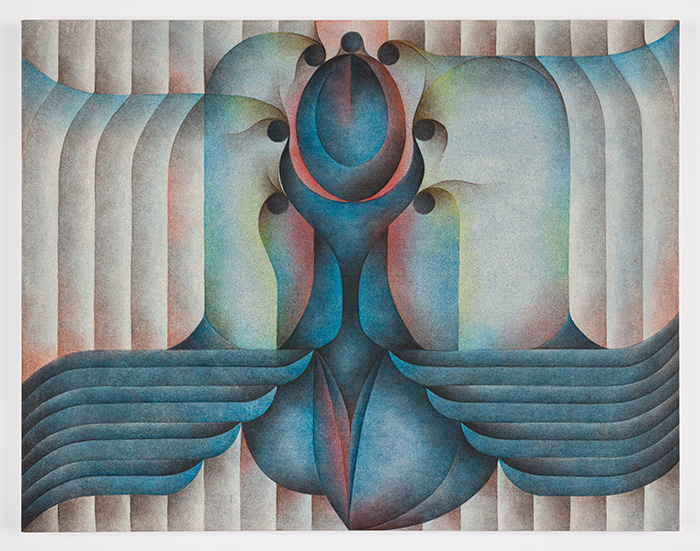
Gentry’s new body of work is a visionary elaboration of elements from La Dame à la licorne (The Lady and the Unicorn), a series of six tapestries created in Flanders around 1500. The show title references the saturated deep red-orange which dominate the tapestries and also animate many of her compositions here.
The rhythm of the tapestry weaving process is present in Gentry’s use of crossing linear symmetries from which images form and dissolve. Distilled versions of woven hair, fecund vines, and towering limbs work in chorus across her compositions through controlled chromatic tonalities and hyperbolic geometries. Out from her fluted colonnades grow a cast of biomorphic forms: a lion, multiple ladies, a pipe organ, holly berries, heraldry, and the unicorn itself—all foci for meditation.
Like the Flemish tapestries that provided the artist with inspiration, Blood Orange is serious about sensuality. If Gentry’s previous body of work, The Walled Garden, grew out of an image of a secluded Virgin Mary in her hortus conclusus, Blood Orange heads us straight into a wild grove.
The ever enigmatic final tapestry in the La Dame à la licorne depicts a noblewoman handling an ornate necklace from a treasure chest. Across the tent canopy above is stitched “À Mon Seul Désir” (“To My Only Desire”). The combined symbolism is ambiguous, but it could fairly be read as an artist statement for this exhibition: ‘My desire is to know true beauty, and artifice is the only way to satisfaction.’