

Official Welcome Los Angeles is pleased to announce Love me, love me not our first solo exhibition with Los Angeles-artist Nancy Evans. Evans studied sculpture at UC Berkeley before relocating to Los Angeles. Lured by High Performance magazine and the dynamism of the artist community in Southern California, Evans immersed herself in the burgeoning scene in downtown LA in the summer of 1980, returning permanently the following year. She first landed in Hollywood and was influenced by the artists emerging from Cal Arts, like Mike Kelley, Jim Shaw, and Megan Williams. The echoes of her earlier practice and training – an interest in structure, the periodic return to sculpture, and an experimental approach to her materials – continue to inform her multivalent painting practice. Evans was included in the 2023 Made in LA Biennial curated by Diana Nawi and Pablo José Ramirez, where her large-scale works inspired by a series of super moons seen over the Southern California landscape charted a contemporary approach to western transcendental landscape.
Love me, love me not; the title evokes a girl plucking daisy petals to divine the intentions of the object of her affection. Child’s play, but play that appears across western art and literature – from “Das Blumenorakel” in Clara Hätzlerin’s songbook (1471) and Goethe’s description of the seduction of Gretchen in Faust (1790) to Rococo and pre-Raphaelite paintings to Lyndon B. Johnson’s cold war era campaign ad, Daisy (1964), which transforms the daisy game from divination to a symbol of innocence. Love me, love me not is a simple but essential question to the universe, and its persistent connection to spring flowers highlights our innate understanding of Nature as divine, as oracle, as magic. Much of Evans’ work is informed by her fascination with nature and rituals of venerating the earth. Her transcendental point of view weaves throughout these paintings, all of which seem to exist in moments of transition – whether time of day, or season – Love me, love me not is a question of dawn, dusk, and spring.
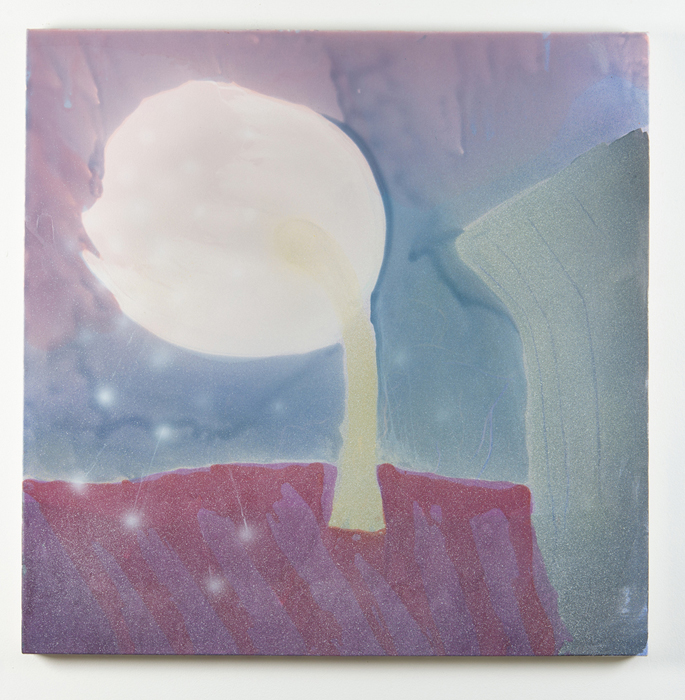
Painted with an approach that Evans describes as “dusty,” these works combine brushed and sprayed acrylic paint to create diffuse luminous surfaces. Like her Super Moon series, these works are anchored in the vastness of the southwestern United States and play with scale, throwing the viewer off-kilter into an experience of this landscape that operates more along the ordering principles of dreams than reality. In Evans’ Lady in the Lake, a woman’s body floats atop the surface of the water or perhaps she is the water; she seems to stretch from shore to shore. Her body appears to slowly dissolve into the water beneath her. Above, a large arm pulls a blanket of clouds across the sky. She floats between worlds, beneath she dissolves, she is caressed by the tawny arm of early morning light. The image sits between reality and unreality, a dream remembered or a play of perspective transforming the scene.
Alongside a new still life titled Pomegranate and a second flower painting titled Narcissus, this supernatural lady encourages an archetypal interpretation. There are echoes of Greco-Roman myth, the abduction of Persephone and her mother’s grief as the logic governing the seasons; the direct reference to the Lady in the Lake, the supernatural woman of Arthurian tales who controls and bestows power upon men. The Lady of the Lake is a condition of the world that creates Arthur and Lancelot more than she is a character or a person – she is nature. Present before the story begins, there after it ends; she is the body of water the myth cannot do without and cannot contain. Evans’ figure carries that same quality: she is not in the landscape, she is the landscape.
Evans’ presentation is accompanied by a presentation of three recent works by Los Angeles-artist Francesca Lalanne. Lalanne’s work in engraved and patinated metal appears as if from outside of time. Describing rituals of care, hospitality, and rest, Lalanne is committed to using her work to express the necessity of attending to the inherent connections between human well-being and the well-being of society.
About the artists
Nancy Evans (b. 1949, Los Angeles, CA) received a BFA from the University of California, Berkeley, in 1972. She has had solo exhibitions at Sargent’s Daughters, New York; Luis De Jesus Los Angeles; Jason Vass, Los Angeles; Cardwell-Jimmerson, Culver City; Ben Maltz Gallery, Otis College of Art and Design, Los Angeles ; Gasworks, London; and Sue Spaid Fine Art, Los Angeles. Group exhibitions include the 2023 edition of Made in LA, Hammer Museum, Los Angeles; Timothy Hawkinson Gallery, Los Angeles; Wonzimer, Los Angeles; Louis Stern Fine Arts, Los Angeles; ArtCenter College of Design, Pasadena; Torrance Art Museum, California; San Luis Obispo Museum of Art, California; Armory Center for the Arts, Pasadena; and San José Museum of Art. She is a recipient of a Joan Mitchell Foundation Grant; Rockefeller Foundation Grant; and National Endowment for the Arts Grant. Nancy Evans lives and works in Venice, CA.
Francesca Lalanne (b. Miami, FL) received an BFA from Florida International University, Miami, Florida and an MFA in sculpture from the Rochester Institute of Technology, Rochester, New York. Recent solo exhibitions include Of Reverence at Spinello Projects, Los Angeles, CA; Guardians of the Dew at Band of Vices, Los Angeles, CA; and Lamentations curated by Kim Dingle at Vielmetter Los Angeles. Her work has been included in group exhibitions at Similien Art, Los Angeles, CA; Orange County Center for Contemporary Art, Santa Ana, CA; Charlie James Gallery, Los Angeles, CA; and The Getty Museum, Los Angeles, CA; and the Museum of Contemporary Art North Miami, Miami, FL. She lives and works in Los Angeles, CA.