

Feia is proud to present Proscenium, a solo exhibition by Los Angeles-based artist Luke Forsyth. Opening July 18, the show marks the second presentation at the Feia Flat. Borrowing from the language of stagecraft, art direction, scenic design, and prop-making, Proscenium unfolds like a play without a beginning, middle, or end. Set within a domestic environment, the presentation invites viewers into a suspended narrative where illusion, performance, and materiality converge, dissolving the boundaries between the theatrical and the quotidian.
Forsyth is known for a playful yet rigorous approach to drawing and image-making, working across painting, sculpture, and installation. Drawing from domestic interiors, expansive landscapes, and the visual cacophony of Los Angeles, his practice is shaped by improvisation, repetition, and sustained observation. Returning to familiar subjects across multiple media, Forsyth gradually abstracts recognizable forms into speculative landscapes that balance formal experimentation with everyday experience.
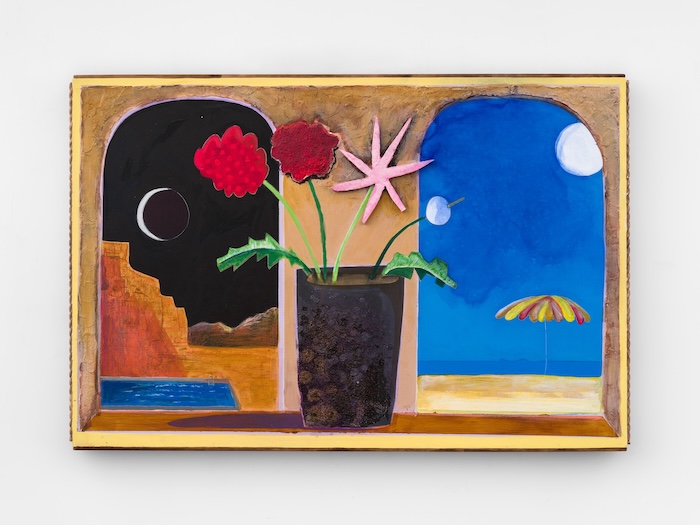
In Proscenium, this methodology expands into a spatial and theatrical framework. The exhibition asks, implicitly: What is the play? Who are the characters? Where and when does the action occur? These questions remain unresolved, functioning instead as framing devices that shape perception rather than narrative. Silhouetted plant forms, reduced gestures, and open pictorial space create a visual language that invites multiple readings, allowing viewers to construct their own narratives.
Color functions as character, palette becomes dramaturgy, and staging determines what is revealed and what remains obscured. In Proscenium, framing devices are central to the exhibition’s logic. Painted borders, including red square demarcations, separate and activate works as if they are windows or portals into constructed scenes. These frames extend into sculptural interventions – using lathed panels, reclaimed wood, and chairs – collapsing distinctions between painting, object, and stage set.
By incorporating found materials and handmade structures, Forsyth introduces a tactile, irregular logic that disrupts formal resolution. Drawing from plein-air traditions, lived experience, film, literature, and digital culture, he weaves together art-historical references and contemporary realities into a layered environment that acknowledges both constructed spectacle and everyday uncertainty. Proscenium proposes an open-ended stage where meaning is assembled by the viewer, and every object carries the possibility of becoming a prop, a character, or a scene.