

In Adobe Photoshop, the Background Layer is the default layer upon opening up the application; it is initially locked and protected, and alterations cannot be applied to it. A photographer is often a background layer to how we understand reality. An image can be static or erratic, demonstrative of a place or a person. Each image becomes a new layer of meditation of our reality. Architecture and other shapes, systems, and arrangements build upon these fundamental or foundational layers.
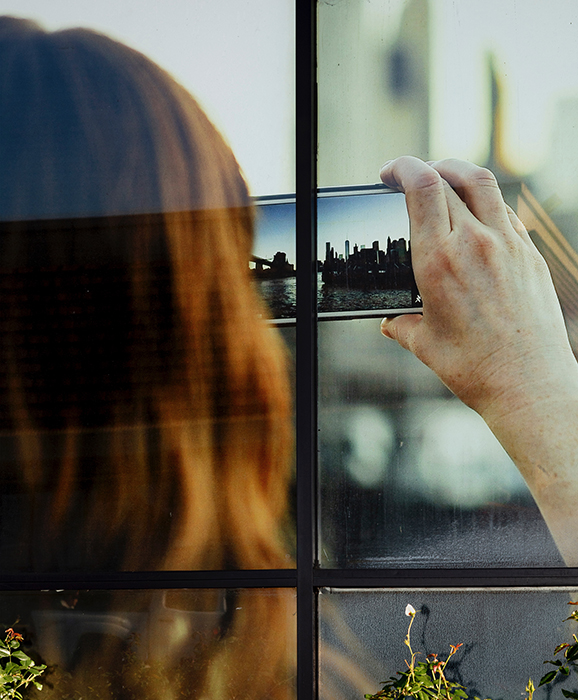
Today, we live in a hyper-saturated, hyper-capitalistic society, in which it is often difficult to discern what is real, what is true, and what is honest. Schaedel’s photographs incorporate a consistent sense of hollowness, dry humor, and various techniques to play with optics and undermine one’s understanding and relationship to images. Collectively, we walk and drive past dozens of physical advertisements from dawn to dusk, we doomscroll for hours upon hours, and we get targeted with and by digital advertisements every time we open our electronic devices. We are absolutely inundated with images, all day, every day. Schaedel understands that he, as a maker of images, is implicated in this process, but he also acknowledges that he doesn’t have to submit or subscribe to it, and he actually aspires to subvert this tendency in his own photographic works.
That is a question that Schaedel keeps coming back to: who, exactly, is implicated in a photograph? Is it just the photographer? Or is it also the viewer, the subjects, or the individuals who disseminate the photographs? Who? And now, a question I keep coming back to is who is implicated in any sort of artwork? But perhaps that distinction is a crucial one that needs to be made – an image, be it still or moving, can describe reality in more concrete terms than any other art form. It is the one medium where “what you see is what you get” can legitimately be applied, or at least that is what can be perceived. However, what you see isn’t always what you get, at least not until context is applied. For an artist like Schaedel, that is the point. And that is precisely from where this propensity to subvert the tendency likely comes.
Moreover, Schaedel has noted on numerous occasions the hidden “ghost gestures” that are present in his practice and in photography, in general. This concept – a persistent, habitual action that has lost its original purpose is a fascinating one to think about in connection to making art, and specifically to Schaedel’s practice of making photographs. For example, he has applied his many years of documenting paintings in a wide assortment of galleries to snapping shots of window vinyl in the wild for his own work. These gestures manifest from slowly developed skills, rooted in muscle memory that translate from one discipline to another and can evolve over time through continued routine. Given the fact that Schaedel exists as an extreme multi-hyphenate, these ghost gestures are extremely present in his work and extremely important to his practice.
For this particular exhibition, Schaedel has collapsed his many roles as artist, gallerist, documentation and commercial photographer, as well as educator, by selecting seemingly disparate and discrete works and carefully curating a solo show as if it were a group show, thus offering a meta presentation for the viewer. Schaedel has such a deep knowledge of photography and photographers, such an expansive practice, and such an immense devotion to the medium. This is not only evident in the pictures he makes himself, but also in the exhibitions he organizes at his gallery, The Fulcrum, and the books he publishes through his imprint, The Fulcrum Press.
– Keith J. Varadi, February 2026