

Duelling Reviews
DUELLING REVIEWS: DYNATON Two takes on "Dynaton: Convocation of Radiant Beings" at Chateau Shatto
More Relevant Than Ever
“Dynaton: Convocation of Radiant Beings,” a museum-level display of gratifying scholarship, would seem to be in the wrong place at the right time. Except that it’s not the wrong place. Château Shatto, one of LA’s hipper galleries, built out expansively like any good Melrose Hill showcase, provides plenty of light and space to the exhibit of an exhaustive but not exhausting survey of a modern, specifically postwar art movement called Dynaton (Greek for “the possible”). One gets the feeling that, drawing on the right archives, curator Laura Whitcomb could have presented a Dynaton survey twice this size (and may yet), but the gallery’s constraints made her focus on the movement’s story at least as much as on its artifacture.
What is that story? Wolfgang Paalen, Austrian member of the Surrealist group in Paris, moves with French wife Alice Rahon to California and then Mexico, and starts formulating a post-Surrealistmovement, bringing Bay Area Englishman Gordon Onslow Ford with his American wife writer Jacqueline Johnson and Oklahoma-bornAngeleno Lee Mullican and his Venezuelan artist wife Lucita Hurtado into the fold. Dynaton peaks in 1951 with a show of the three men at San Francisco’s Museum of Modern Art and the movement dissolves not long after. But the concepts advanced by Dynaton’s principals and their contact with a wide range of artists (including writers, musicians, dancers, et al) they knew before, during, and after themovement’s flourish—especially its engagement with Mexican art –establish it as a key manifestation of avant garde thought in postwar American, and especially West Coast, art.
Re-establish it, that is. Dynaton has been looked at museologically before—LACMA, for instance, mounted a thoughtful survey, a bit smaller than this one, a half-century ago—but this iteration is special. Whitcomb’srespect and even passion for the work itself resonates through the gallery. Her enthusiasm is rewarded by the power of the Dynaton style, the tendency of all three men to work vibrantly with calligraphic strokes and to invoke non-western cosmologies through graphic conjuration. (Dynaton itself began in Paalen’s fascination with the totemic forms of Northwest indigenous peoples.)At the same time, the metaphysics of modern life—quantum theory, nuclear energy,non-Freudian psychology—weighed heavily on their world view. You can feel that weight throughout the show, but as a counterbalance to the lofty speculations of mid-centuryartistic imagination, the momentous vision that so enthralls Whitcomb. And that’s the ultimate success of “Convocation of Radiant Beings”: not its academic rewrite of modern art history (although it does significantly broaden our knowledge of art in California), but its infectious embrace of what was once a blip on the timeline, an eighty-year-old art movement that now feels more vital than ever.
[adrotate group="28"]
Wormhole Cul-de-Sac
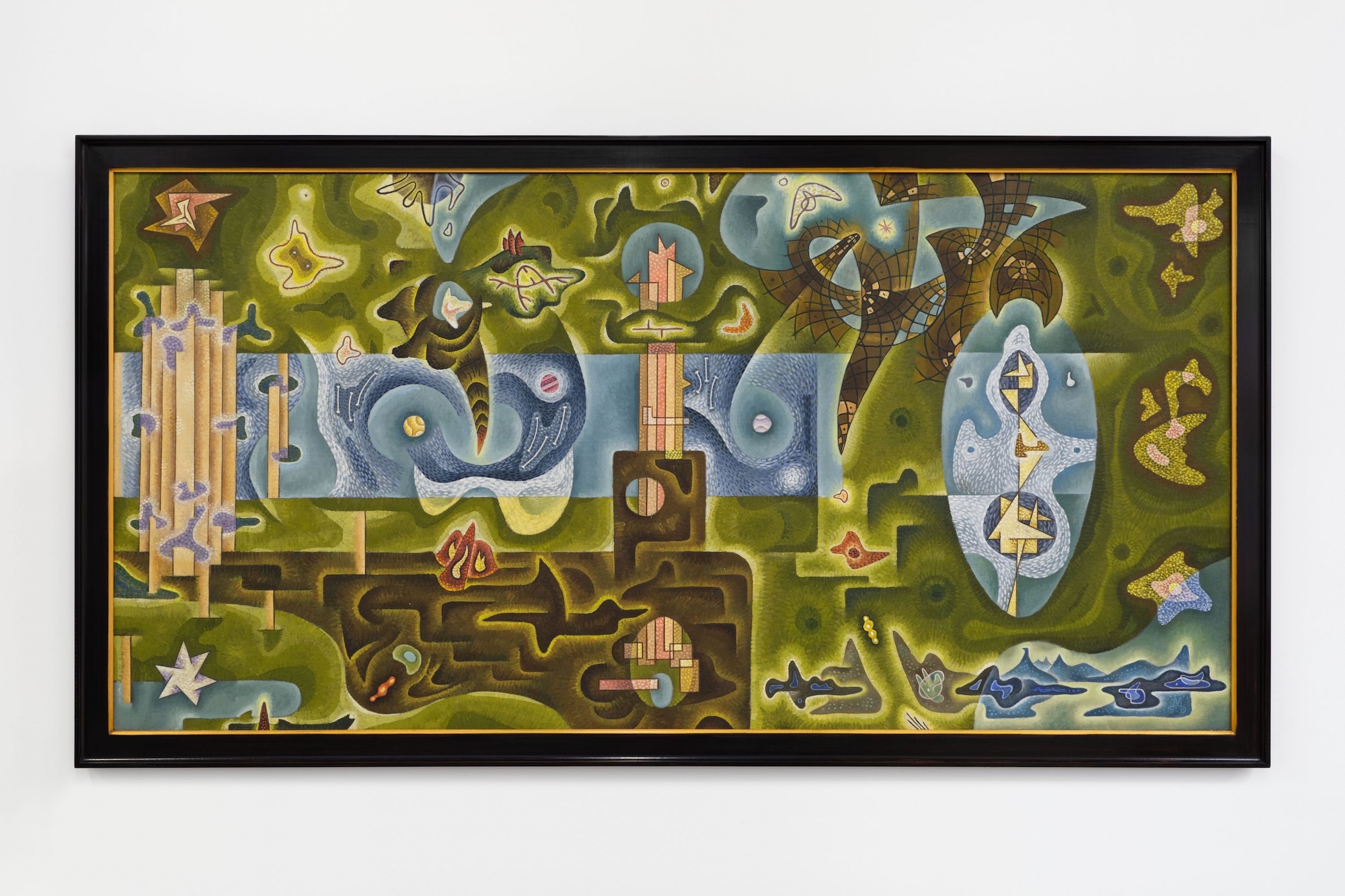
Running the gauntlet of discarded condom wrappers, takeout containers, and smiling delivery robots along East Hollywood’s Western Avenue to enter Château Shatto’s storefront and view “Dynaton:Convocation of Radiant Beings” was like passing through a wormhole into an alternate timeline. Gordon Onslow Ford’s stunning The Luminous Land (1943) greeted visitors, its small-scale muralismo infused with abstract structures, topographies, and biomorphisms overlapping avocado to forest green, mushroom brown, and steely blue. The mythical/sci-fi landscape glowed, impelling past utopian visions distant from contemporary LA’s trashy letdown.
The show gathered art and artifacts of Dynaton—the quasi-cultish, mid-20th century movement led by Wolfgang Paalen, who drafted Onslow Ford, Lee Mullican, and others into a loose collective during the 1940s and ’50s. Paalen, as lead thinker, articulated extraordinarily high-minded goals: to represent a fragmented universe’s imperceptible physical and temporal potentialities, cross-connecting subjective structuring forces of human psychology.
Impeccably curated by Lauren Whitcomb and accessibly installed in Château Shatto’s airy, unpretentiously intimate galleries, the exhibition carried whiffs of past generations’ assertive yet anachronisticart-meets-science fervor. The residual effect wasn’t quite quaint—more like a cultural cul-de-sac where eddies of perception and cognition swirl faintly but lapse, ultimately becalmed. Given subsequent anti-object, anti-representational conceptualism, social practice art that engages with real-world challenges, and immersive digital media, creative invention has engulfed modes like painting and sculpture.
However disappointingly, popular culture has discounted and superseded such attempted transcendence of image-making as in Paalen’sNuclearWheel(1942)—an awkwardly pentagonal, darkly explosive color gradient swirl—or Space Unbound(1941)—the pastel vortices of which portray not objects but invisible forces. These images could’ve easily graced last century’s sci-fi book covers. The assimilation of theoretical physics concepts into near-everyday usage (“alternate timeline” itself an online discourse staple) and the intense spectacles of CGI filmmaking have outpaced our wonder at extra-dimensionality rendered in ink, oil, and acrylics. How to advance Dynatonian ruminations in a cultural ecosystem colonized by inflated superhero multiverses or pursued pell-mell through film adventures like Everything Everywhere All at Once (2022)?
Dynaton fired somewhat scattershot, not always portraying new logics or shifting cosmos. Mullican’s wall-mounted, untitled 1950s painted sculptures—arte povera avant la lettre—and his etch-y, horizontal paintings draw on experiences in the U.S. Southwest and observation of Indigenous American culture, veering into appropriative caricature, as does his inked Kachina (1948). Standards of cross-cultural awareness and respect have surged since Dynaton’s zenith of experimentation.
However striking their individual presences, these works don’t persuasively synthesize Indigenous cosmic knowledge with Western Enlightenment science as much as the short-lived group, especially Paalen, had wanted. For every bold declaration of quantum physics shifting paradigms to infinity and beyond—as in Onslow Ford’s Birthing Anew(1946), Mullican’s Specter on New Sun(1949) or Paalen’smagisterial Messenger from the Three Poles(1949)—there are moredown-to-earth references: Paalen’s Klee-like drawing ofMill Valley(1950), Mullican’sThe Dust Bowl, Amiably(1948). Marvelous as it is to see so many works by Dynaton-affiliated artists Alice Rahon and LuciaHurtado, their engagement furthering Indigenous design and Surrealist-tinged abstraction points to a larger challenge: for all his many declared “farewells” to surrealism, Paalen and company struggled to escape its gravitational pull. Dynaton’s cosmic addresses were made toward other artists and art-lovers, not a real world they could transform.
Leaving this cultural outpost, we re-enter avenues where autonomous vehicles disgorge passengers thumbing their transactional devices. We’ve witnessed what-might-have-been but are now overwhelmed by futures Dynaton didn’t imagine. Their vision was genuine; their work remains often alluring. But beauty and intention aimed inward rather than the larger social world haven’t yet bent history’s arc. Beyond the gallery, confronted with rising technocratic determinism, we mourn the real world-possible these artists couldn’t generate—and head in other directions seeking utopian visions and actualities