

THE HAND OF THE UNDISCIPLINED
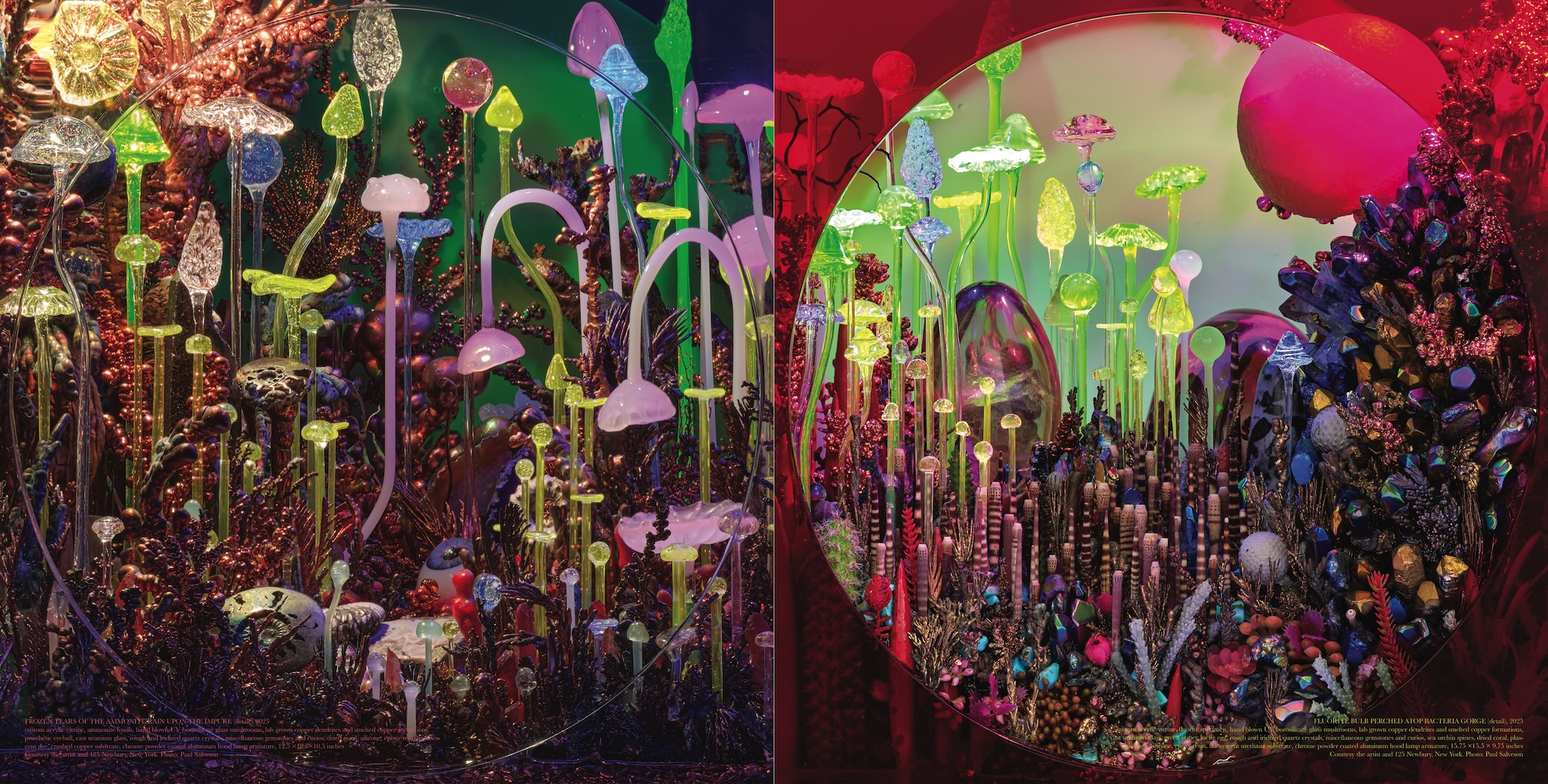
There was a time when art and science, theory and practice, and differing areas of thought, were not considered unrelated endeavors and I am more comfortable with this “undisciplined” mode of thinking: in general, and about what I do day to day. There is a book—more like a tome—written around 1400 by the Paduan painter Cennino d’Andrea Cennini which builds upon late medieval scholarship to address the importance of experience in the attainment of knowledge—e.g., scholars such as Roger Bacon, Albertus Magnus, and Petrus de Maricourt. Cellini’s The Book of Art is filled with titillatingly cogent instructions dealing with materials—how to extract colors from plants and minerals, how to make ink from charred animal bones, how to fix color to wet plaster so it doesn’t fade—but in addition presents a general “theory” of art as science made by hand, an alchemy of materials whose methods are derived directly from empirical research—i.e., experience and experimentation with the materials themselves. This is a roundabout way of saying that my practice belongs to a tradition, now forgotten or if remembered marginalized, that emphasizes collaboration between what are now called ‘disciplines’ and places value on what is learned by contact and experimentation with materials. As an artist I remain disciplinarily promiscuous and see myself as a manual laborer whose workshop, where materials congregate and miscegenate, is designed to facilitate experimentation with what Cellini calls the techniques of art as science made by hand. It is interesting, and perhaps revealing, that Los Angeles, like the city-states of renaissance Italy, teems with an abundance of master artisans and fabricators and the knowledges they possess and disseminate.
THE FUTURE IS AN EMOTION
The fixity of time is nothing more than a fairytale, a precarious and highly amusing human pursuit. Calibrated calendar time didn’t exist until the 19th century and used bristlecone pine tree rings as its currency. The state of Arizona does not observe Daylight Saving Time. On a more idiosyncratic level, the metrics of epochs and milieus, and thus of futures, conjure for me a melancholy of loss and thus I tend to avoid imagining any particular personal future with its inevitable absence of dogs, loves, stamina, brain cells, etc. In short, I feel the future is an emotion more than anything. There is also the problem of bounded time: when does “the future” begin? At what point does it become the present or past? It is impossible to pinpoint the moment of change. We know nature is fecund and often surprising. There may be hope for the planet’s survival sourced in the generative power of non-human nature. While for the moment, the fates of human and non-human species are inextricably intertwined, the power of humans is waning. We arrived late on the planet and are likely to exit early.
UTOPIA AND DYSTOPIA: WHO AND WHAT IS LOOKING?
The original meaning of utopia, and the Greek translation, is “no place” or “nowhere.” I believe utopic nowheres have great potential, hopeful in terms of generative prowess but neither moralistic nor positivist. I see the plastic bag not as a menace but a substrate for a system in flux, a mutation to come. All utopian and dystopian pronouncements must be tempered by the understanding that humans lack the kind of complex knowledges necessary for accurate prediction and by the fact that nature is autopoietic, incessantly creative, and non-deterministic, and is capable of producing its own utopic and dystopic biomes. Whether the planetary future will be dystopic or utopic depends entirely on the perspective: from the point of view of humans, if the present trends continue, there is no doubt that dystopia is the future because they, or at minimum, life as it is presently known, will have been exterminated by their own actions. If the future is the sole domain of extremophiles, for instance, then from their point of view they inhabit a utopian paradise created precisely by the ruinous actions of humans. In my work, I present what is, nature naturing, attempting to demonstrate that the what-is and the what-is-yet-to-come is utopic or dystopic or neither depending upon who or what is making the assessment.