

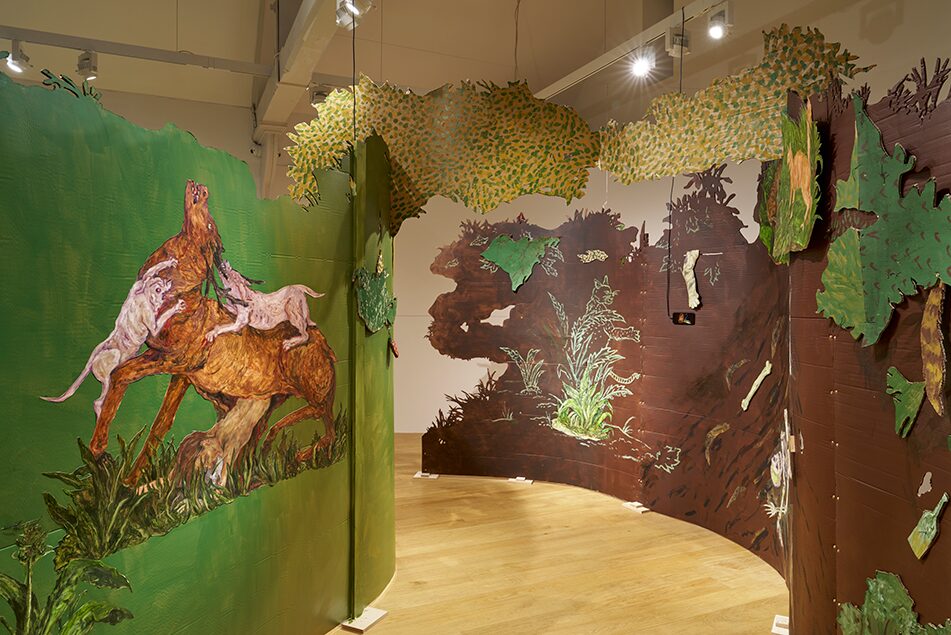
At first, the installation in London’s Whitechapel Gallery seems childish: flimsy cardboard walls covered in forests, foliage and animals, all painted with loose brushwork, like set design the adults painted for their kids’ school play. In Candice Lin’s world of painted cardboard, there are cat tails to slide around, dangling frogs to spin, peep holes to spy through…
But it quickly becomes clear that the LA-based artist’s new commission, “g/hosti” (October 2025 – March 2026), is not an innocent place—it’s brutal and disturbing. Cats play a central role, as usual for Lin; in her previous UK exhibition, “The Animal Husband” (Talbot Rice Gallery, Edinburgh, 2024), the musings of Lin’s own cat, Roger, narrated a central video work. But here the painted cats seem more savage than before. They drink beer, rip each other apart, dance around blazing bonfires. There are whiffs of necrophilia and bestiality: one cat straddles a wounded, half-stripped human; a human skeleton crawls away as a large cat grips it from behind, doggy-style. Nearby, another human skeleton sits on the forest floor and watches, casually smoking a cigarette. Elsewhere, skeletons dance a memento mori rave for two. The cardboard walls form a circular spiralling maze, a wild animal-dominated fairytale where the only humans are dead or dying.
Smartphones are dotted throughout the labyrinth on the cardboard walls. They loop video works which combine drawn animations and footage of environmental or political violence–a wildfire, a mega quarry, an ICE arrest at a protest, a Free Palestine march–which Lin has witnessed as an Altadena resident and UCLA professor. Reality’s intrusions into the savage fantasy woodland echo magical realism, like the human head that appears in Frida Kahlo’s The Wounded Deer (1946). The phone screens are windows to a world not dominated by animals, but still cruel. The clips’ sounds–beeping diggers, protestors’ distressed shouts–spread throughout the maze. Paintings sometimes parallel the clips: animals tear into a stag near the ICE arrest; more cats dance around a bonfire near the wildfire inferno. The two worlds feed off one another. It’s feline displacement, if you’re feeling Freudian.
A couple of the video works feel like a jumble of drawn animation and real footage slapped together with no meaningful emotional impact. The better clips succeed through clearer narratives: in the ICE arrest clip, officers try to pin down a young man (“Get on the ground!” “I was born and raised here!”), but he transforms into an illustrated butterfly and darts away past a US flag. When successful, the screens trigger self-realization and guilt; often we’re not much better than this fictional wilderness. But the more the maze immerses us in fantasy, the more the phones feel out of place, like a disconnected afterthought.
The centre of “g/hosti”’s labyrinth is a circular area housing an old wooden desk scratched with instructions: “ASK TO SEE THE BOOK.” If you’re brave enough to ask, the desk is unlocked to reveal a tiny book shaped like a cat’s head. You can leaf through indecipherable texts, strange anatomical sketches, grisly scenes from feline mythologies, more skeletons, more necrophilia. Nearby, there’s a drawing of a mystical cat bordered with tearable tabs saying “EAT ME.” (I may or may not have taken one. I haven’t eaten it. Yet.) Lin establishes interactive world-building: compared to the maze’s absorbing heart, the screens are merely sidelined snapshots into some other world beyond.
The idea of entanglement appears regularly in Lin’s interviews and reviews; Lin has often sought to combine fantasy, materiality and history, forming powerful post-colonial commentaries. The present is more foreign. The sensory and material richness of Lin’s previous work (lard, live insects, tobacco, opium poppy, tea, urine) isn’t foregrounded in “g/hosti.” It’s as if the colonial past was easier to reach via its materials, while here the present sterilizes the scene via its phone screens. Fantasy and present-tense reality bleed into and butt against each other, without cleverly combining. The reality of recent wildfires, protests, and arrests is somehow too strange to become tangled with fantasy. Reality is distanced; fantasy takes us instead. We leave not just with a brutal fairytale’s eeriness, but with the eeriness of having been so effectively distanced from our own real-world brutality.