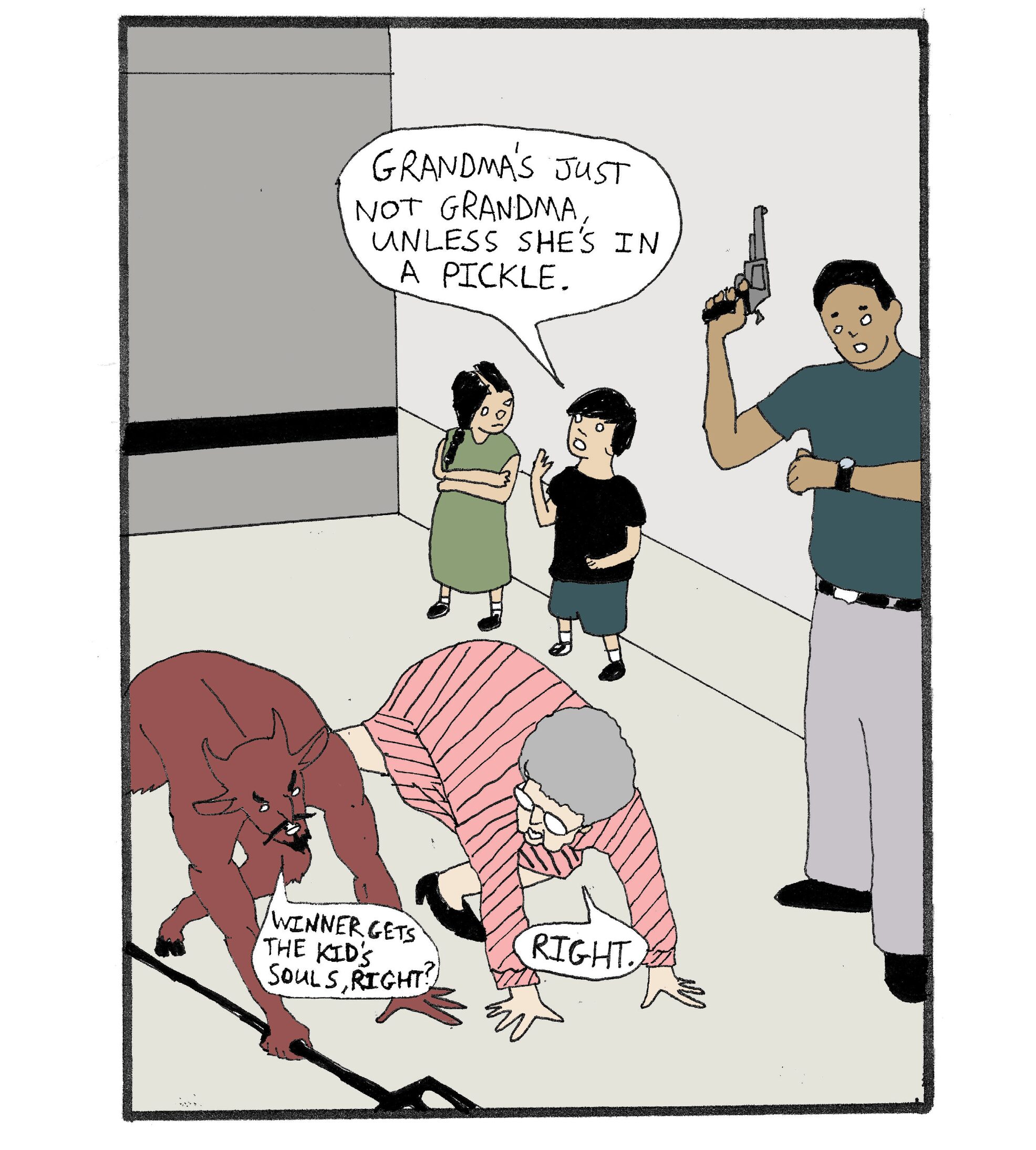


In Spanish, the term feísmo is used to denote ugly technique in the pursuit of ugly truth. In its canonical expressions, it pairs the slapdash with a luxuriant emphasis on the grotesque. It’s a useful concept for the art of Brad Neely: looking at it closely, you can see a developed understanding of figure, perspective, and composition, but the immediate impression it gives is of a person picking up a pencil for the first time.
People of a certain age will remember Neely as the creator of “George Washington,” which a recent YouTube commenter described as “still the most important thing the internet has given us.” Created for a friend who had asked him for a ringtone in the mid-2000s––Neely didn’t have a cellphone and didn’t know what ringtones were––it recites in languid rap over a spare, hazy beat, the supposed doings and attributes of the first American president. “Washington, Washington, six-foot-eight, weighs a fucking ton,” goes the chorus, over an illustration of a wigged figure in a greatcoat on the low end of a teeter-totter, with a one-ton weight on the high end. Washington rides a crystal horse, kills men with his eyes, rescues children, invents cocaine. The verses fuel further speculations as to his grandeur: in the break, as the two rappers wonder just how great Washington was, one remarks, “I heard that motherfucker had, like, thirty goddamn dicks.”
It’s hard to encapsulate what makes this so funny. It’s too silly to be really irreverent; it is absurd, but what does absurd mean? A juxtaposition of incongruous elements: that’s what Kant thought humor was, but much that intends to be funny throws out such juxtapositions and still falls flat. Such is the case for virtually every New Yorker cartoon, which casts a shadow of prospective humor it is too straightlaced to fulfill (they achieve perfection, not in the magazine, but in Matt Jordan and Willy Staley’s @ShittyNewYorkerCartoonCaptions Instagram).
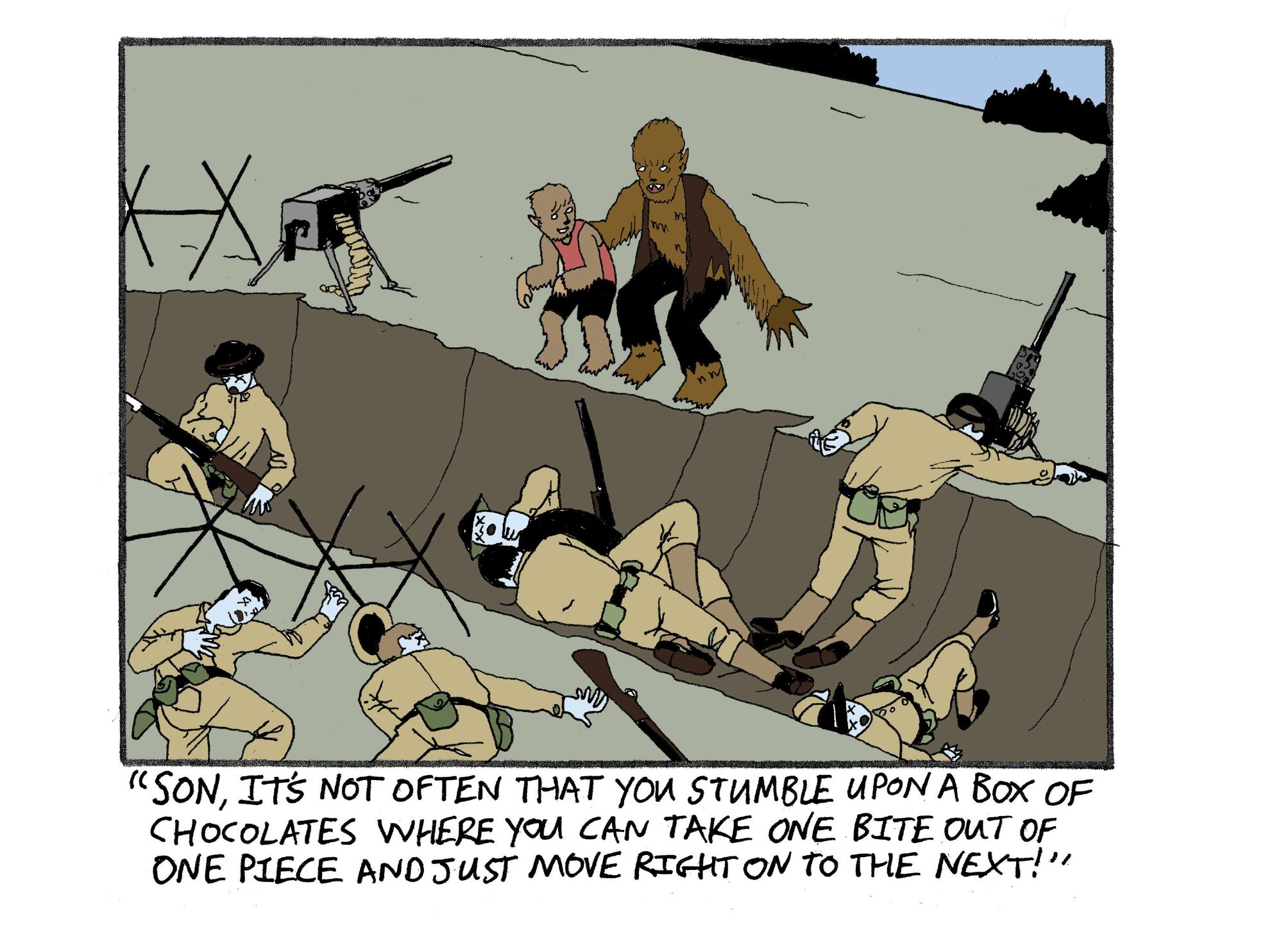
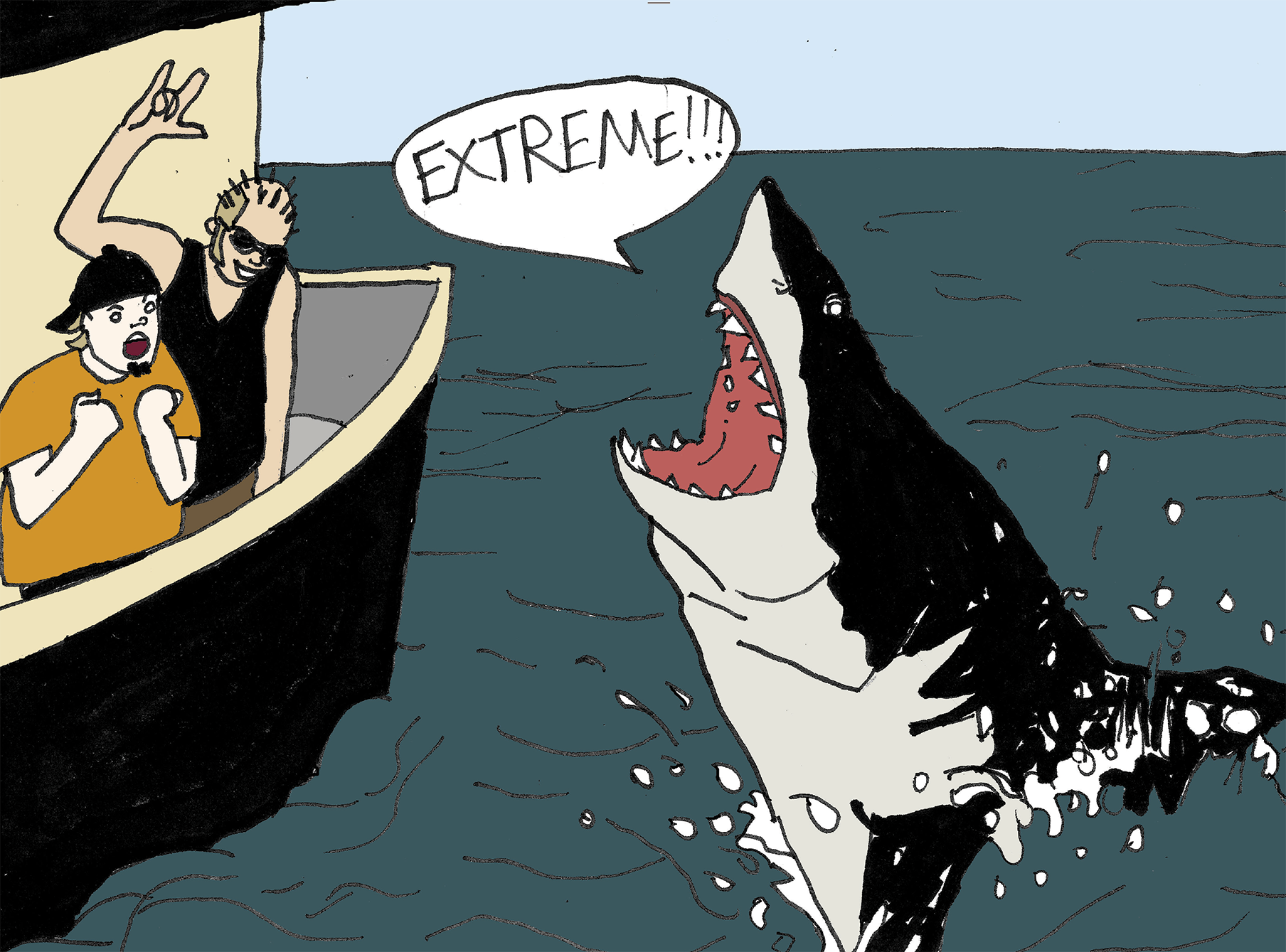
Neely’s Creased Comics began as black-and-white submissions stuffed into the mailbox of a student newspaper in Austin, Texas. For a long time, the color versions were archived at creasedcomics.com; the website’s certificate is now expired, and you get a warning if you try to visit. There was a time when I would show my favorites among them to almost every person I met: the man and woman mid-coitus, him looking like a stolid Groucho Marx, she removing a mask of his face and saying she’s sorry, but can’t breathe while wearing it; the bean-shaped, quadriplegic oldster telling two boys seated at his feet, “That’s when I said fuck it! Live life to the hilt”; and the two men on a boat, one throwing up devil horns, the other a shoo-in for moron rock demigod Fred Durst, gawking at a great white shark that breaks through the surface of the gray waters, shouting, “EXTREME!!!”
This last image furnishes the cover for New York Review Comics’ long-overdue anthology of Creased Comics. “Cathartic” is a reviewer’s cliché, but it is one that applies to Neely’s work: he brings before viewers’ eyes, in a palette of monochrome pastels both dismal and evocative of hokey 1950s optimism, the pretensions, sorrows, vanity, and fears of American life in the suburbs. It is as though David Hockney’s garish visions of carefree California life were allowed to fade and wither in the sun, or as if his subjects had gone mad after decades of floating in swimming pools and sitting at picnic tables and had turned into sexual deviants, obsessive-compulsives, serial murderers.
If a sense of European art’s meaning relies on historical memory––an awareness that a set of disembodied eyes evokes the torments of Saint Lucy, or that the man shearing the pig in Bruegel’s Netherlandish Proverbs (1559) alludes to a Dutch adage about wasted effort––Neely demands a deflation and disregard of knowledge and culture in favor a blithe semi-amnesia in which Jesus is, like, some guy that got crucified, and might conceivably compete for glory with two superheroes trying to rescue him; Caesar’s killers shake their fists and chant the name “Jeffrey” over and over, encouraging a reluctant boy to sink in the last dagger; and a Founding Father taking an oath on the Bible hesitates and asks, “Now, if I do this, I can still eat people, right?”
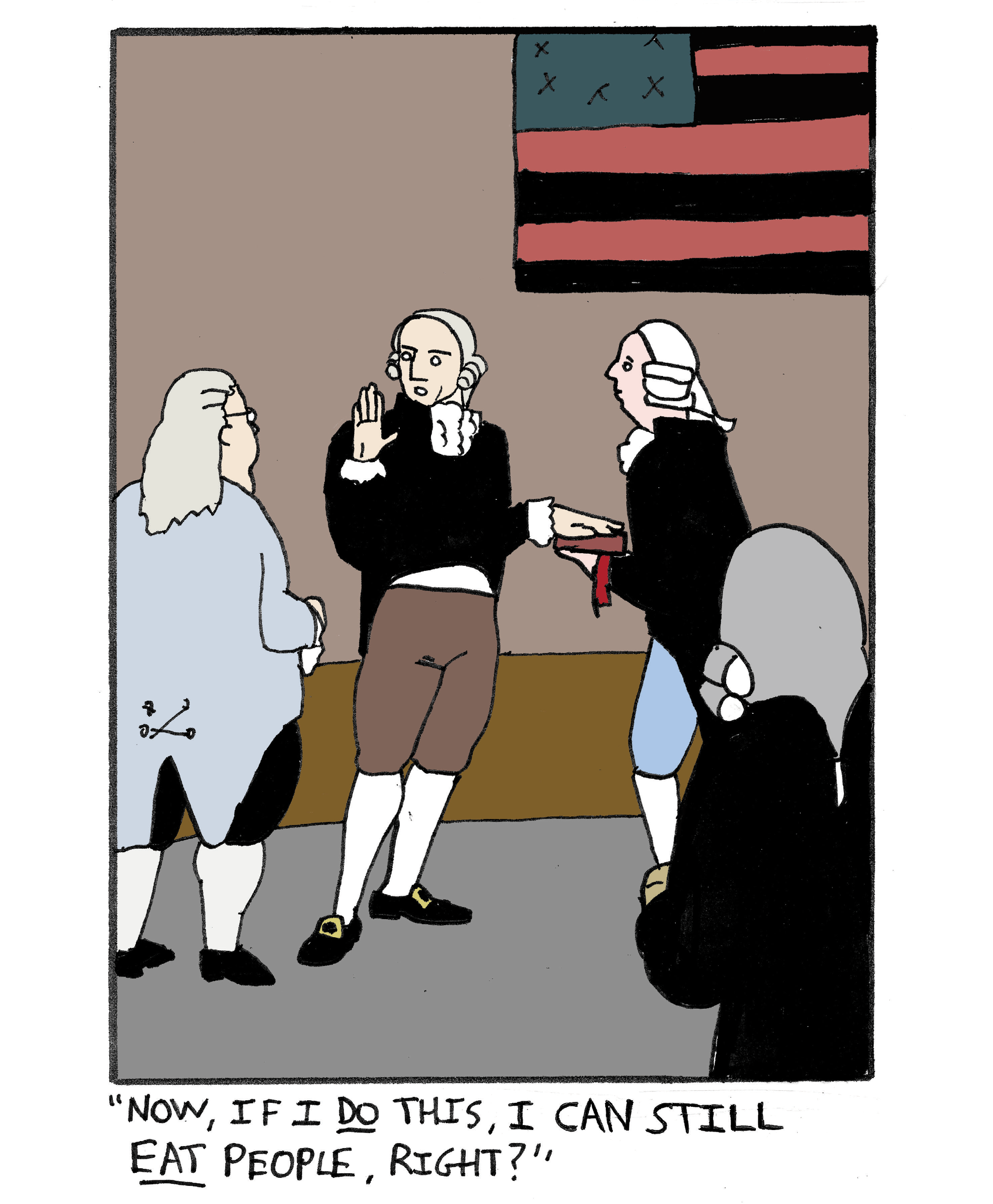
This is too indifferent to be iconoclastic; it lacks the pluck of Renee Cox’s The Signing (2018) or the pointedness of Robert Colescott’s George Washington Carver Crossing the Delaware: Page from an American History Textbook (1975), pieces that displace but do not dispense with the idea of grandeur. Neely’s is an art suited to a post-greatness society––one with statesmen, moguls, and visionaries so second-rate, they couldn’t play themselves in a B movie––projecting into past and future alike the softly giggling abulia that is steadily devouring both. The joke is over, he seems to tell us––the joke being any notion that human endeavor was ever something more than a joke––and what remains is to look at the waste surrounding us, to marvel at its vanity, and to note all the cracks where absurdity is soaking through.
America is notoriously the land of the free––this is a cliché, but in some ways a true one; the problem is we have an expansive freedom-from and a constantly contracting freedom-toward. Our billionaires build dick-shaped rockets and buy yachts with support yachts to hold their helicopters and cars; the lesser among us get alcoholic seltzer, dispensary weed, and sports gambling. The only recurring character in Creased Comics is a lean man in a vest and jeans who sets fire to a Christmas tree, watches a couple having sex through a window, and takes a piss on a snowman; in all three panels, he asserts, “Free country.” His counterpart or saner reflection, epitome of that angst that is undercurrent of all of Neely’s work, is a lonesome moose cradled by brush in the flatlands, gazing up at a snowcapped mountain, and thinking to itself, “I have to get the fuck out of here.”
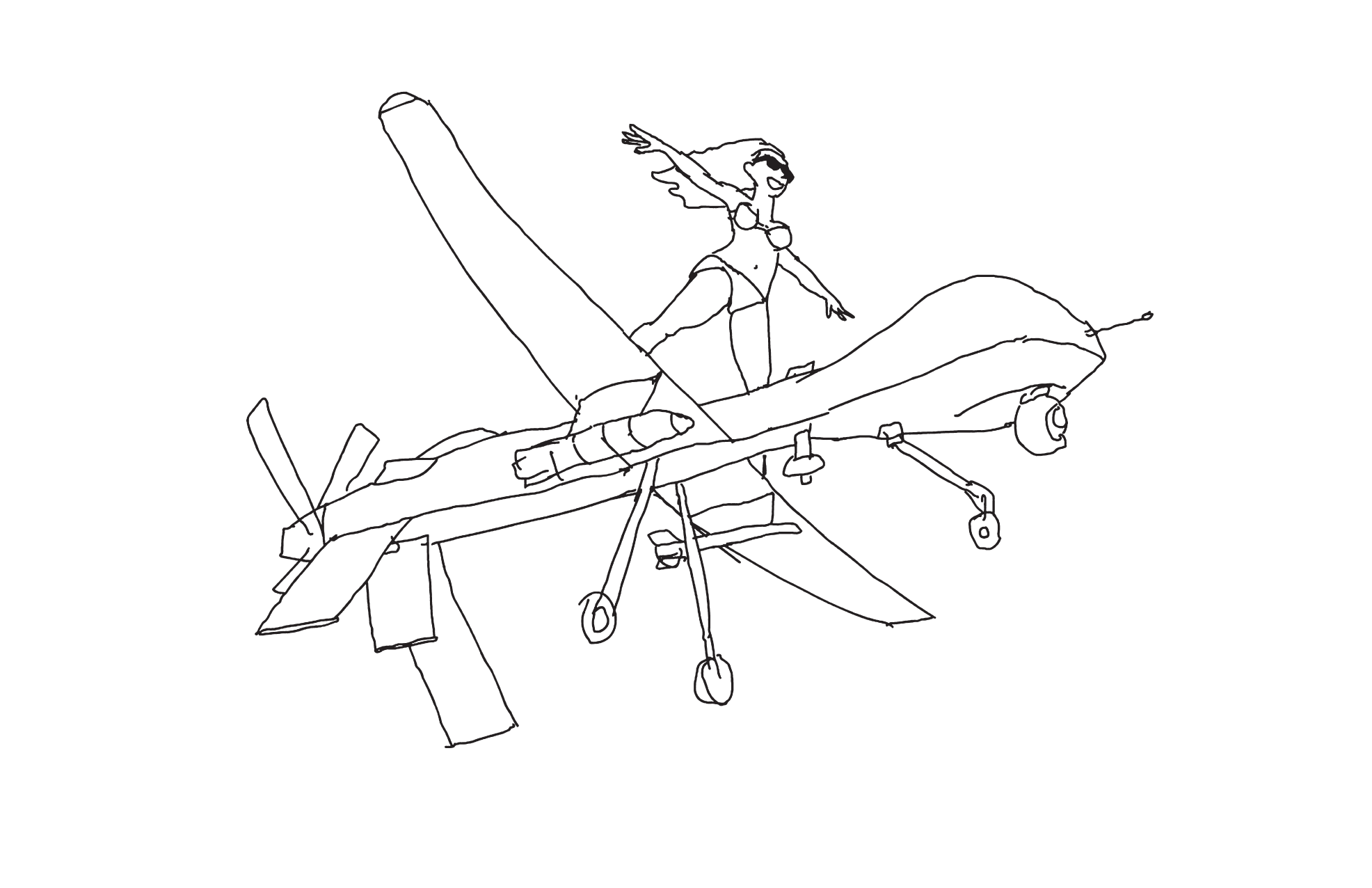
Glory, in Neely’s world, is the handmaiden of delusion—moronically harmless when it is a man in a crop top flexing his muscles in front of a giant Roman statue, sinister when it is a bikini model cheering on top of a predator drone. His absurdity has many sources, but the most abiding one is death. Once you’ve stopped laughing, you can’t help but feel the pathos in a rudimentarily drawn father holding his baby high above his head, asking, “How will I die, me junior?” And there is even poignancy in a fallen soldier on a blood-drenched battlefield confessing to his comrade, who is pierced through the abdomen with a bayonet, “You probably don’t want to hear this right now, but this kind of thing is really beautiful to me.”
Creased Comics comes with a warning on the back: “Suggested for mature readers.” It’s wise policy for the publisher, perhaps, but terrible advice for the public. This is a book that should be shoved in everyone’s hands as soon as they learn to read, like a Gideon’s Bible or a pocket Constitution. If the phone is the distorting mirror that tells us all we’re girlbosses, deal flow guys, ROI thinkers, personal brands, Neely’s pen is a scalpel that whittles us down to actual size: ludicrous, perishable, and frail. Its humor is untimely in an era of vanity as vocation; this makes it all the more essential.