

Casually, colloquially—sifting through photo albums, sorting through obsolete tech in our parents’ homes, watching TikToks ironically warning of TikTok-induced brainrot—we refer to “Y2K” as the start of a new digital frontier. Yet a phenomenon far greater than any symbolic system error would follow just six years later—the genesis of social media as we know it. In July 2006, Twitter (now X) was launched. Come September, Facebook was made accessible to the public after a trial period for Ivy League Students. Meanwhile in Cupertino, Apple wizards were developing the iPhone, although it wouldn’t be unveiled for some time. It wasthis same year, rather conveniently for your writer, that Artillery was founded.
In 2006, I was seven years old and living in suburban Maryland. I wouldn’t move to Los Angeles full-time until 2022—and yet, I can visit digital archives to see museum exhibitions that took place long before my arrival. Using Google Earth’s historical imagery setting, I can even wander through Los Angeles neighborhoods as they existed years ago. Before the fires. Before COVID closures and renovations. Before I had any concept that Street View existed.
An artist can copiously photograph their most recent show and post the pictures to their website, allowing audiences to bear witness to it without ever setting foot into a gallery. They can create work that forgoes three-dimensional space entirely, situated exclusively in the realm of the digital. I can review said work from the comfort of my bed (where I’m writing from right this minute). With a few taps on my phone screen, I can share the review with everyone I’ve ever met, plus a crowd of lurking strangers.
As much as the world is at our disposal, so are we at the world’s.
#Artists, Anonymous
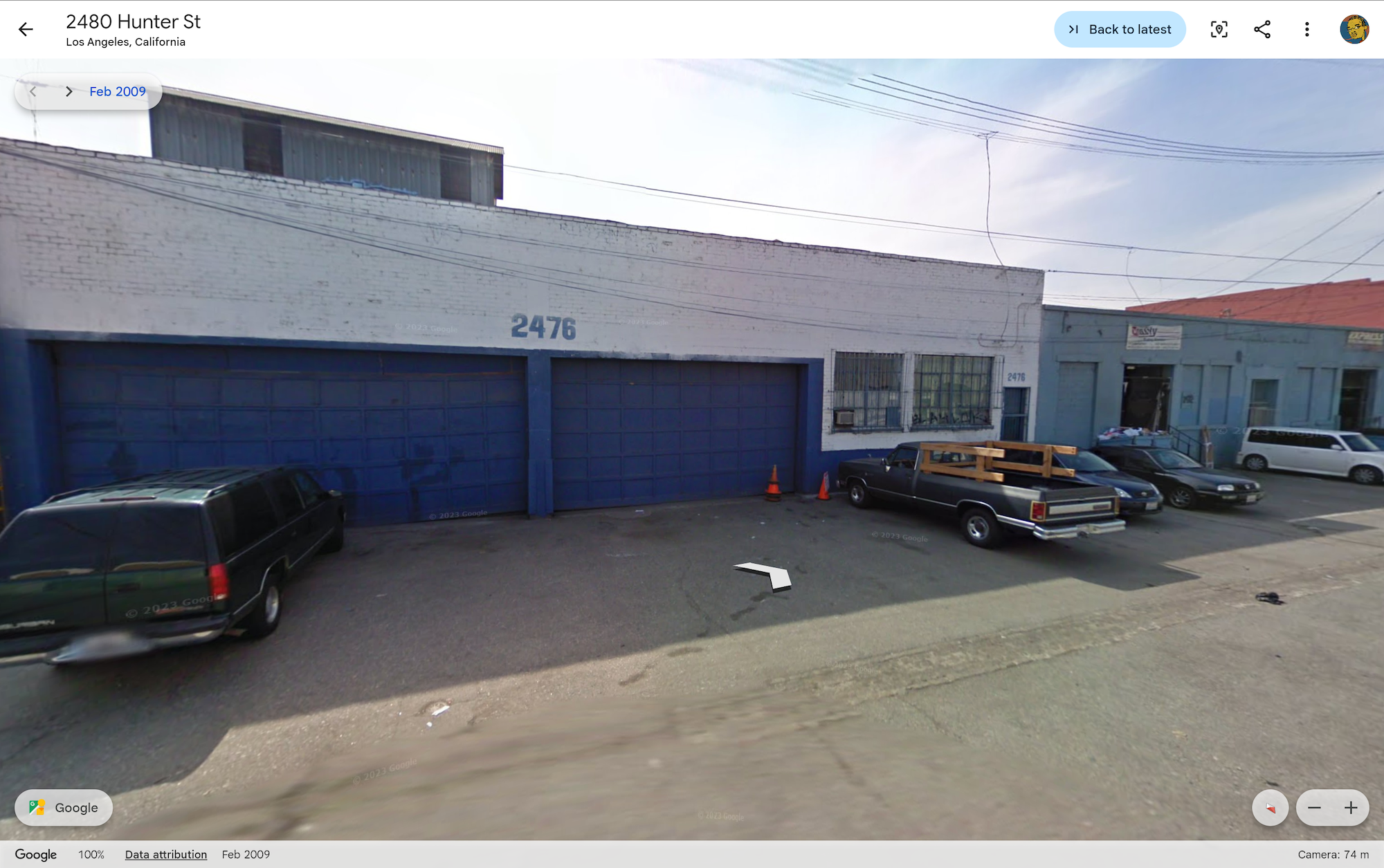
My digital avatar strolls down Hunter Street, two blocks from the freeway in Downtown Los Angeles. The dead-end alleyway’s quiet, primarily used for parking cars—and yet there are signs of life, of creative life. The occasional wall of street art pops up—a tag here, a mural there. Several businesses share the space; I spy a movie set construction company, a gallery called Artbug, a screenprinting shop. On September 15th, 2006, I might have walked this very path in search of “a three-day vandalized warehouse extravaganza” titled “Barely Legal.” Back then, Google’sarchival footage tells me, the cement buildings were drab and colorless, plastered with “For Lease” signs. Yet one of them held a vibrant world within: the third major exhibition by the artist known as Bansky.
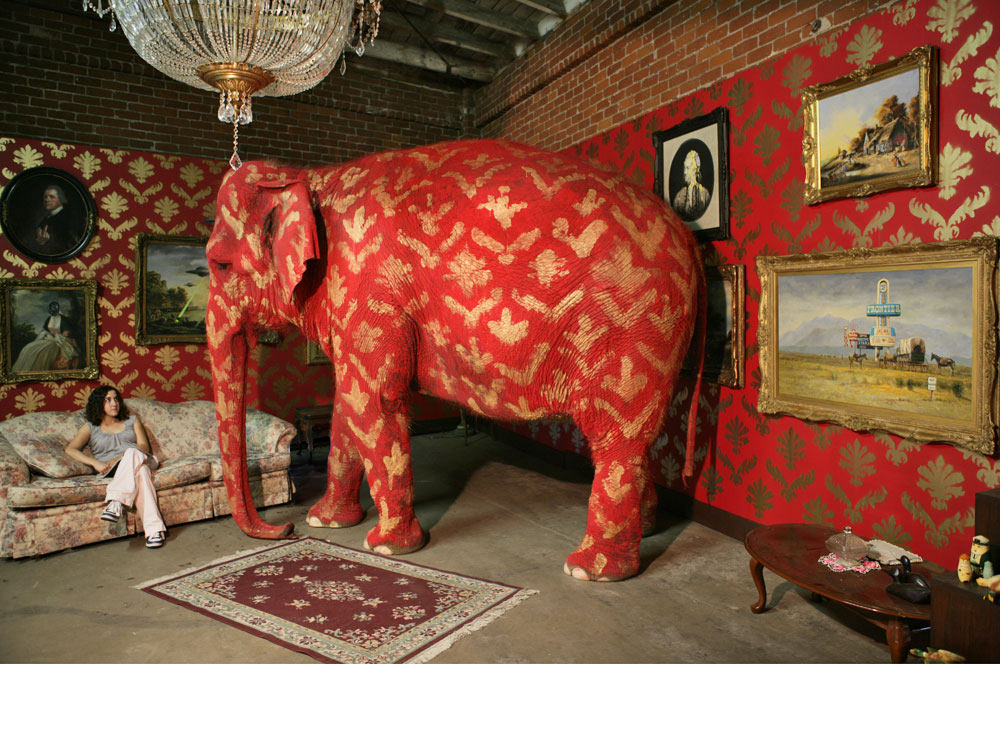
Is Banksy a man named Robin Gunningham, as a March 2026 Reuters investigation asserted? Considering his lawyer’s tight-lipped response to the article (“[Banksy]does not accept that many of the details contained within your inquiry are correct”), we might never know. Not too surprising, and not too disappointing, either. While some of Banksy’s projects might fall into “barely legal” territory, others would almost certainly warrant prosecution were he caught. Besides, the characters who come to life through his graffiti art and installations are continuously more intriguing than the man behind the proverbial mask. Case in point: “Barely Legal” featured a live elephant painted to match a wallpaper backdrop. The exhibition text read as such:
There’s an elephant in the room. There’s a problem we never talk about.
The fact is that life is not getting any fairer.
-1.7 Billion people have no access to clean drinking water.
-20 Billion people live below the poverty line.
-Every day hundreds of people are made to feel physically sick by morons at art shows telling them how bad the world is but never actually doing something about it.
Anybody want a free glass of wine?
Call it what you want, but with Banksy, the medium is the message, and when the medium is a 6,000-poundpachyderm, it’s pretty damn hard to ignore.
Of course, artists need to make a living; some might go so far as to desire a comfortable living, even the anonymous ones. Just a month later, on October 19, 2006,Christina Aguilera purchased one of the simpler worksfrom the exhibition—a piece depicting Queen Victoriaengaged in a lesbian sex act—plus two prints for £25,000. Whether you found Banksy’s sales figures hypocritical or all part of the joke, you couldn’t laugh off his success. Commercialization breeds commendation. As graffiti ever spread throughout LA’s celebrities (Angelina Jolie and Keanu reeves were also reported to be fans), it also caught on with the city’s establishment. In 2007, the“Meeting of Styles: LA” event invited visiting artists to legally spray-paint a 10,000-foot section of concrete paneling alongside the Los Angeles River. Several years later, the Museum of Contemporary Art in Los Angeles would host its most widely attended exhibition to date: “the first major US museum survey of graffiti and street art,” aptly deemed Art in the Streets. Banksy took part with various contemporaries—including Shepard Fairey, who had already achieved institutional legitimacy via his “HOPE” poster for Barack Obama. But institutional embraces of outsider art rarely come by without controversy. As part of the show, MOCA commissioned the street artist BLU to paint a mural along the side of the building; when it depicted dozens of caskets wrapped in dollar signs (rather than the traditional American flag for soldiers), then-director Jeffrey Deitch ordered its removal within 24 hours, citing insensitivity with respect to a local veterans’ hospital. Such clashes between daring and decorum happen often, and yet they are rarely so visually apparent.
Today, as bootleg “Girl with Balloon” merchandise abounds and fellow LA-made street artist Alec Monopoly designs custom boxing shorts for Jake Paul, it’s tempting to dismiss Bansky and his ilk as trite. (Consider a memeI’ve had saved on my phone since 2018: a brick wall rendered in Microsoft Paint, emblazoned with the crudely scrawled slogan “they call emcell phones because they hold us prisoner and stuff —BANKY.”)Given Banksy’s elusive nature, it’s easy to forget the real stakes behind his stunts. Some of his slogans might now remind us of engagement-baiting social media posts, but he was spray-painting his thoughts onto brick and cement long before anyone posted their joys or grievances to a Facebook wall. When we look past graffiti’s co-opting, we can recognize how it might serve as a sort of public commons not unlike an online feed. Detached from the trappings of identity, artists can engage in the kind of dialogues that Internet censorship might not allow—their tags and crude caricatures not unlike usernames and profile pictures.
#Art in Abundance
Shepard Fairey’s proclamation of Hope was fulfilled, not only for Obama but for the Los Angeles art scene. By the 2010s, a field trip downtown was no longer an absolute necessity for those who wanted to take in contemporary art.
Pacific Standard Time helped to kick off the craze. Between 2011 and 2012, over 60 galleries united to present exhibitions encompassing “Art inLA 1945-1980”; shortly after, critic Kevin McGarry proclaimed via T Magazine that the “LA Art Invasion” had arrived. Here comes the part of this article that might easily be reworked into a new version of “We Didn’t Start the Fire” with some creativity. In 2014, Frieze announced its impending arrival in the city, marking it an art market to watch. In 2015, The Broad opened its doors—MOCA’s trendy younger cousin. In 2016, the Marciano Art Foundation and Hauser and Wirth followed. By 2017, Sprüth Magers had joined in; 2018 brought the Institute of Contemporary Art into the mix. In2019, cue the fanfare, Frieze came to town, with Felix concurrently taking the Roosevelt Hotel by storm.
Yet to the untrained observer, much of this remained invisible. Even the hottest new transplants—those who had the talent and momentum to secure a feature in the first place—enjoyed a sense of surreptitiousness in the shadow of the Hollywood sign. And they loved this “possibility of disappearing,” as Amalia Ulman put it.
From McGarry’s piece:
“In L.A., artists can test things out without the glare of the spotlight,” says Ali Subotnick, a curator at the Hammer Museum, who moved from New York in 2006. “The proximity to the entertainment industry guarantees that the art world will never be the main industry in this town, so artists are able to work on the sidelines.” Anonymity has become its appeal: Like no other place, L.A. offers artists the ability to be alone, together.
Down the line in 2015, the NYT proper touted LA as potential paradise for Big Apple transplants in particular. A roundup of former Brooklynites shared their surprise at the freedom LA offered the average artist, allowing them to shed concerns about rent and reputation and focus on their practice.
“On the east side, where we live, we know maybe four or five people who work traditional9-to-5 office jobs, out of our entire friend circle,” said Hamish Robertson, an artist and designer who lives in Los Feliz with his wife, Andi Teran, a novelist. “And if they do have them, it hasn’tcome up, because people rarely ask what you do for a living or where you went to school.”
In other words: While the New York artist would perpetually find themselves keeping up with the Joneses in terms of industry success as well as expensive brunch orders, The Angeleno artist, hypothetically, could toggle between two parallel realms—the excitement of national, even global notoriety via newspapers and blogs, and the day-to-day solace of a retreat amidst the palm trees. Before “micro-celebrities” introduced the notion of a fame that isn’t pervasive, LA artists learned that there’s more than one way to be a star.
#Artists, Automated
Return with me to Hunter Street, or its virtual analogue. Scrolling through the 2010s, we can witness the rise ofHunter Street Studios, a loft building providing studio space for various artists-in-residence; Print Renegades, the aforementioned screen printing atelier; a cutting and fusing service for textiles; more graffiti. Looking back from the future, we know when the hubbub would come to a halt. The offices closed. The schools closed. The galleries closed—and yet, supposedly, a new type of art was proliferating, one that could be purchased and experienced entirely online. Do you remember where you were when you heard the word “blockchain” for the first time? We were primed for the rise of NFTs, non-fungible tokens, by the hype around Bitcoin. Crypto bros were eager to extol the virtues of a decentralized and stable system of currency as they waved off environmental concerns; NFT heads, by and large, spoke less of such lofty matters. The art itself was unexceptional: who cares about the composition of Bored Ape #6969?
What mattered was not the cartoon chimpanzee but the link and number attached to it, designating you as the image’s exclusive owner. The simplicity and seriality of the Bored Apes was perfectly attuned for a moment when so many of us Homo sapiens, reduced to our most animalistic nature in the captivity of the COVID-19 pandemic, found ourselves, well, ridiculously bored. Check this out—you can become an Art Collector without having to curate taste, or go out to a gallery, or figure out how to display it in your home in an interesting way. The rapid evolution of AI tools has led to a similarly individualistic obsession with identity amongst some users. Despite much progressive distaste for ChatGPT, Sora, et cetera, it is curious that many avowed devotees of Generative AI have co-opted the language of accessibility and inclusion to argue their cause—implying that the ability to claim a certain level of artistic “expertise” should be a right rather than a privilege. The end game is not necessarily to make art, but to declare that one has made it—and therefore, that one is a “real artist.”
In criticizing the proliferation of AI-generated work, many artists find it important to investigate whether the art made by AI is bad, either through subjective surveys or the scientific method. This is a red herring. Excessive concern over the quality of AI writing reveals an obsession with proving oneself as one of the chosen few, gifted from birth with exceptional talent. A more thought-provoking task is to inquire why AI developments might be alluring in the first place, to creators as well as the consumers of their output.
Consider the work of Jon Rafman, who lives in Los Angeles but refers to himself as a “post-studio artist”(and, incidentally, whose oeuvre makes frequent use of Google’s satellite imagery). Rafman has been invested in digitally-rendered alternate realities since he started giving tours of Second Life as the Kool-Aid Man in 2009. Fifteen years later, in 2024, he debuted Cloudy Heart, an AI-generated “popstar” who would go on to answer questions from Petra Cortright, Lucy Bull, and other creative SoCal “contemporaries” in an Interview Magazine roundtable—before achieving a single hit.
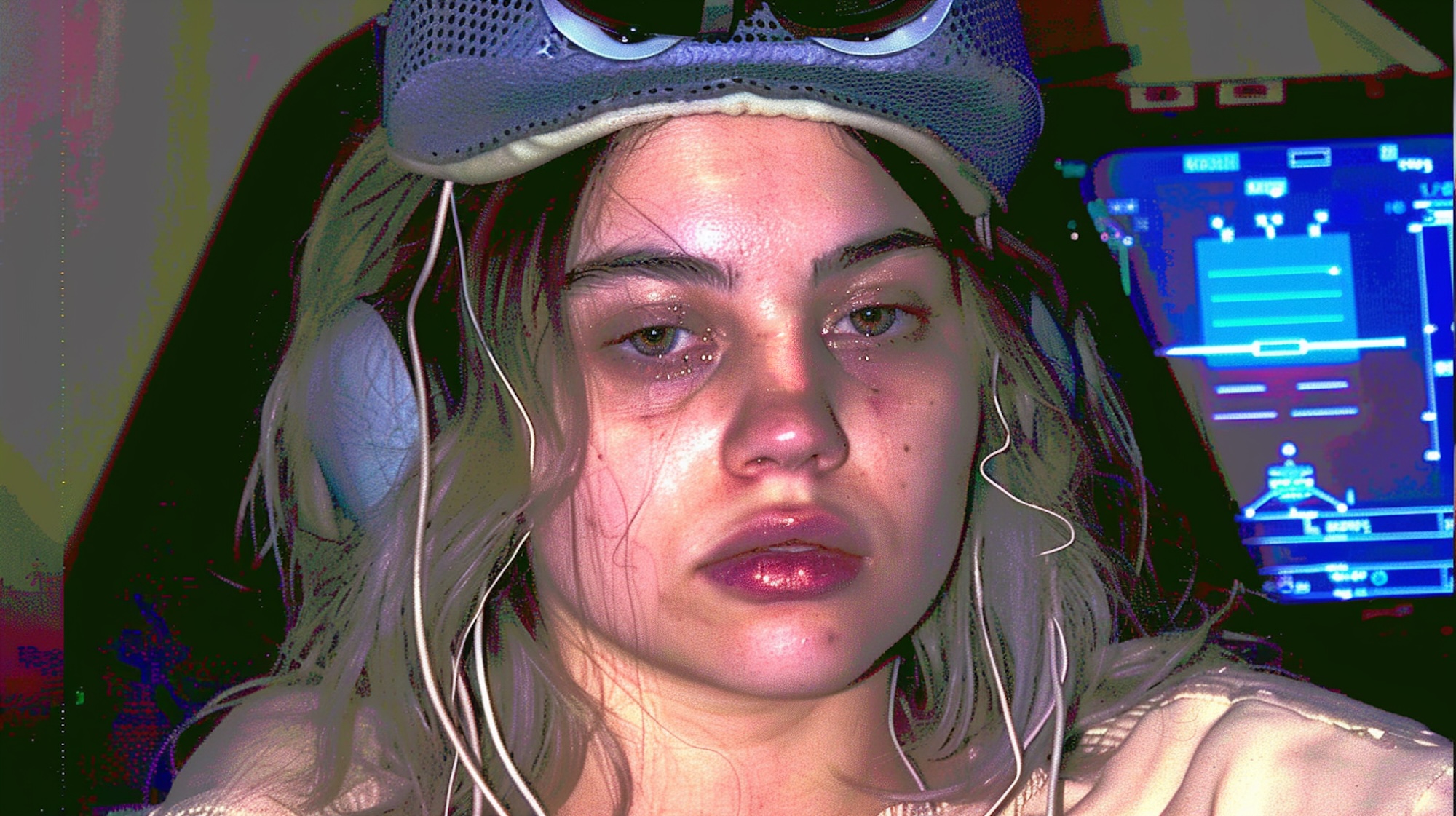
In creating Cloudy Heart, Rafman was not aiming to conquer the entertainment industry like Tilly Norwood’s human handlers; his interest might safely be defined as exploratory rather than commercial. Before writing this article, I had never heard her music—just seen her likeness on my Instagram feed about a billion times, always mutating slightly, but with the same easily describable features. Heart’s niche popularity makes all too much sense in an era where algorithms prioritize faces, yet privacy remains a concern for even the most forthcoming Internet users. Lacking a past, a social network, and a human sense of vulnerability, Heart could expose as much of her life as she wanted without risk of reputational damage or harassment—or even simple embarrassment. Perhaps in the near future, flesh-and-blood influencers will create digital copies of themselves just to get away from the discomfort of presenting themselves to their followers, trusting that the distinction between the real and the false will continue to hold some minor significance.
#Artists, Anonymous (Pt. 2)
Looking back at the past twenty years—with the clarity offered by the passage of time and the perspective of the algorithm—the trajectory of contemporary art in Los Angeles comes into focus. Hollywood was always built upon mythmaking. How logical that the city’s growing art scene should make itself in its image.LA’s capacity for reinvention exists in tandem with its tendency toward recursion. Although we might not be able to discern exactly who’s driving its future (or even its present), we can have some confidence in what that future will look like—a series of mysterious, archetypal avatars upon which the masses can project, whether they’re doing so by word of mouth, social media, or Neuralink. After all, La La Land loves a star, but even more so, it loves a promising nobody.