

Everyone seemed to agree that “Alone, alone, all, all alone was topical. The word hovered around the opening at Ehrlich Steinberg with the peculiar force of consensus: loneliness, online life, avatars, algorithms, the thinning distinction between connection and its simulation. One hardly needs convincing. The exhibition’s premise arrives already confirmed by the conditions outside it.
Its title, borrowed from Coleridge’s “The Rime of the Ancient Mariner,” announces solitude as its subject, while the accompanying text locates that loneliness in the familiar conditions of contemporary life through phrases like “numbing connectivity” and communication “filtered through avatars and algorithms.” It also pauses over the etymology of alone: a contraction of all ane, “wholly oneself”—a strange phrase to carry into a group exhibition.
To be alone is to be all one; to be complete, perhaps, or merely sealed. The difficulty is what happens next. An essay can name a condition; an exhibition has to produce relations between things. Across works by Ramsey Alderson, Ella Fleck, Ant Łakomsk and Erin Calla Watson, “Alone” circles questions of intimacy and distance, but the works do not always submit easily to that frame. At moments, this looseness feels productive. At others, the exhibition resembles four distinct practices waiting for the viewer to provide the connective tissue.
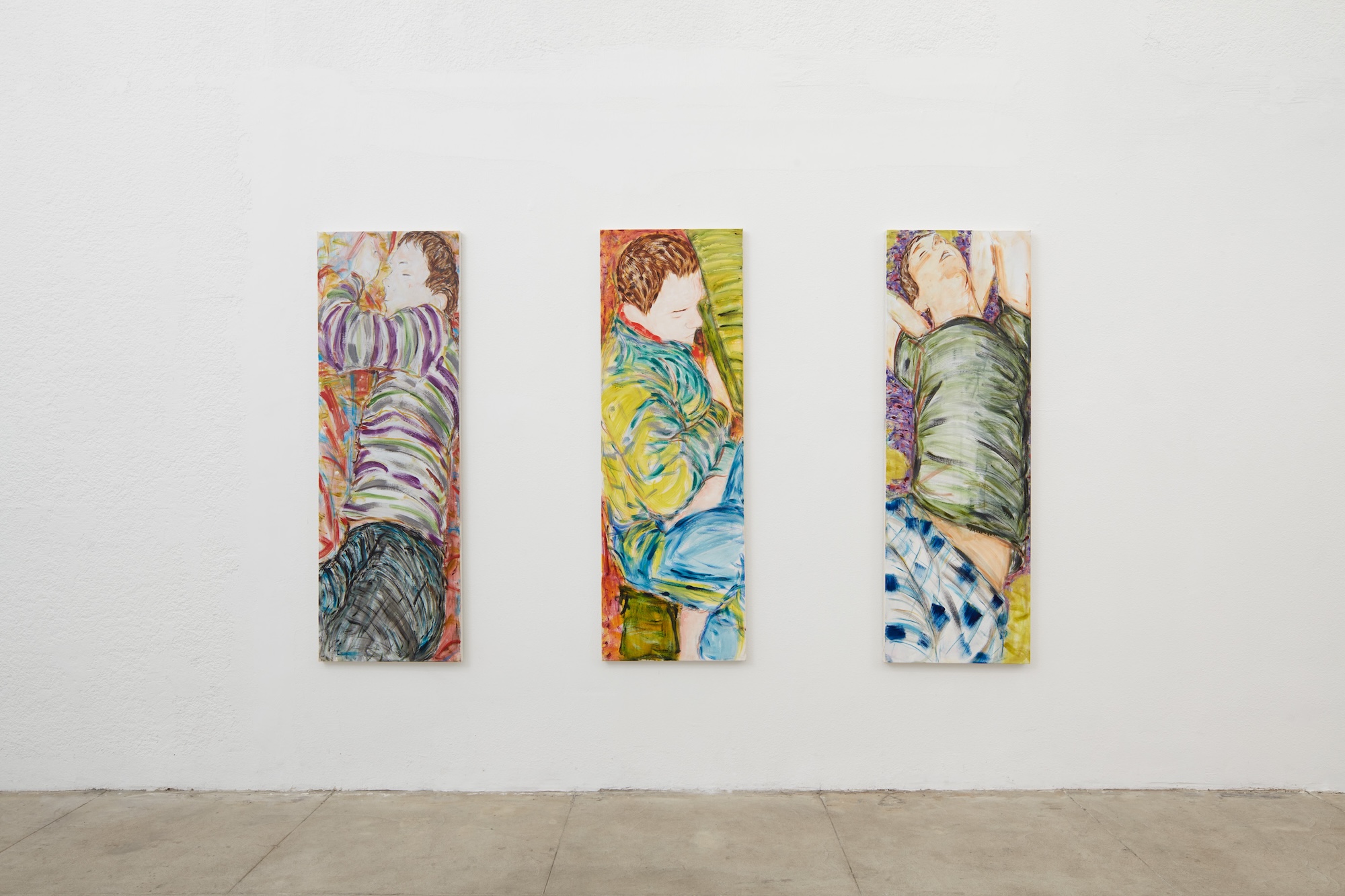
Ramsey Alderson’s three paintings are the exhibition’s first encounter. Three elongated canvases transform reclining male figures into improbably vertical images. Bodies that should sprawl horizontally become upright, compressed into narrow columns that feel almost devotional. Faces disappear into shoulders, patterned clothing competes with flesh, and each sleeping figure seems suspended somewhere between vulnerability and withdrawal. Their scale lends them a quiet monumentality, but the paintings resist portraiture’s promise of full access. Rather than revealing their subjects, they seem content to let them remain unavailable.
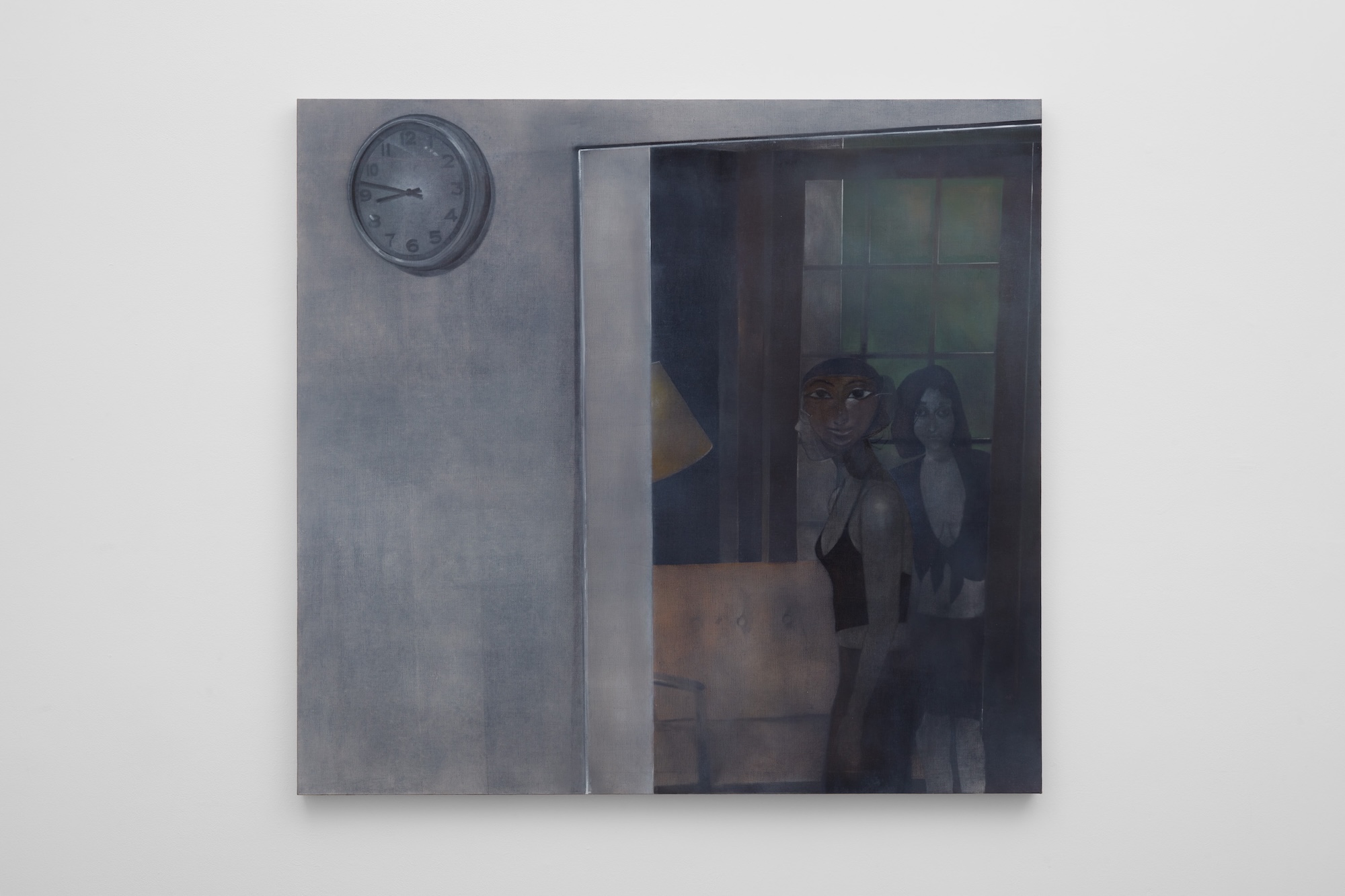
Ant Łakomsk’s Egyptian Wing (all works from 2026) and Egyptian Wing 2 approach distance differently. Their muted surfaces layer windows, architecture, and corporate-looking figures until looking itself becomes uncertain. An Egyptian sculpture occupies the same pictorial space as contemporary bodies; a wall clock quietly anchors the scene to ordinary time while every other spatial cue slips out of focus. The paintings feel less interested in solitude than in mediation. Every encounter arrives through another surface.
Erin Calla Watson’s photographs introduce another kind of remove. Their titles identify precise locations, while the images themselves remain oddly unspecific—a house with a boy looking out the window, a railroad with a face shape cut through stone. Human presence is registered indirectly, through architecture and infrastructure rather than through the body itself. Read together, the four artists seem to share an interest in what remains once direct presence has been interrupted.
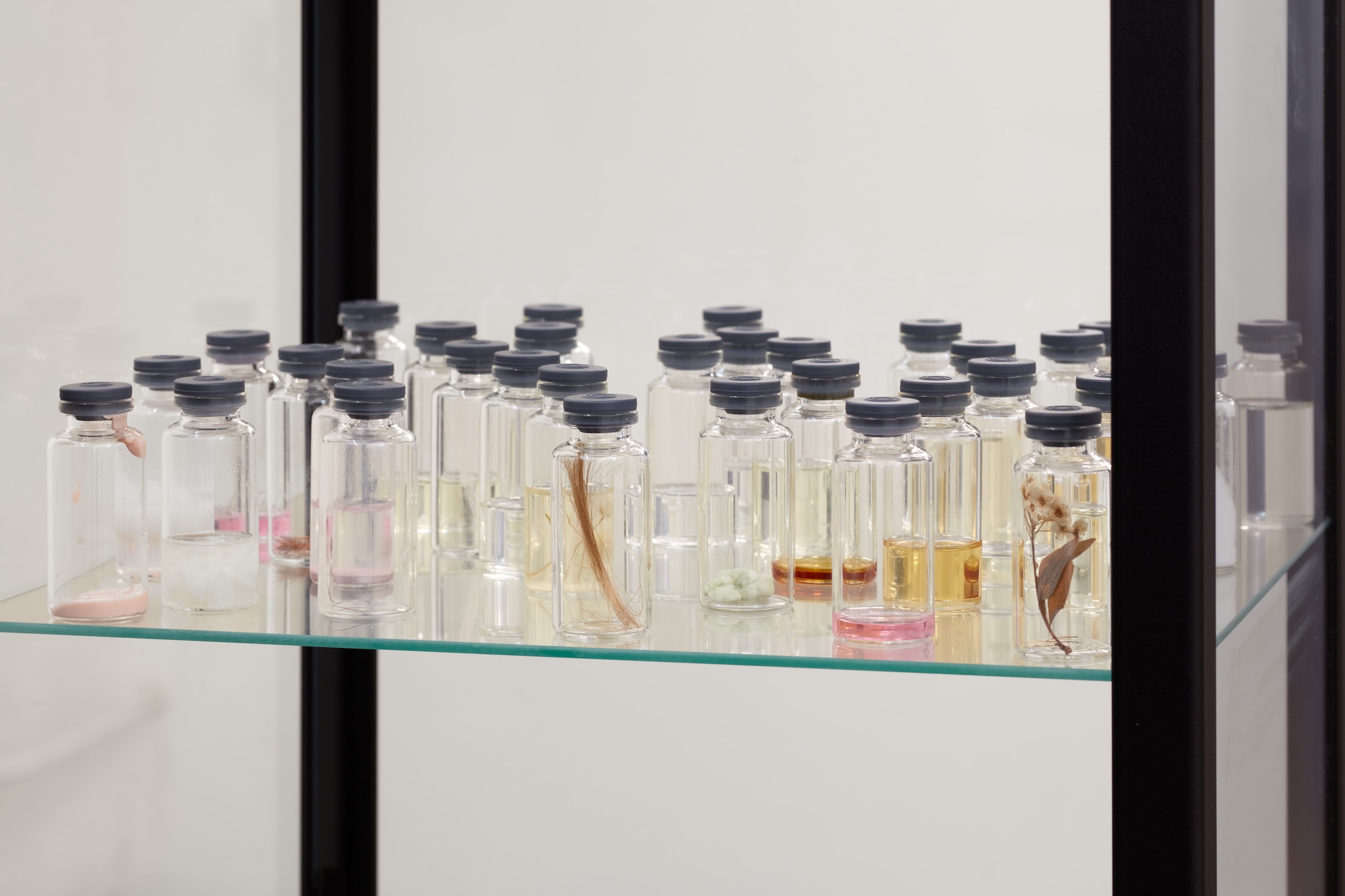
The loneliest object in “Alone, alone, all, all alone” may also be its most crowded. Ella Fleck’s a zombie resurrected by a ghost (2026) contains one hundred glass vials filled with the chemical and material evidence of a body: saliva, urine, hair, eyebrow hair, lipstick, hand cream, perfume oils, dried flowers. The checklist runs on for nearly half a page, moving promiscuously between the intimate and the industrial, from keratin and mucin to Baby Powder fragrance oil, cadaverine, and White Musk. It is an extravagant portrait assembled through residue rather than likeness.
Perhaps the exhibition’s looseness is appropriate to its subject. Loneliness rarely presents itself as a single experience, and these artists approach it through distinct visual languages: Alderson through bodily intimacy, Fleck through bodily residue, Łakomsk through layered perception, and Watson through photographic fragments of landscape and domestic architecture. Still, there is a difference between withholding connection and failing to produce it, and “Alone” is most compelling precisely where that distinction becomes harder to maintain.
It was difficult to look at the work without also looking at everyone else looking. For an exhibition about aloneness, the room was almost comically full. This may have been an accident of timing, but it clarified the exhibition’s central difficulty. Loneliness is easy to recognize and remarkably hard to exhibit.