

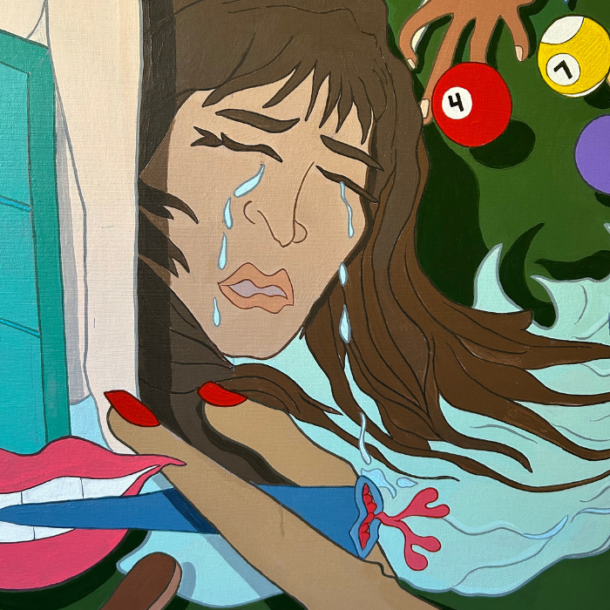
Currency Exchange is pleased to present Cast Shadows, a presentation of sculptures by Andy Montiel-Phillips and large-scale paintings by David Vega, nothing is as it seems at first glance. Bright colors, cartoon shapes and referential and ubiquitous symbols, icons and fonts create a quick access point and immediate familiarity, only to divulge into something darker and more distorted. The familiar becomes a kind of mirror—reflecting personal memory, popular culture, and our collective psychic entanglement with a muddy national history back at us.
A visual storyteller, Vega blends vibrant color palettes with crisp lines, striking patterns, and abstract forms to create large-scale paintings that offer an all-too-familiar, dizzying reconciliation of contemporary visual culture and history. Vega’s paintings are an accusatory gesture—confronting histories of Indigenous displacement, massacre, exploitation, and cultural erasure. Through his work, Vega questions who has been given the authority to record history, whose stories have been erased, and how those erasures continue to shape the way he understands himself today. The works are direct in their intent to reclaim and remember.
In his most recent work, this investigation turns inward. Vega questions what it means to understand oneself as Indigenous while growing up within a Catholic framework—a faith imposed through colonization, where conversion was often accompanied by violence and the destruction of sacred traditions. He asks what happens to ancestral identity when the gods, rituals, and beliefs of one’s ancestors are replaced or forbidden.
Montiel-Phillips uses symbol and technique to reduce the artwork to a cartoonish state in which viewers can enter easily and are rewarded the more they invest. The simplicity also allows for projection – something inherent in nostalgia – a principle focus of Montiel-Phillips work. Nostalgia is a powerful psychic tool. At its most benign, it allows for an almost euphoric daydream—a temporary disassociation from a difficult present. At its most consequential, nostalgia can become a political tool, reinforcing a desire to return to a past that either never existed or existed only through the exclusion of others. Montiel-Phillips utilizes one of the most emblematic symbols of the post-war idealism of the 1950, the white picket fence. In Specter, the artist sets a fixed perspective of this iconic architectural feature. There is a frontal logic to the work that operates similar to a facade. The freedom of the viewer to navigate outside of the fixed perspective demonstrates a time based disintegration of the original perspective, reminiscent of the fallacies of a unified national identity.
In How it Feels to be Alive, Megan O Grady writes “Our understanding of the universe is determined by ever-evolving parameters and by the distance between our present reality and how we once perceived things. We know more, and we know differently. Occupy another position in the orbit, and a slice of the world once cast in shadow comes into the light.”
The meeting point of the distorted reflection that emerges by looking into the past and a desire to accurately reflect our current “post-truth” (sometimes already distorted) reality is at the core of Cast Shadows. And as we sit at this inflection point – we wonder as the point in which we shine a light on truth is forever moving – how might the shadow that is cast on this current moment shift in ways we can’t currently even imagine.
The meeting point between the distorted reflection that emerges when looking into the past and the desire to accurately reflect our current, “post-truth”—and sometimes already distorted—reality sits at the core of Cast Shadows. Both artists use familiar imagery to question how we understand the past, and how that understanding shapes our current perception of reality.
And as we sit at this particular inflection point, the exhibition leaves us with another question: if the position from which we shine a light on truth is forever moving, how might the shadows cast by this current moment shift in ways we cannot yet imagine?
About CXLA: Currency Exchange is a neighborhood-first arts and community center rooted on Washington Blvd. in Mid-City Los Angeles that creates space for community to practice and integrate the exchange of alternative cultural currency. Born from the evolution of DMST Atelier, Currency Exchange expands the role of the traditional gallery into something broader: a neighborhood resource. Through its art gallery, artist residency, supportive programming, partnerships, outreach, and engagement, CXLA facilitates a space of care and connection between artists, neighbors, and residents of the affordable housing community above the gallery.