

When Liv, my middle sister, was three years old, she drew a perfect still life in sidewalk chalk. She rendered a side table and vase of flowers with a consistent perspective as if second nature, like a spider spinning a web. My dad loves this story and has told it so much that the anecdote is shaped by his own narrative flavor. Even though I was there with Liv, when I try to remember the event, I always picture the drawing through my dad’s eyes. The photo he took, after running into the house to grab the family camera, is from his perspective as well.
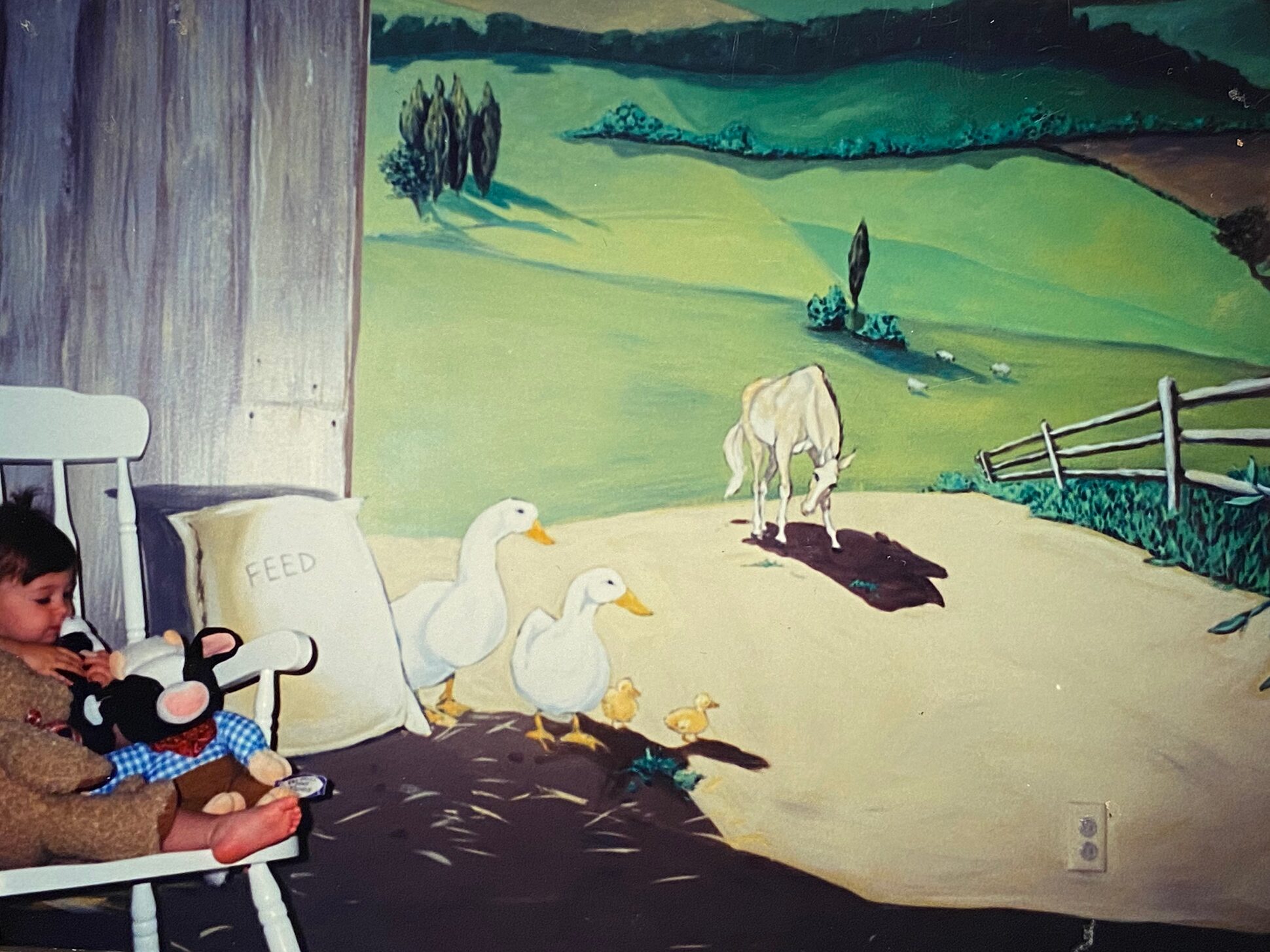
A lot of our family photos are of art. My dad is an artist and the murals he lovingly painted in our bedrooms served as the backdrop for many childhood photos of my sisters and me. We had rooms painted like a pet store and a barnyard and a Parisian pied-à-terre at various points in time and in various houses. In plastic storage tubs of photo albums and sketchbooks as well as in dated folders on the family PC, my family has always archived art alongside snapshots of birthday parties and holidays. We grew up in very different circumstances than our parents did, with more stability and the kind of unconditional, judgement-free support they didn’t invent for kids until after the 1970s. And on top of all that, we had unlimited access to the materials in the basement studio. It was pretty sweet.
My dad’s paintings are often about his own childhood. A lot of his recent work employs symbols of youth—Fisher-Price toys, comic book clippings, and ACME bombs—as reliquaries of childhood emotion. Sometime after I was born, my dad ditched the plans he made in a
rt school and got a better paying job and didn’t paint for a few years. When he returned to art, he began creating these giant abstractions of text. The stories told in the text paintings were personal narratives from his childhood and adolescence, but the letters took on crabbed geometric forms, rendering the unguarded stories illegible.
He wouldn’t tell anyone outright what the words were, so I would sit in the hallway and stare at the massive paintings there and puzzle through the narratives. I’d read as far as I could memorize the text to house guests like a party trick. Horse Heads, my dad’s first painting in this series, begins with the words, “I knew I wanted to be an artist when I was four years old…”
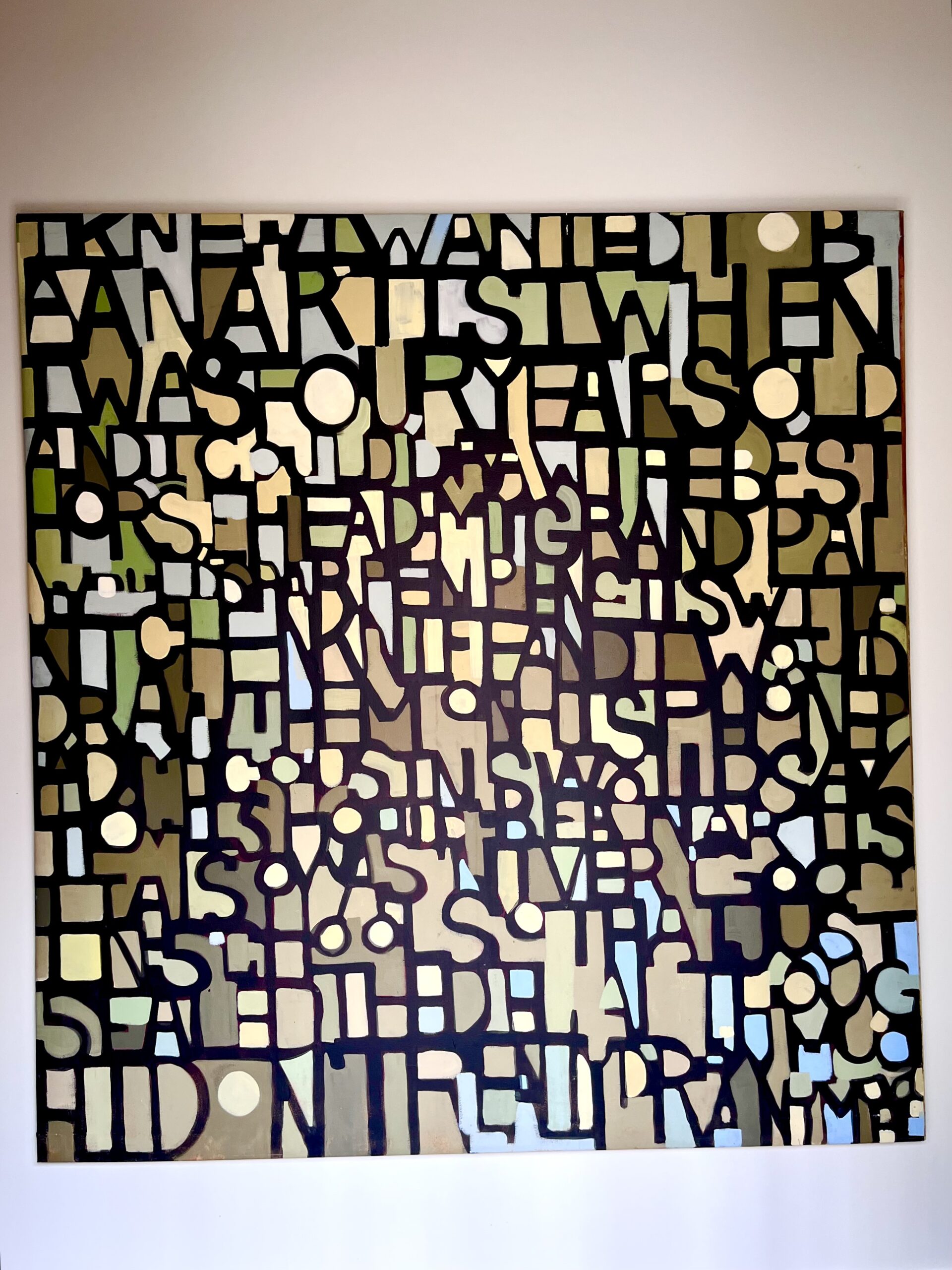
Horse Heads
I asked my dad, recently, whether he was so fond of Liv’s chalk drawing because it so closely mirrored the story he tells in Horse Heads of his first display of natural artistic ability being recognized by his family. I was surprised to learn he had never consciously made the connection, even though he was developing his obscured text style to retell this story around the same time Liv displayed her incredible grasp of composition on the driveway. Upon reflection, my dad wondered in hindsight if seeing Liv embrace creativity so freely reminded him of the encouragement his mother gave him and, consciously or not, pushed him toward painting again.
Like my dad’s text art, I also distort personal stories, sometimes in order to repackage reality into little character details in my fiction and other times to achieve a better punchline when trading anecdotes at a party. I don’t write very personal fiction, but I know my perspective and experiences seep in anyhow. I worry about potentially embarrassing parallels my loved ones might see between my life and my characters that I did not intend and about, in this way, offending them.
My sisters divulge more of themselves in their work than I feel capable of doing. In some ways, the stories they tell through their work feel more immediate and real than if we were to sit around the dinner table and reminisce together. When I hear Greta’s old breakup songs, she being the baby sister and musician of the family, I am flooded with so much more empathy than what I felt sneering at how dramatic she was being over her high school heartbreak. I feel more emotional about sisterhood when I look at Liv’s paintings than I do when I look at our childhood photos.
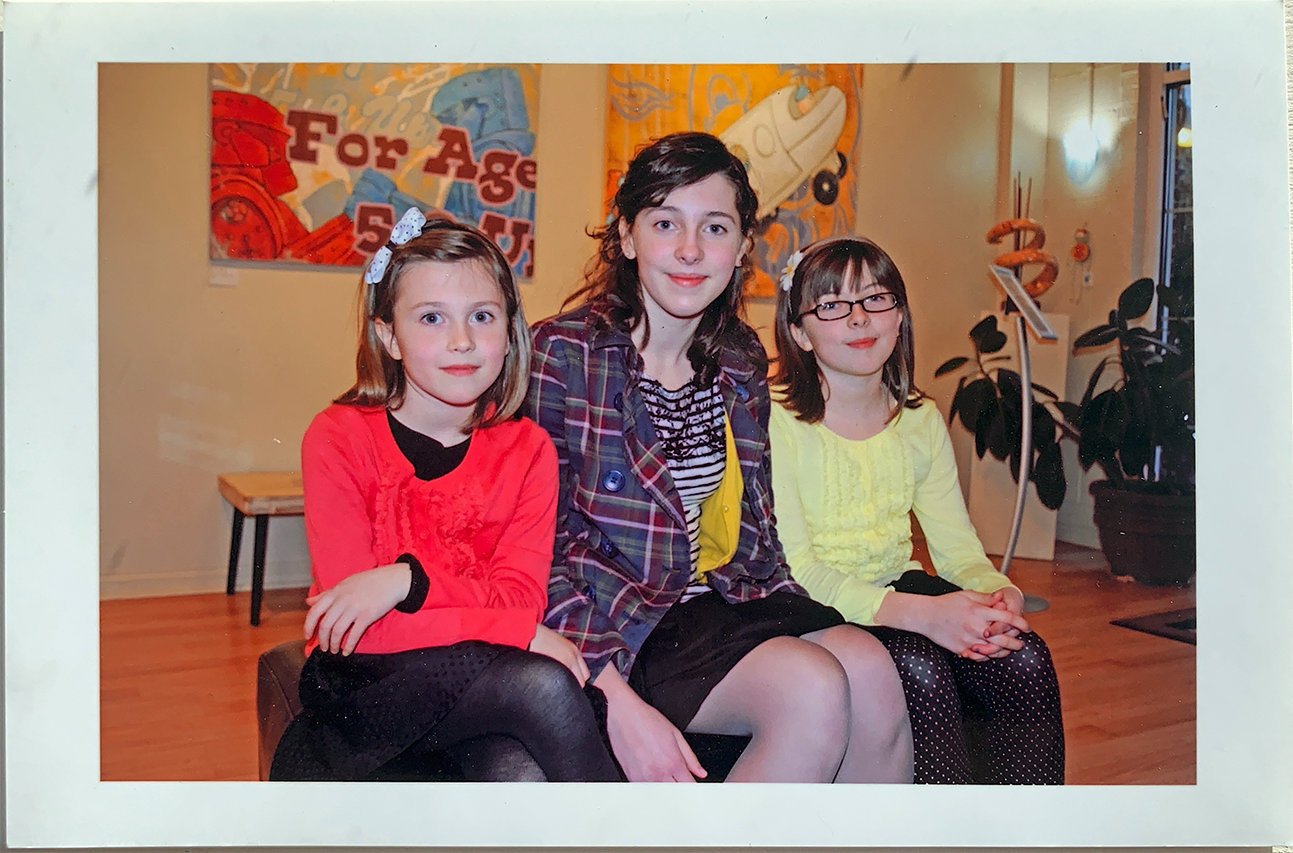
Greta, Ella, and Liv
Most of Liv’s portraits resemble flash photos disturbing subjects in private, domestic scenes. She poses her subjects to look surprised and annoyed by the intrusion of observation, leaving the viewer feeling voyeuristic. I know this because Liv mostly paints family members and I’ve been on the receiving end of her direction.
I wish every person who views her work could know that she got the light exactly right. That portrait of Greta replicates exactly how the TV glowed on her face in the living room and the one of me laying on the duvet captures the particular warm cast of that bedside lamp. The house Liv painted so many of these portraits in has been sold and I wonder if, overtime, my memory of how it felt inside will fade outside of these posed candid moments.
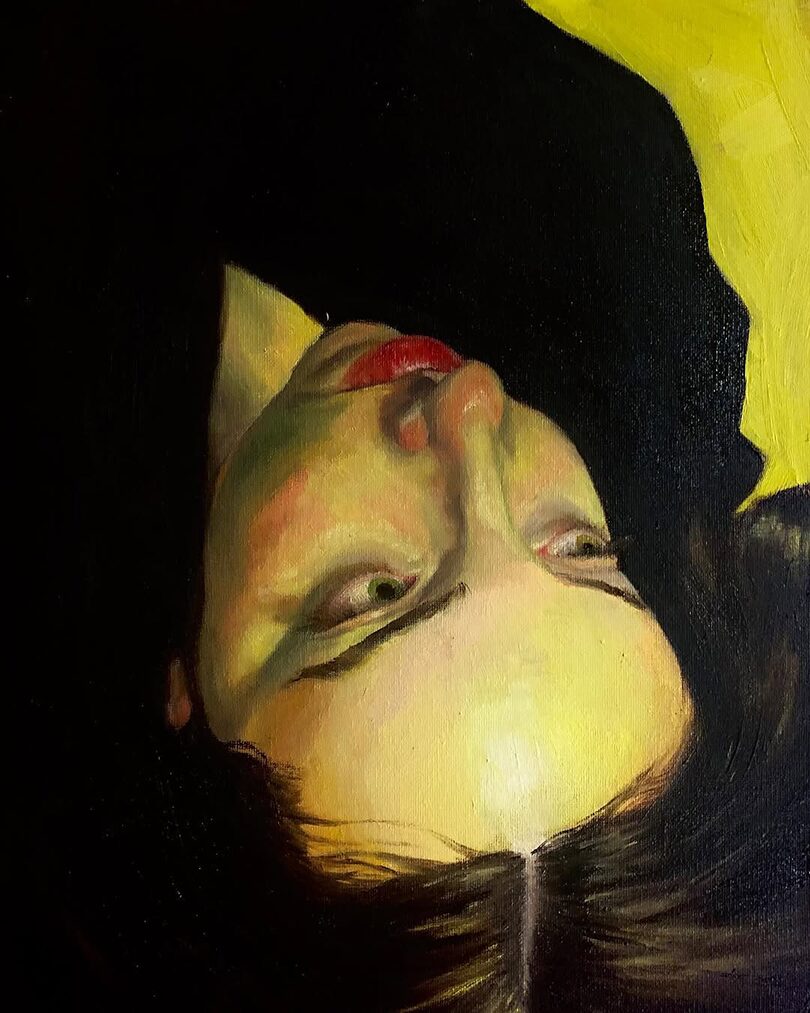
Portrait of Ella
While I have no proof of causality, I think I care so much about the light in Liv’s work because I inherited a very poor sense of smell from my dad. I snore and put too much salt on my food and experience arresting shocks of nostalgia in response to specific lighting on par with that madeleine Proust dipped in his tea. Lamps placed just so can bring me back to a dinner party my parents threw and all of a sudden, I remember the sound of the adults laughing while I fell asleep on someone’s lap. The sun filtered through leaves at a specific hour can transport me to playing tag with my cousins under dappled light.
I know it is not unique to experience scent in this way, and maybe experiencing light like this isn’t unique either, but I never heard anyone talk about it until I mentioned it to my dad. He knew exactly what I meant. He said that sometimes in the late afternoon, when the sun comes in through the window sideways, he thinks it looks exactly like his bedroom after he got home from 3rd grade.
My dad was working on a collaborative sculptural project right before I was born. He intended to explore how memory degrades over time by iteratively casting progressively indistinct duplications of a Gerber baby doll’s head. Scientists say each time you remember an event, you are really just recalling the last time you remembered it. They think this is the mechanism by which memories distort and fade, especially those we retell. When my dad recalls how the plastic stink of his babydoll heads made my third trimester mom nauseous, he calls the doll parts he was replicating “Patty heads” even though I wouldn’t name my Gerber doll baby Patty until years after. He probably just does so for my benefit.