

You recognize it before you know what to do with it. A cartoon, a flower, a line that feels like it’s been there before. Kitsch comes to mind, maybe, but it doesn’t quite stick. Or it sticks and then loosens. The image doesn’t hold you where you expect. It keeps moving, and you move with it.
There is something disarming about encountering Magdalena Suarez Frimkess’ work in the context of a gallery like David Zwirner. Not because the work doesn’t belong there, but because it resists the kind of coherence and finish that blue-chip spaces often reward. Organized by Shio Kusaka, the exhibition leans into that resistance without over-framing it. What emerges is less a retrospective than a practice that continues to unfold. There is a brush with what art history might call kitsch here—the quick legibility of familiar forms—but it doesn’t hold. Recognition arrives without settling. It stretches out, becomes durational. You keep looking, and the images keep not finishing.
The installation gives this logic space. A long, continuous pedestal carries a row of forms resembling ancient vessels, each given enough distance to breathe, while glazed stoneware paintings adorned with cartoons punctuate the room. Along another wall, a suite of framed drawings hangs salon-style, accumulating into a loose field. The effect is both structured and open: lateral movement rather than narrative progression. Kusaka’s presentation isolates the works just enough that each can hold its own, even as they participate in a shared rhythm.
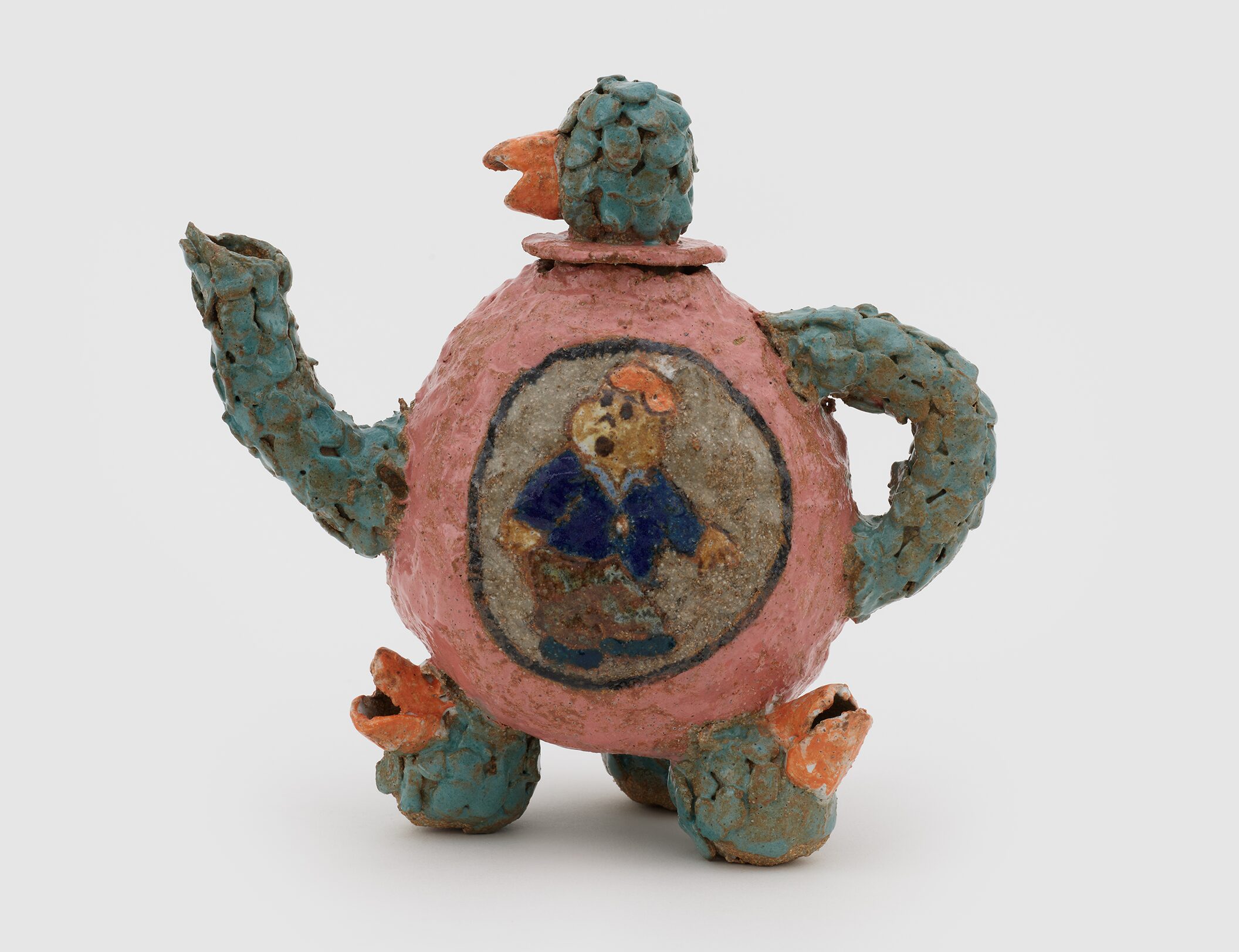
Suarez Frimkess’ ceramics and drawings operate through a persistent vocabulary: cartoon figures, floral motifs, fragments of text, historical references that sit side by side without hierarchy. Minnie Mouse appears next to Chilean cartoon Condorito; a large urn on a pedestal carries a loose drawing of the Beatles; a plate holds a magnolia; a parrot appears in colored pencil; Olive Oyl stretches across a bumpy ceramic surface without fully conforming to it. These are not ironic appropriations or nostalgic gestures. They read more like habits of attention through images that have stayed with the artist long enough to become thoroughly part of how she sees. The work hovers near kitsch but does not deliver its satisfactions. The figures don’t resolve into sentiment or parody. Perhaps because Frimkess’ engagement with these images so obviously comes from a sincere adoration for them. Still, they remain slightly out of sync, where recognition doesn’t stabilize meaning.
Frimkess’ line holds everything together. It is steady but not precious, confident without being declarative. It could keep going indefinitely. This is especially clear in the drawings, which feel both preparatory and complete. They remain in a state of rehearsal, where thinking and drawing happen at the same speed. In a fine art context that often diminishes drawing, here it operates as an equal—moving fluidly between mediums, collapsing distinctions between sketch and finished work.
That fluidity extends to the ceramics. Suarez Frimkess’ practice straddles painting, drawing, and clay, collapsing the hierarchies that have historically separated fine art from craft. In this sense, she bridges an art historical divide completely, not by asserting it but by working through it. The work holds a tension between the childlike and the rigorous: simple forms and familiar imagery carried by a discipline of repetition and time. It has a kind of liquidity—images, references, and gestures moving across surfaces and decades without fixing into a single position.
The collaboration with her longtime partner, Michael Frimkess, makes this especially clear. His vessels, rooted in historical ceramic traditions, provide a stable form that Suarez Frimkess interrupts with her drawing. The line does not fight the vessel; it drifts across it, sometimes ignoring its logic. The collaboration does not resolve into synthesis so much as coexistence. In contrast, Kusaka’s role as organizer introduces another pairing, where presentation becomes its own form of dialogue. Two works in the exhibition feature Kusaka’s much more pared down porcelain forms with Magdalena’s hand drawn line work. Across these relationships, the work is continually being remixed: old and new, personal and historical, individual and collaborative. This approach also marks a shift from the recent LACMA survey, where the work was installed more densely, closer to a studio logic. Here, Kusaka opens it up. The spacing allows the work to breathe, to remain unfinished in a productive way.
There is a temporal dimension beneath all of this. Suarez Frimkess’ daily drawing practice, her decades-long engagement with clay, and her recent collaborations with Kusaka (after no longer being able to form ceramics herself) point to a practice shaped by duration rather than spontaneous rupture. The work does not announce its evolution but rather carries it quietly, even modestly. What you see now is continuous with what came before, even as the conditions of making have shifted.
At the same time, the exhibition participates in a familiar narrative: the late-career recognition of an artist long working outside institutional visibility. The LACMA survey and this presentation position Suarez Frimkess within a lineage of California ceramics now being reabsorbed into the contemporary canon. That framing is not wrong, but it risks smoothing over what remains idiosyncratic.
What resists that smoothing is the work’s refusal to fully declare itself. A cartoon is not quite a symbol; a flower is not quite decorative; each reference is not illustrative. Meaning accumulates without stabilizing. You are left not with an argument, but with an atmosphere shaped by repetition, memory, and the persistence of certain images over time.
In this sense, the exhibition does not ask to be interpreted so much as absorbed. Its strength lies in its refusal to condense. Instead, it offers a practice that continues, quietly, right in front of you—one line, one figure, one object at a time. You leave with the sense that it wouldn’t be entirely inappropriate to still take a sip from one of her teacups.