

The title of this exhibition, “Disappear Here,” is a reference to Bret Easton Ellis’s novel Less Than Zero. It alludes to the reality of anonymity in a city in which fame and glamour are the reigning myths. However, the works on hand only reflect these themes in a scattershot way. Some of these tackle this theme head on and others don’t. Take, for instance, his paintings of ad hoc shrines devoted to dead celebrities David Lynch, Ozzy Osbourne, Kobe Bryant, and Ace Frehley. Are these shrines instances of celebrity worship, a testament to our own faded dreams, or an impromptu community ritual? These are interesting questions, but they seem unrelated to most of the paintings here.
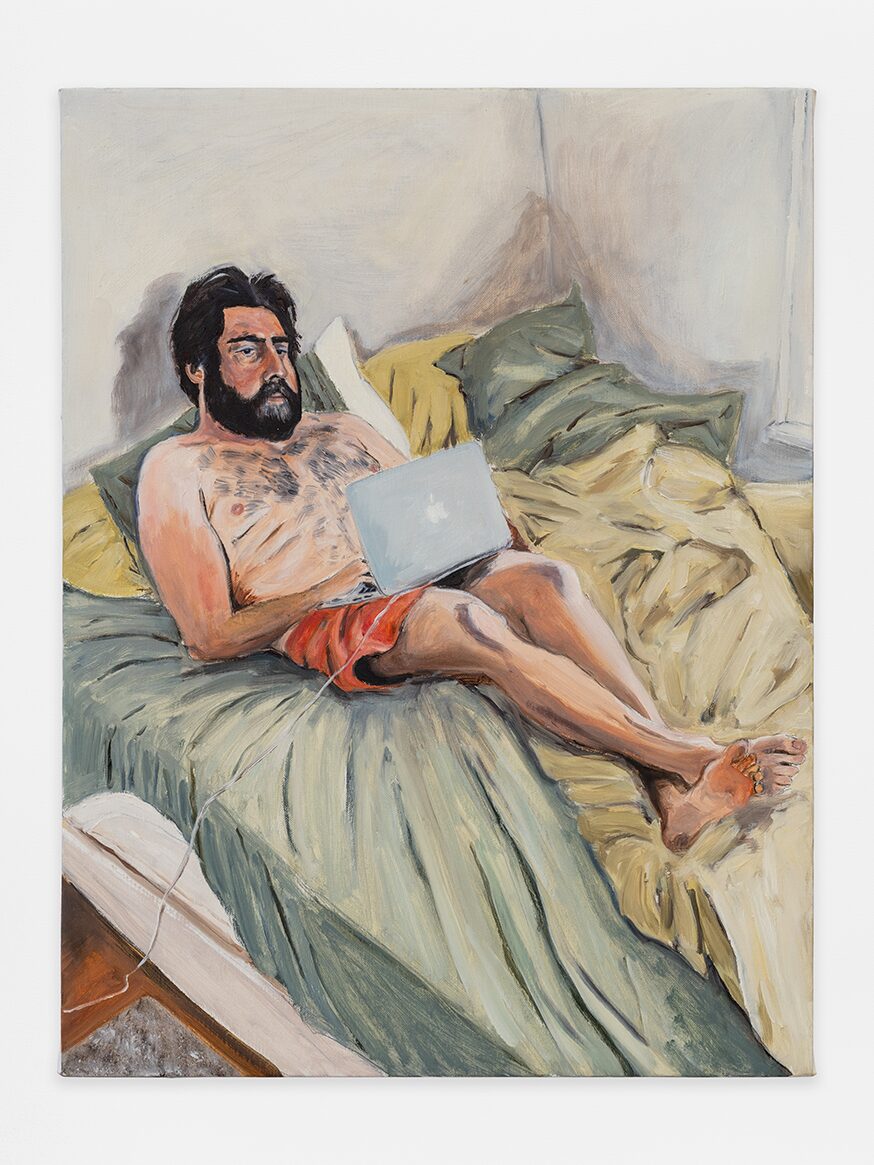
These range from self-portraits to street scenes, still lifes, a hypnotist’s garage, and a monkey tending bar while holding an Emmy statuette. Most of these suggest familiar painting genres while falling just outside their normal parameters. His self-portraits, for instance, present a distinctly third-person perspective, how painters would normally paint someone else, not themselves. Similarly, the still lifes are taken directly from life, like cinematic insert shots, rather than still lifes composed for the sake of painting. For instance, the potted plant and vase in Good Vibes (2025) awkwardly compete for limited space on a bedside table while the adjacent vibrator feels transient.
These all have a slightly askew quality, as much a function of their compositions as the subjects. Theo and Reuben’s Wedding Party (2025) depicts a view of downtown from somewhere in the hills; the picnic blankets in the foreground consume the bottom half of the painting—an unusual juxtaposition of extreme foreground and background. This is made stranger by the appearance of a sideways Elvis Presley, apparently printed on a blanket, shoehorned into the frame. There are no people here, but the haptic quality of the blankets, dirty paper plate, and shrubbery assert the actual centrality of their presence, relative to the twin apparitions of the sunset and celebrity which is sort of how living in LA feels.
In general, the streetscapes, if that’s what we call them, are standouts. If these refer to any art genre it’s Stephen Shore’s slice-of-life photography in its most proto-Zillow mode, but they feel like something you see in life and not art: that feeling when the happenstances of scenery and light strike you just so—like, say, on a night walk through the hills. The light itself is nearly perfect, not specifically in terms of phenomenological accuracy, but in terms of a mood and atmosphere—how it just hits a certain way.
His rendering of form, however, tends to have an offhand quality which can veer into the ham-fisted. This is both a strength and weakness but, if we’re keeping score, it depends on the painting. His first take/best take approach to painting works great when it doesn’t err on the side of too loose. The awkward figure in An Imminent Splash (2025) is too misproportioned to sell the scene, much less the apparent metaphor (everyone’s just-about-to-happen moment, suspended, indefinitely, in mid-air). His notational way of rendering foliage can, at times, start to seem like just that, notational marks which fall just short of convincing foliage.
Compositionally, the most unusual painting here is Pasadena Rearview (2023), which depicts a rearview mirror with streaks of reflected light in it. Like some of the other paintings here, the rendering seems just as unfocused as its relationship to a theme. It’s hard not to be ambivalent about this show because the works themselves seem so ambivalent about what they’re trying to do. What do the still lifes have to do with the shrines? What does the monkey have to do with the street scenes? Why do about half of these seem a little bit too sloppy and drab?
They all relate to a kind of “LA”-ness but that’s a bit too vague while the redundancy of certain subjects feels too narrow. Per the press release this show is about “the city’s aspirations and its urban sprawl.” So then, why do all the residences depicted here look like single-family homes in Highland Park? This show could be a welcome corrective to the mythologizations of LA, but its own narrative is too narrowly autobiographical to really work.