

All of Marina Stern’s work is weighty. The objects in her intensely matte, sleek oil paintings and densely packed graphite drawings receive an egalitarian touch. In contrast to often airy and delicate subjects—paper, string, and flowers—Stern’s quality of paint is impenetrable. Heavy machinery and buildings are painted in the same manner as blue skies. The density is due to opacity of paint, lack of brushstrokes, and, most strangely, to overdefined shadows that become objects unto themselves.
The first major gallery show since her death in 2017, “Luminary” is divided between Bel Ami and CW American Modernism, a private gallery specializing in Modernism between 1910 and 1960. Both galleries’ showings, while discordant (CW American Modernism houses Stern’s more conventional factories and landscapes), are united by a stillness. But it’s an unnerving stillness—an unnatural one, engineered by Stern’s hand through a complete removal of the unnecessary. Grime, wear, and unseemly marks or shadows are discarded in favor of something that approaches an ideal.
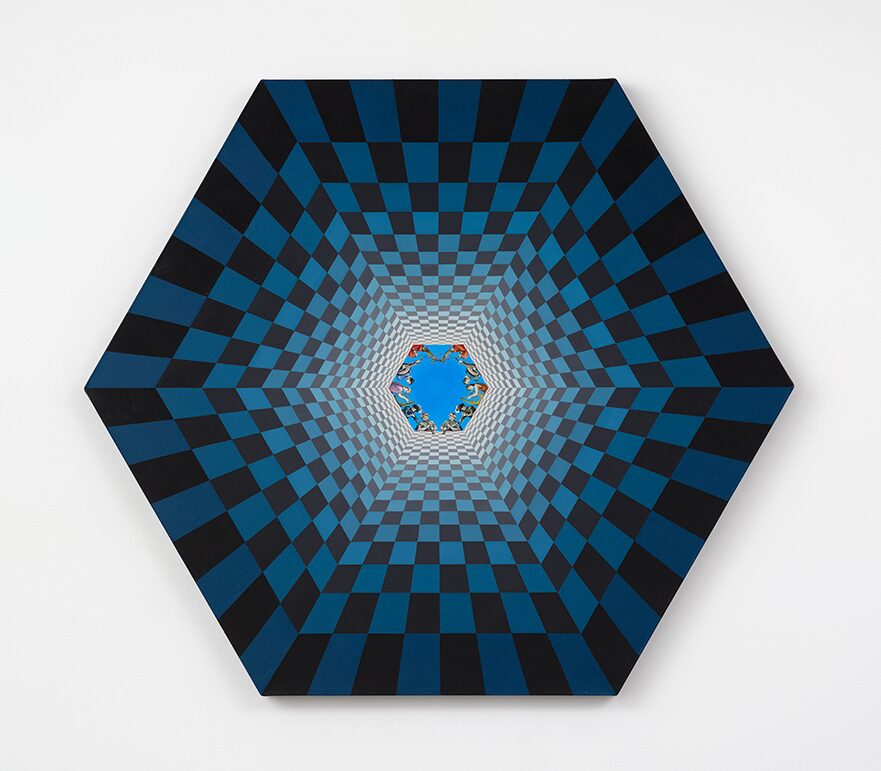
Moving from Op art in the 1960s to Precisionist industrial scenes in the 1970s, Stern’s career is largely traditional in scope: still lifes and landscapes. It’s most blatantly apparent in Stern’s Op art period that the grid is of particular relevance. However, her later still lifes and window scenes are what unexpectedly push grid logic into a terrain of image doubling and self-referentiality. In Rosalind Krauss’s seminal essay “Grids,” she argues for a “schizophrenic” movement between a materialist and spiritual dimension to the grid in Modernist art history. Stern’s Op art grids are characterized by checkerboard floors or walls. Nocturne (1966) was the only painting that created a kaleidoscopic visual trickery for me. These paintings are self-consciously art historical, with an undercurrent of cheeky play. The references span the Renaissance to Minimalism, plucking imagery from art history and dropping it into Stern’s paintings (she doesn’t beat around the bush; one of the paintings is simply titled Renaissance). These works are trying to engage in a play with optics, but don’t quite commit fully to the endeavor. The pasted-on references, jokes, and house-of-mirror compositions point to Stern’s interests lying outside a purely optical sphere. Krauss argues that “behind every twentieth-century grid there lies—like a trauma that must be repressed—a symbolist window parading in the guise of a treatise on optics.” When Stern drops the pretenses and brings the window to the surface, her work both blossoms and becomes seemingly more mundane.
From the 1970s until her death, Stern painted industrial scenes, still lifes, and views outside her window. There’s a handful of still lifes in “Luminary” that include a window. The strangest (and my favorite) of the lot is Interior with Cabbage (1979). A purple cabbage sits atop a wrinkled white tablecloth. In the top two-thirds of the painting a canvas leans against the table, its stretcher bars facing us, with a drawing on paper of a bisected cabbage tacked onto them. The back of a canvas is an unusual place to hang a drawing. It implies a casualness, either of the drawing or the painting that’s serving as its armature. But it’s the stretcher that Stern wants us to see. It’s precisely the grid of the stretcher, because isn’t painting forced to inhabit an invisible grid? Stern is painting a staged process of painting. The cabbage drawing is graphite directly on the canvas. It’s not an imitation of a drawing—it is a drawing, embedded within the painting. The scene isn’t simply that of an artist’s studio; it’s a tangle of object and its imitation.
Another standout is Red Tulips (1987), a uniquely fashionable painting for Stern of tulips sitting atop a surface that reflects a windowpane. The window itself is absent; we get only the reflection. The tulips are uniformly red and green and devoid of any distinctive marks. The shadow of the tulips looms large and is an almost perfect mirror image of the flowers themselves. Here we get a doubling, the underbelly of the flower. The reflection from the window is simultaneously transparent and opaque. The blocks of light are extremely solid but represent a transparent surface:glass. And what is the surface upon which the flowers sit? It nears mirror levels of reflective. The paradoxical window/mirror echoes the allure/genericness of the flowers.
Stern’s project isn’t particularly lofty. It’s admirable in its lack of flashiness. It rewards patience, even when it ventures into banal or unsalvageable conservative territory. Sometimes it ventures too far, in the case of many of the barn and landscape paintings. However, for all their art-historical references, these paintings are pleasantly unburdened by the weight of history.