

I felt dizzy at mosie romney’s show “every Spiral has its law” at Sebastian Gladstone. I could chalk it up to external factors (fatigue, harsh gallery lighting), but I suspect that the work itself was the incubator of disorientation. My previous visits to the space, which, prior to Gladstone’s descent, had been Gaga & Reena Spaulings, always felt a bit clandestine, like an out-of-commission lecture hall. But now the space is sterile, like every other gallery, save for a garish pale pink exterior. In conditions such as these, romney’s work forces vertigo on the unsuspecting captive. The work—unassuming paintings and a collection of sparse sculptures—demands eye movement at every point between floor and ceiling, a feat on romney’s part. The viewer’s gaze circles around the room, suctioned to the walls until reaching the center. Forcibly rocked as if on a ship stuck in a whirlpool, the viewer becomes ensnared in the spiral.
The show consists of eight paintings and a handful of sculptures. romney is largely a painter, and their free and playful, moderate-sized oil on linen works are united through a sensibility that favors the discordant and theatrical; they border on narrative, but rebuke rationality. Appearing for the most part in a castle or chateau setting, objects, people, and animals appear to grow and shrink. These characters and objects exhibit varying degrees of embeddedness in their environment—a trait that has less to do with their compatibility with the setting than the manner in which they are painted. Figures appear at awkward angles in relation to the ground, curtains are unnaturally slanted, while giant ping-pong balls look unquestionably natural. The paintings instantly deliver their strangeness, laying on the table all their bells and whistles.
A sheer curtain divides the main room of the show from the front of the gallery. The curtain is less a dramatic gesture than a veil between realms. Likewise, the paintings function as veils. The paint is often diaphanous, watered down by medium, or, when opaque, is a simple sheet of color placed atop the canvas. The paintings are rather cold despite their reliance on pinks, reds, and jewel tones. The sheets of color all end up dissolving into a murky brown or grey, often with the solidity of a floor or wall turning into a gaseous grey haze. The directness of the paint application makes this murky ambiguity that much more apparent. In a varied but hurried manner, information is translated directly onto the canvas. Proportions are decidedly wonky, and perspective is skewed. There is a childish quality to the awkward proportions and flat depictions of space, and this skewing is an effect that reinforces the spatial disorientation and unreality.
romney’s paintings are at their best when in the puppet play space. My favorite of the bunch, Nervous System 33 (all works 2025), depicts a reddish persimmon-colored overpass looping and crisscrossing in the manner of a roller coaster (spiraling). Shadowy figures with bikes and a stark white cat loiter under its depths, and a floating woman’s head peeks through the freeway’s gaps. The woman’s face is like a mask, heavily made up with an exaggerated widow’s peak. She’s a larger-than-life diva, a drag queen deity keeping watch. romney’s accolades beyond painting include puppeteer and set designer, and the work gets good when these pursuits collide. In Ring Shout, a bald and pupil-less yellow figure crumples to the ground like a puppet, and in T Peripheral I, the show is about to start, the curtain drawn. (This is the first painting the viewer encounters upon entering the gallery. After pushing past a physical curtain, we are met with another closed curtain.) Wavering between powerful and vulnerable, static and animate, romney is the puppet master of the fantasia.
The sculptures, assembled mainly of found trinkets, photos, and spray paint, snake up the corners of the room (one of the objects is an actual snake skin in a bag taped to the wall). A placard, casually stuck to the wall, is titled “THE SECRET OF THE TALISMAN” and lays out a list of spiritually protective qualities. A diffuse yellow circle sits at its center, like a solar afterimage. I squint at the dot, unsure if what I am seeing is really there, and am washed over with a wooziness. The exception to the wall works is a cinderblock at the center of the room with similarly talisman-like stones and bottles stuffed into its center, sloshing with black and chartreuse liquid (an unreadable message in a bottle). I crouch down, practically lying flat on the gallery floor, to find photos hiding in the cave of the cinderblock. The photos are old, of families, an athlete, a 1920s woman posing, evidently thrift-store finds. Then I must crane my neck up to the rafters to look at a wood-burned placard that says “technologies” and is surrounded by bundles of dried mugwort. While they are haphazard and collaged in a similar manner to the paintings, these sculptures are underwhelming. We are not actually let in on the excitement of discovery or the magic of the talisman; they are merely dictated to us. These objects do a good job of navigation—our physical unease and movement through the space is guided—but they feel limp in comparison to the paintings.
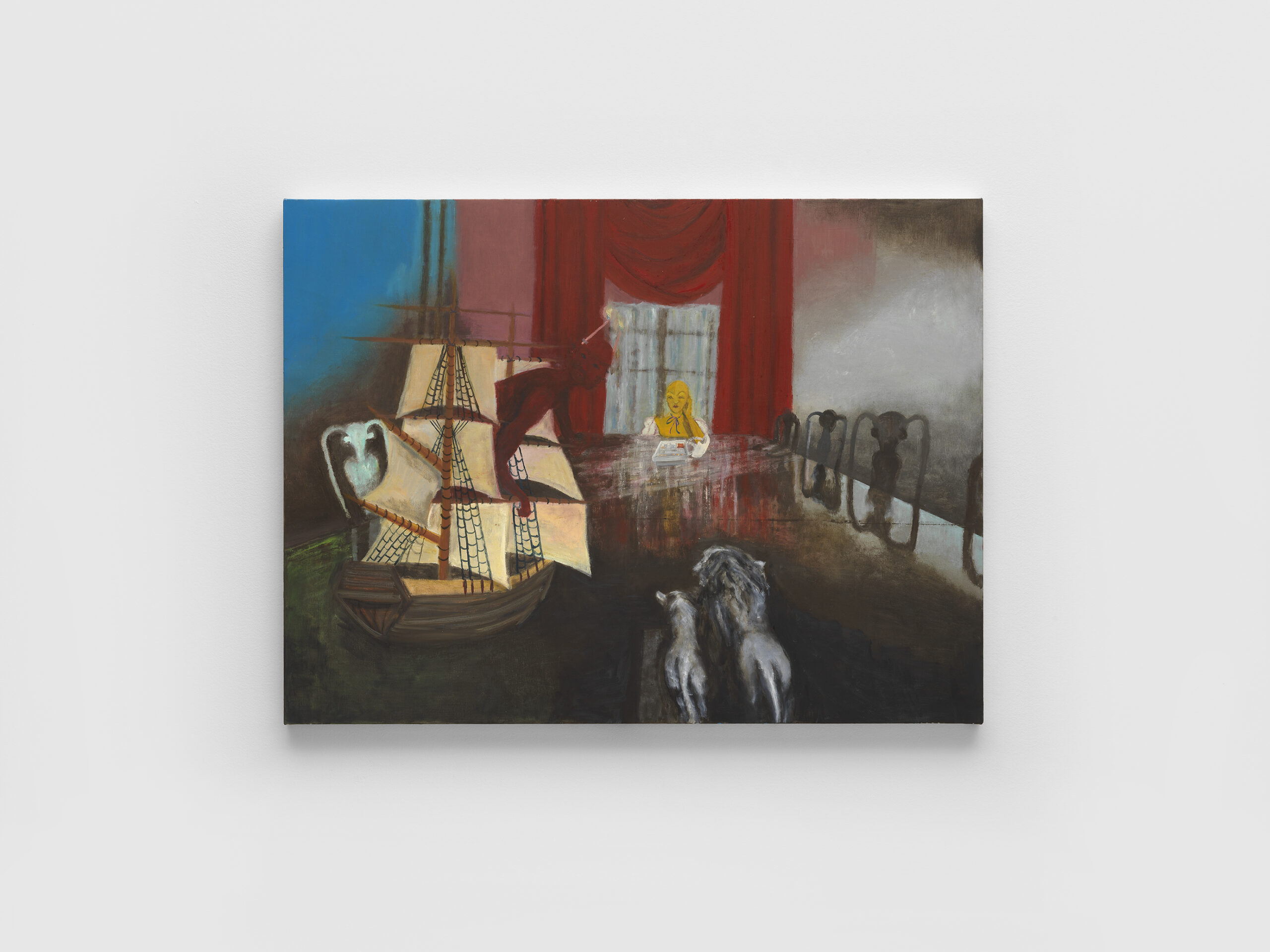
As we are swayed from ground to sky, we are likewise taken between elements. Nautical imagery emerges in Belly of the Beast (nigredo): a miniature ship sits atop a vast dining room table with a black lacquer-like finish that resembles a murky liquid. The tabletop is positioned at a disorienting slant. Appearing less as a product of some unchanging quality of the table, the slant is more a decision of brushstroke. Which is to say that the paint dictates the formal aspects of the objects rather than the objects dictating the paint. In a similarly nautical fashion, Revelation Station depicts a metal bathtub inlaid in a wooden perch. Akin to a boat deck, the wooden planks look out onto a structure somewhere between a Franz Kline painting and the splintered remains of a shipwreck. The scene is made stranger by the presence of a stoplight hanging decoratively on the wall. The “spiral,” as presented in the show’s title and press release, takes the form of a ship caught in a maelstrom.
I don’t think these paintings are doing anything new per se, but there is something refreshing in their illustration-like quality. The surface is worked just enough to be a painting, but there’s something kind of like a drawing about them, in the sense that it kind of looks like the brush is being held like a pencil; they’re sketchy. This immediacy is both that of mark-making and content. They evidently come from a surrealist lineage of dream logic; the paintings land somewhere between the whimsy of Leonora Carrington and the disheveled puppets of Hans Bellmer (albeit far less in the way of freak factor). But perhaps romney’s work is closer in spirit to Bellmer’s wife, artist and poet Unica Zürn, whose novella The Man of Jasmine details talismanic obsessions and a psychic downward spiral, fueled by a WWII-imposed (and probably preexisting) schizophrenia. Zürn’s poems, with their anagrammatic animal and sea themes, mirror romney’s paintings in their disjointed surrealist language. One of Zürn’s poems ends with “A mast rise up in seas and: the lonesome table.” A fitting description for romney’s paintings.